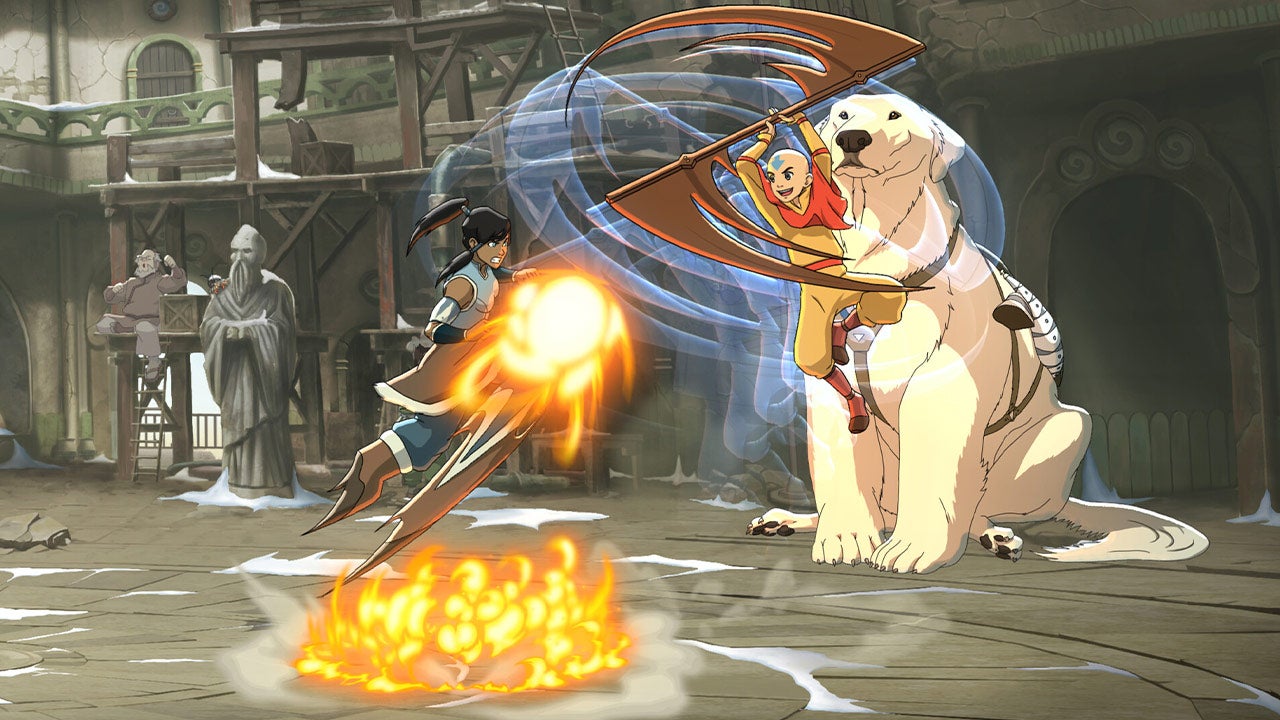

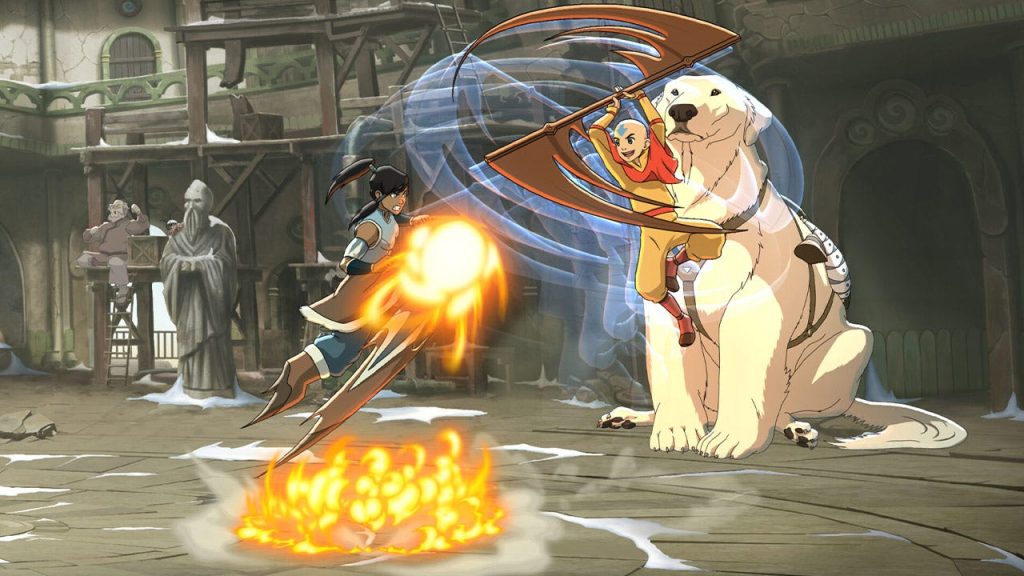
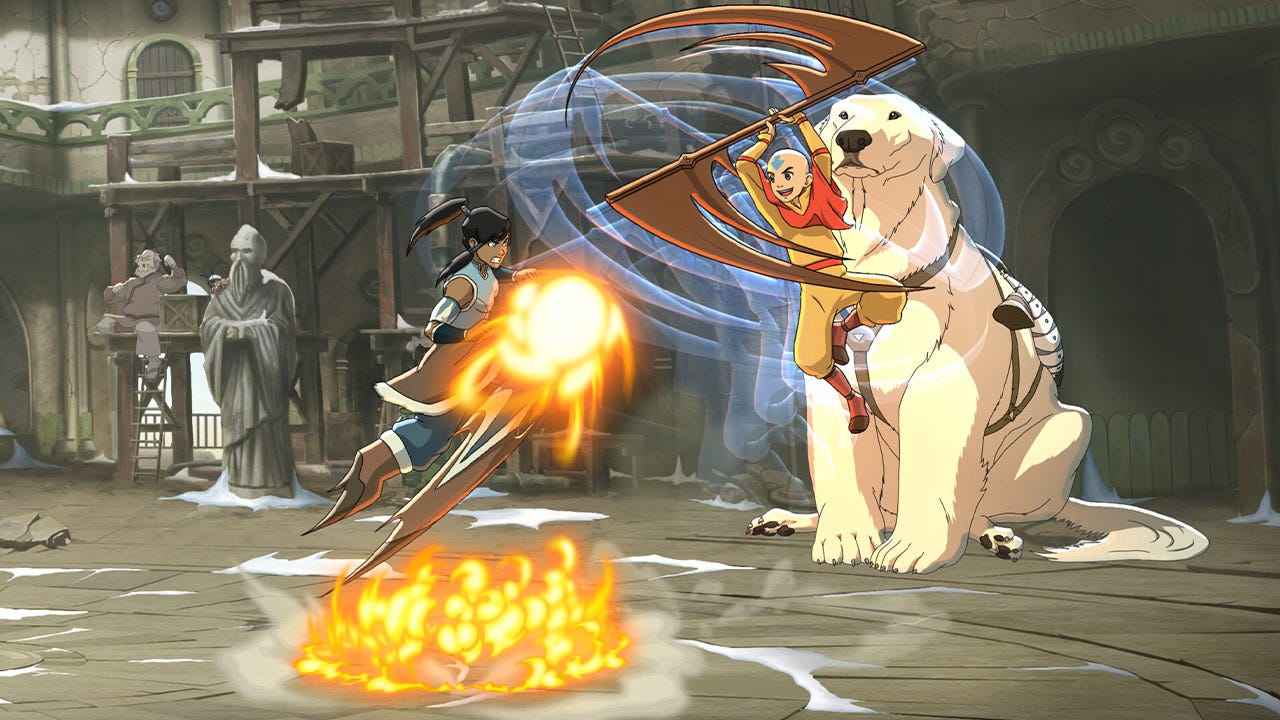
Okay, we’ve got a bit of a good news/bad news situation here. Good news first: Without hyperbole, Avatar Legends is one of the most fun fighting games I’ve ever played. There’s something special about the way these characters move, the variety in their playstyles, their incredible animations, the flexibility of their combat options, and the satisfying ways they can execute some of the sickest combos I’ve ever seen. In so many ways, this is the game Avatar: The Last Airbender has deserved, as well as the old-school 1-on-1 fighter that hardcore fighting game fans have been clamoring for recently. But now the bad news: That stellar gameplay does some pretty heavy lifting, as the package around it is lacking in surprising ways. From an inability to change the difficulty level of the AI in single player, to a cumbersome training mode that’s missing standard features, to lobbies that can only support two players, the list goes on and on. Like Aang and Korra at the beginning of their stories, Avatar Legends is rough and unpolished, but beaming with potential.
The best way to describe Avatar Legends in fighting game terms is that it’s a fast-paced, mobility-driven 1v1 fighter, focusing on creative combo expression, a high bar of execution, and the uniqueness of each character as opposed to powerful, universal system mechanics. All of that to say, this is one of the most difficult 1v1 fighting games to learn, but the payoff once you’re able to actually perform even a fraction of what these characters are capable of is extraordinary.
The fundamentals of the fighting system are simple at a glance: there are three attack buttons, covering light, medium, and heavy strikes, and then a “Flow” button that is generally tied to each character’s unique movement options. As is the case with many anime fighting games, there’s a basic logic of being able to combo a light into a medium into a heavy into a special move, and there’s even an auto-combo for those that just want to mash one button and get some respectable damage.
But it’s that Flow button that really opens up Avatar’s fighting system and makes it truly special. Every character has a very particular way of moving around the screen, and these mobility options can be absolutely wild. Aang, for instance, can press forward-Flow for a quick forward hop that has three different follow-ups, all of which have wildly different uses. Or he can press Flow and a direction in the air to take out his glider to attack from unpredictable and awkward angles, control the direction of the wind to affect his momentum in the air, or fast fall from the sky, just to name a few of his techniques.
Meanwhile, Azula can air dash in eight directions twice before touching the ground (in just one of her forms); Toph can shift the earth to pull opponents towards her, or herself towards opponents; Katara can charge special moves while being able to slide across the ground – and that just scratches the surface of what these characters can do. Each of the 12 fighters on the roster has their own way of breaking the rules of this system, and it makes each one feel incredibly powerful and satisfying to learn.
In addition to the Flow meter that governs all of those crazy movement techniques, there’s also a well designed energy meter governing EX special move and super usage. Instead of being a bar that fills up as you take or receive damage, the energy meter is segmented into individual points, and you only get a maximum of one point per combo. There are other ways to gain energy as well, including character specific “critical hits” that reward you for performing certain skillful feats. I love having to make on the fly decisions about how to build and spend resources, and between both meters, Avatar Legends’ fighting system is one of the very best when it comes to that aspect of fighting games.
As a big Avatar fan, another aspect of the design that I love is how closely each kit embodies the spirit of the character. In the show, Korra is highly skilled and powerful from the very start, but she’s also reckless and tends to wind up in bad situations after acting without thinking. Here, that’s reflected with a very hard-hitting playstyle that can deal a lot of damage, but also comes with a lot of risk. Her high damage combo routes can cost of lot of meter, she has risky tools that most other characters don’t (like a meterless invincible reversal), and her special moves can all be enhanced for more damage at the cost of even more meter, which makes it very easy to accidentally wind up in the highly detrimental “unbalanced” state that’s caused by emptying your entire Flow meter.
Azula, on the other hand, has two completely different forms: Focused and Firelord. Focused embodies Azula’s calm and collected demeanor that we see throughout most of the show, and that’s reflected with a fighting style that requires a lot of precision, with much of her damage locked behind special move extensions that require button presses within a one or two frame window. That’s contrasted by her Firelord form, which represents her total meltdown toward the end of the series. Her precisely timed special move extensions go out the window, her air dashes become slower but cover more distance, she does more damage with fewer hits, and ultimately just becomes an absolute close-range monster that can smother you with overwhelming force.
That’s not all, as the entire roster also has three support characters that can be chosen before a match begins to change up elements of their kits, much like the character variations from Mortal Kombat X. These can empower specific special moves in ways that open up new combo routes, grant you new special moves entirely, or improve your movement techniques. All of these systems work together to make what is a fairly small roster on paper feel much bigger.
Then The Fire Nation Attacked
Avatar Legends’ story mode is an original tale outlined by series creator Michael Dante DiMartino and written by Tim Hedrick, who has written many episodes of both The Last Airbender and The Legend of Korra, along with several other pieces of canonical Avatar content. Despite that authenticity, however, it mostly feels like fanfiction fluff. It begins with Aang waking up in an alternate universe where he doesn’t exist, people who shouldn’t exist in the same time period are best buds, and everyone is basically the polar opposite of how they normally act. There are a handful of fun callbacks, and the voice acting is quite good despite not featuring almost any of the original cast, but the overall story never sank its hooks into me, which made the whopping 27 chapter campaign overstay its welcome by the time I hit chapter 15 or so.
Outside of the lackluster story mode, there’s really not much else here to hold the attention of anyone who isn’t interested in competing against other people online. There’s a traditional arcade mode, but no ability to adjust the difficulty of the AI, so if the matches are either too easy or too hard, you’re out of luck.
On the teaching tools front, Avatar Legends is kind of all over the place. It’s great that there’s a frame meter turned on by default to immediately help you understand the frame data of a move, as well as an option to turn hit boxes on so you can understand the actual range and vulnerability of an attack. But on the flipside, doing simple things in training mode like setting a dummy to jab after blocking is extremely cumbersome thanks to a poor UI; and, shockingly, there is no way to set the dummy to block randomly, making it very difficult to practice hit confirms.
The combo trials at least are pretty good at teaching practical combos at the novice and intermediate ranks, and a clever “Breakdown” feature allows you to go through a combo step by step – the screen freezes for each input, allowing you to get the muscle memory of a combo down without having to worry about the timing. What’s really cool though is that in addition to combo trials, there are character specific tutorials that actually teach you how to best make use of a character’s tools to pressure opponents, open them up with mix-ups, or defend against their offense. I do think these tutorials could do a bit better of a job easing you into the nutty stuff that characters can do, but nonetheless, it’s a great idea and I wish more fighting games would spend as much time teaching you how to land the hits that enable combos as they do on the actual combos themselves.
Finally, my experience thus far with online play has been excellent, with smooth rollback netcode and a very snappy pace thanks to quick rematches, lightning fast load times, and instant returns to practice mode if the match drops due to a disconnect. That said, online also has some very surprising omissions that should be standard in a modern fighting game. The worst offender is the lack of lobby support for more than two players, which means you can’t set up a room to play with more than one friend where two people play and the rest watch and await their turn. This is apparently planned for a post-launch update, but it’s a glaring omission right out of the gate. Less shocking, but still worth pointing out, is the lack of replay search, which is used to find replays of high-level players so you can see how they handle specific matchups, nor is there replay takeover. Both features would be nice to have, especially in a game with so much variation in how its characters can be played.