
After a mysterious portal transports their town to a prehistoric era filled with deadly dinosaurs, the Platt family must do everything they can to survive.
Has anyone had as strange or circuitous a career as David Robert Mitchell? The American filmmaker started out with 2010’s hazy teen drama The Myth Of The American Sleepover, broke out with 2014’s cult hit horror It Follows, and then took a sharp left-turn into surreal neo-noir thrills with 2018’s Under The Silver Lake (which featured a nude owl-woman, a random skunk, a mysterious pirate, and a bit where Andrew Garfield shoves an egg into a child’s mouth). Now this former indie darling takes a swerve into summer-blockbuster territory with The End Of Oak Street, a film that wholeheartedly embraces its big, brash genre pleasures.
This is 1982: a suburban America of Polaroids and perms, picket fences and playdates. It’s here we meet the Platts, a seemingly perfect nuclear family, soundtracked by Michael Giacchino’s sweeping, John Williams-esque score. Under the surface, however, all is not well: dad Greg (Ewan McGregor) has lost his job and has started drinking, mum Denise (Anne Hathaway) is a frustrated writer, son Brian (Christian Convery) is secretly smoking, and daughter Audrey (Maisy Stella) is worrying her parents will divorce, while very saliently quoting Carl Sagan.
A Jurassic-coded dino-movie which largely out-dinos recent Jurassic entries.
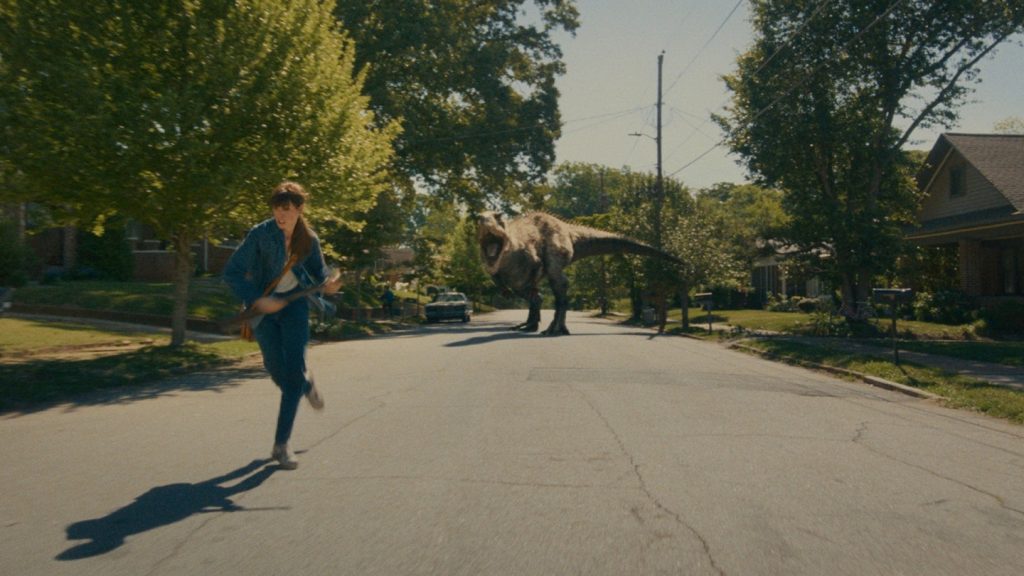
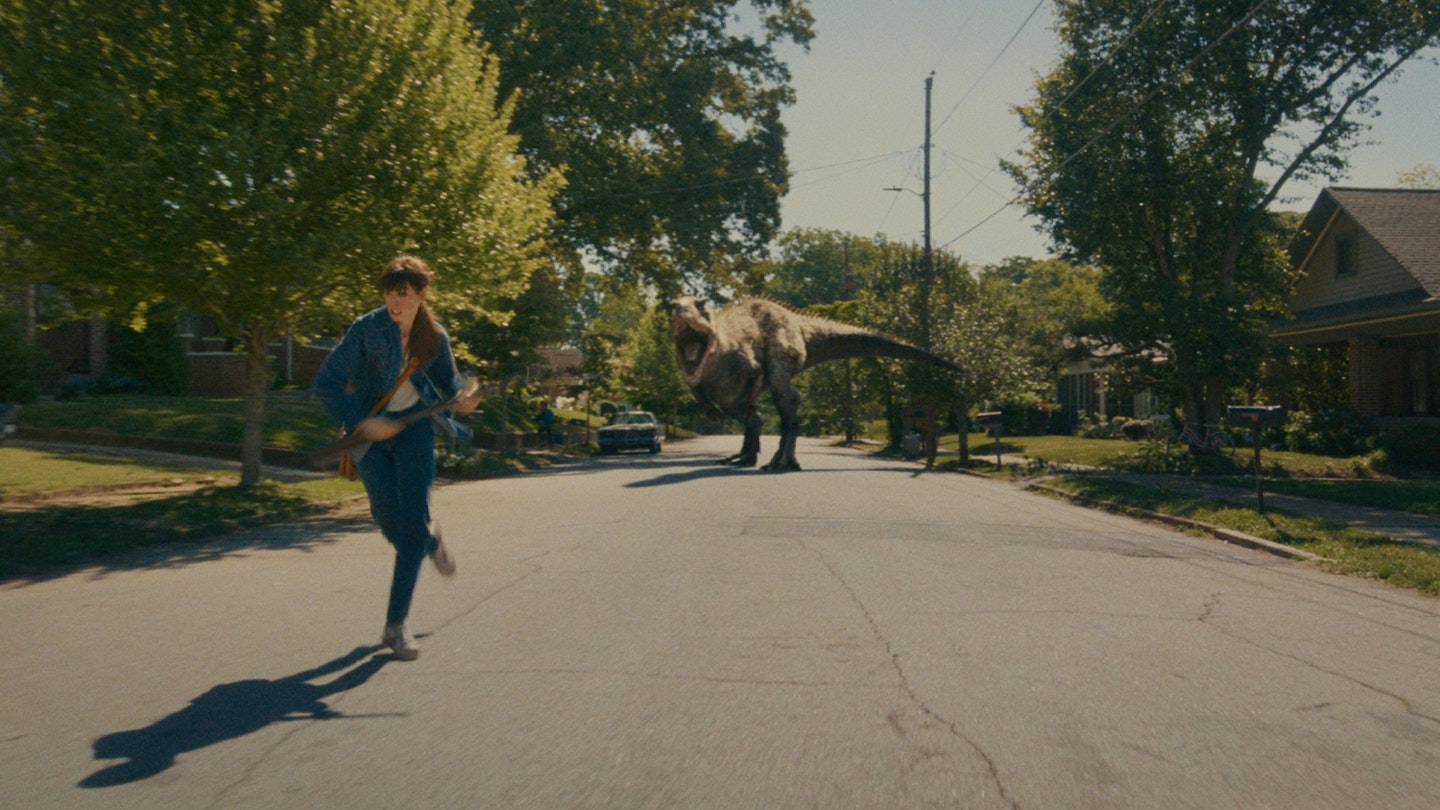
As if that weren’t enough to be dealing with, strange prehistoric plants begin cropping up in the neighbourhood, and before they know it, the entire town has been mysteriously transported back in time, to when dinosaurs — those with paleontologically accurate feathers and fur, please note — roamed the earth.
If you were thinking this sounds a bit like a suburban Jurassic Park (‘Jurassic Park Crescent’?), you’re not far off. Mitchell wears his Spielberg influences on his sleeve, from the shots of kids riding bikes, to the fractious family unit, to the close encounters with bright light, to the T-Rex earning top billing. There’s even one big pile of shit. Sneakily, Mitchell has made a Jurassic-coded dino-movie which largely out-dinos a lot of the recent Jurassic entries, chock-full of deliciously tense set-pieces. It’s mounted robustly and handsomely, too. Like the New Hollywood auteurs of old, the cinematography deploys careful, deliberate framing and some very prominent split-diopter shots; if it weren’t for all the (excellent) CGI, it could pass for a 1980s period piece.
Which is not to say it isn’t supremely daft. How and why the dinosaurs arrive is never explained, the film fairly hoping you will enjoy the tense fun on its own silly terms, its internal logic hardly standing up to too much scrutiny. The Platts make some terrible decisions, too (going on a suicidal rescue mission for a dog, jumping off a roof, walloping a T-Rex with a small hammer). But it is, ultimately, the convincing character work that makes this outlandish trip such a delight: suburban anxiety, played out through the Cretaceous period.
Mitchell makes for one of the better Spielberg tribute acts in recent memory. Your inner seven-year-old will have a great time.