
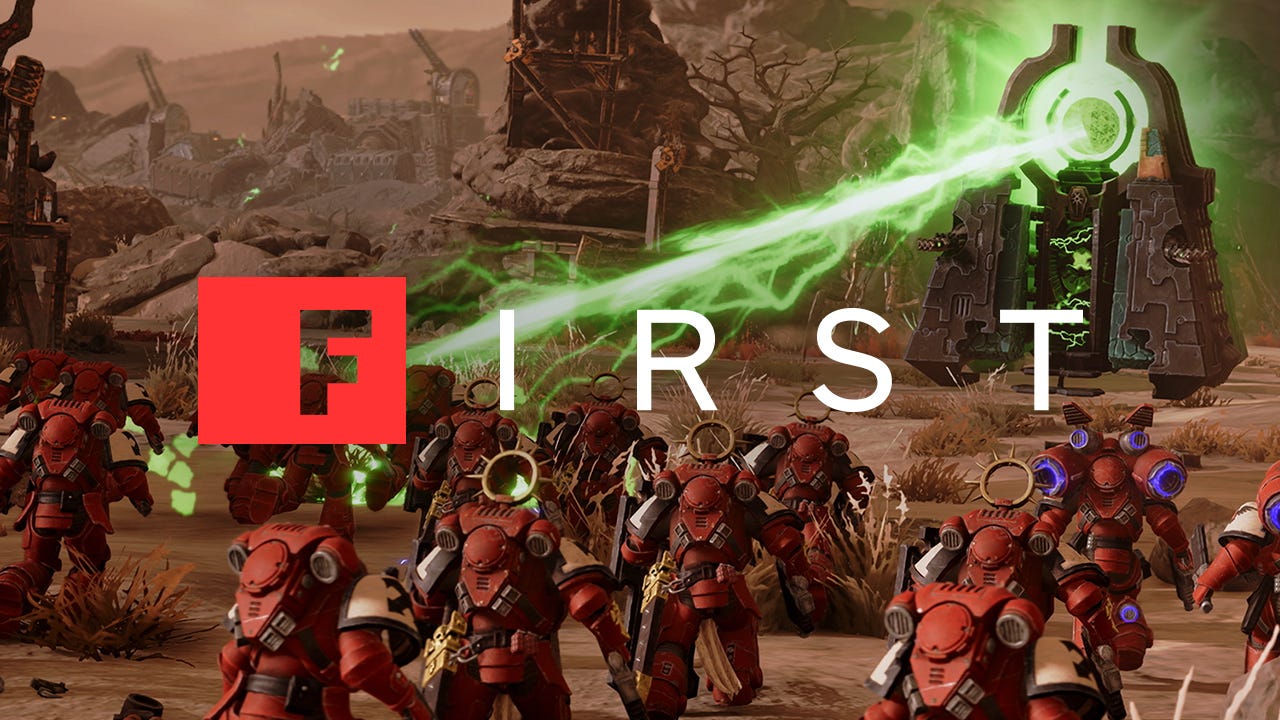
Warhammer 40,000: Dawn of War has been in hibernation since 2017, and its most recent installment was far from universally well-received. So when King Art Games was handed the task of bringing it back, there were a lot of tricky decisions to navigate and an eager but picky fanbase to face. We recently got to chat with Creative Director Jan Theysen and Senior Game Designer Elliott Verbiest about how the team is calling the shots. (Read on or watch the video interview below.)
It was King Art’s previous game, Iron Harvest, that seemed to catch the attention of someone at Games Workshop. And it’s not too difficult to see why, if you look at its big, stompy robots.
“So we were working on Iron Harvest, our previous game, an RTS game as well,” Theysen recalled. “And that was a Kickstarter game. So we were very open about the development and we showed a lot of stuff we can do with the engine and what we do in terms of art and so on. And as someone at Games Workshop must have seen that and they basically contacted us and asked, ‘If we were doing Dawn of War 4, what would you do, basically?’ And so we made a little pitch and we sent them over our ideas and the presentation and we didn’t really hear back from them a lot. And so we basically thought, okay, that’s it, right? It’s like, cool that they asked us, basically. And then when Iron Harvest came out and was successful, they basically came back and said, ‘Okay, let’s talk about it for real.’ But you can’t really believe it, right? Yeah, well, okay, now they’re asking us, but in reality, we’re not going to make Dawn of War 4. And then slowly but surely it becomes more realistic and you don’t really dare to believe it, right? And then at some point you sign the contract and it’s like, holy… it’s there. We’re doing it.”
For many, myself included, Dawn of War was the gateway to the whole Warhammer 40K universe. And King Art hopes this next installment might be as well. It’s a sprawling and… sometimes convoluted setting, so that’s not exactly a straightforward task.
“It’s funny because we hear that a lot, right?” Theysen agreed. “And that was also one of the big things for Dawn of War 4, that a lot of people say, ‘Okay, Dawn of War, yes, that was like the first time I really interacted with Warhammer.’ And so for us, it was very important to basically make a Dawn of War 4 that is of course for fans, but also a potential entry point for someone who’s new.
“Yeah. I think I remember basically how I felt when I played Dawn of War for the first time and it was like, okay, super cool, but also I don’t understand a lot, right? But I understood enough so the game was fun. It was not like I had to know what all the different weapons do or something like that. It was more like, okay, I can figure it out. And I think that is also the approach we take for Dawn of War 4, which is basically without any prior knowledge of Warhammer, you still need to understand what the factions are about, what the units are about. You won’t understand all the different weapons and equipment and all of that, but it’s fine, you can figure it out.”
Taking the brutal, aggressive Orks as an example, the goal with the design of the whole faction is that you should naturally be able to figure out how to play without knowing a ton about their lore or having to have it spelled out for you. But those of us who have been living part of our lives in this universe for years should still have stuff to get excited about.
“We don’t really tell the players, if you play Orks, you should have a lot of units and a lot of buildings and just have this explosive expansion,” Theysen explained. “It just kind of feels natural to play that way, right? Because buildings are cheap, units are cheap, you lose a lot, so you build a lot … We make sure that even if the people don’t know what Orks are about, they can still play them correctly, basically.”
“I think that’s actually one of the main appeals for the Warhammer 40K universe is that enormous breadth and depth of things that you can potentially learn,” Verbiest added. “It’s definitely one of the things that attracted me to it was that, okay, sure, of course there is a surface level understanding of it that you can introduce to the games, for example, through a story or a campaign that kind of gets you into that world essentially. But there’s so much more to it. And I think that that promise of, hey, there’s much more going on beneath the surface, I think is what attracts so many fans to it. And I think that’s also how you can serve both fans old and new is that you introduce a story, something to help onboard players into this world, but you have enough detail and other things within that, that signal to more established, more veteran fans of the universe, hey, we are aware of this and we speak the same language. We have the same understanding here.”
But even within the Dawn of War envelope, there are different players bringing different expectations to the table. Dawn of War 1 was more of a traditional basecraft RTS. Dawn of War 2 put the focus more on upgrading a few elite squads, almost like an RPG. And Dawn of War 3 was… well, I try not to think about it too much. But even it had its fans, apparently. So deciding what Dawn of War 4 was going to be in context of the previous entries was a judgment call all its own.
“I mean, that was definitely one of the big questions at the beginning, right?” Theysen said. “What is a Dawn of War game, right? Because Dawn of War 1 and 2, at least everybody here at the company really loves, but they’re very different games. And you can say, okay, maybe we can make a kind of best off of both of those. But we’re not sure that that actually works. And so in the end we said, okay, we have to go with one of them. And we said ultimately, okay, let’s go a little bit back to the roots, right? Let’s do Dawn of War 1, or our version or our interpretation of Dawn of War 1. Let’s see if something from Dawn of War 2 or even 3 works with that. And if it does, sure, then let’s put it in. But Dawn of War 1 was clearly our guiding star.”
“And it’s really interesting because that also informed a lot of the gameplay and design decisions that we made as well,” Verbiest elaborated. “The real time strategy genre is also something that has very different market segments or different audiences that have very different, sometimes conflicting needs. And I think that having that clarity of vision of, we want to go for Dawn of War 1 and how people felt about that definitely also informed a lot of the choices that we made as to what kind of parts of the game are we focusing on. So that’s why we have this emphasis on the campaigns as kind of like our flagship feature, as well as having all these fantastic cinematics and CGIs that we then have then to inform that story. Because that’s something that I think a lot of people were missing from the genre for quite a while.”
And storytelling is poised to be front-and-center for Dawn of War 4. While many RTSes have led with a competitive multiplayer mindset, King Art is putting a lot of emphasis on their dynamic campaigns and the single-player experience.
“Because that is like the first big decision we made was basically, okay, if we do a Dawn of War 4, we want four factions back and not only three,” Theysen continued. “And if we have four factions, we really would like to tell a story for each of the factions, right? And then all of the four campaigns have this overarching story, basically. And for us, that just felt like a natural thing we wanted to do because we like campaigns, we know that a lot of RTS players like campaigns, and so let’s really focus on that. And then we made our lives even harder because we decided, okay, let’s maybe also have the campaigns be a little bit non-linear. So there are things like, you can pick which of the Ork bosses you want to play, for example. Or there are missions that are mutually exclusive or things that you can optionally do and so on. And so for us, it’s like this: the campaign is like the heart of the whole thing and that has to work. But of course, then also we have multiplayer and we have Last Stand and so on.”
If you’re interested to hear more about the nonlinear aspects of the Ork campaign, keep an eye out for our hands-on preview later this month. Then be sure to check out all of our other Dawn of War 4 coverage as part of IGN First, including the Ork cinematic trailer. And for everything else, keep it right here on IGN.