

Platforms: PS5, PS4, Nintendo Switch 2, Nintendo Switch, PC
The Trails series of JRPGs is one of the most ambitious franchises in modern gaming. Since 2004’s Trails in the Sky, developer Nihon Falcom has been building one massive shared universe, charting the history of the continent of Zemuria over more than 20 real-world years and, now, more than a dozen games. It’s a magnum opus of striking scale, with a complex central narrative exploring politics, religion, war, and imperialism, albeit through a science fantasy lens and draped in anime visuals.

No series survives on continuity alone though, and a large part of the reason for Trails’ success is that they’re typically excellent RPGs to play, balancing strong stories and great characters with robust combat and smartly designed worlds. That remains the case with Trails Beyond the Horizon, which elevates an already brilliant battle system to impressive new heights and delivers some powerful plot beats. It’s a high point for the series — but you absolutely shouldn’t start here.
Let’s backtrack slightly. Players who’ve been following Trails all along have seen the various countries that make up Zemuria advance from fantasy-steampunk trappings to futuristic technology. As Beyond opens, the nation of Calvard is about to take humanity’s first steps into space, with the ambitious Project Startaker on the cusp of taking off. However, secrets swirl around the launch, and conspiracies are mounting that the entire space program hides a grander, darker purpose.
Like 2023’s Trails Into Reverie, this splits its focus broadly three ways. For the most part, it remains Van Arkride’s story, picking up from the events of 2021’s Trails Through Daybreak and 2022’s Trails Through Daybreak II. As a Spriggan – think a cross between private detective, social worker, and bounty hunter – he and his allies at the Arkride Solutions Office take the lead in protecting Calvard’s capital city Edith, drawn into conflict with a mysterious group calling themselves Vestiges. At the same time, Rean Schwarzer – instructor at a military academy and protagonist of the Trails of Cold Steel tetralogy – investigates the space program, while Kevin Graham, a holy hitman for this world’s high church, is hunting down a heretic.
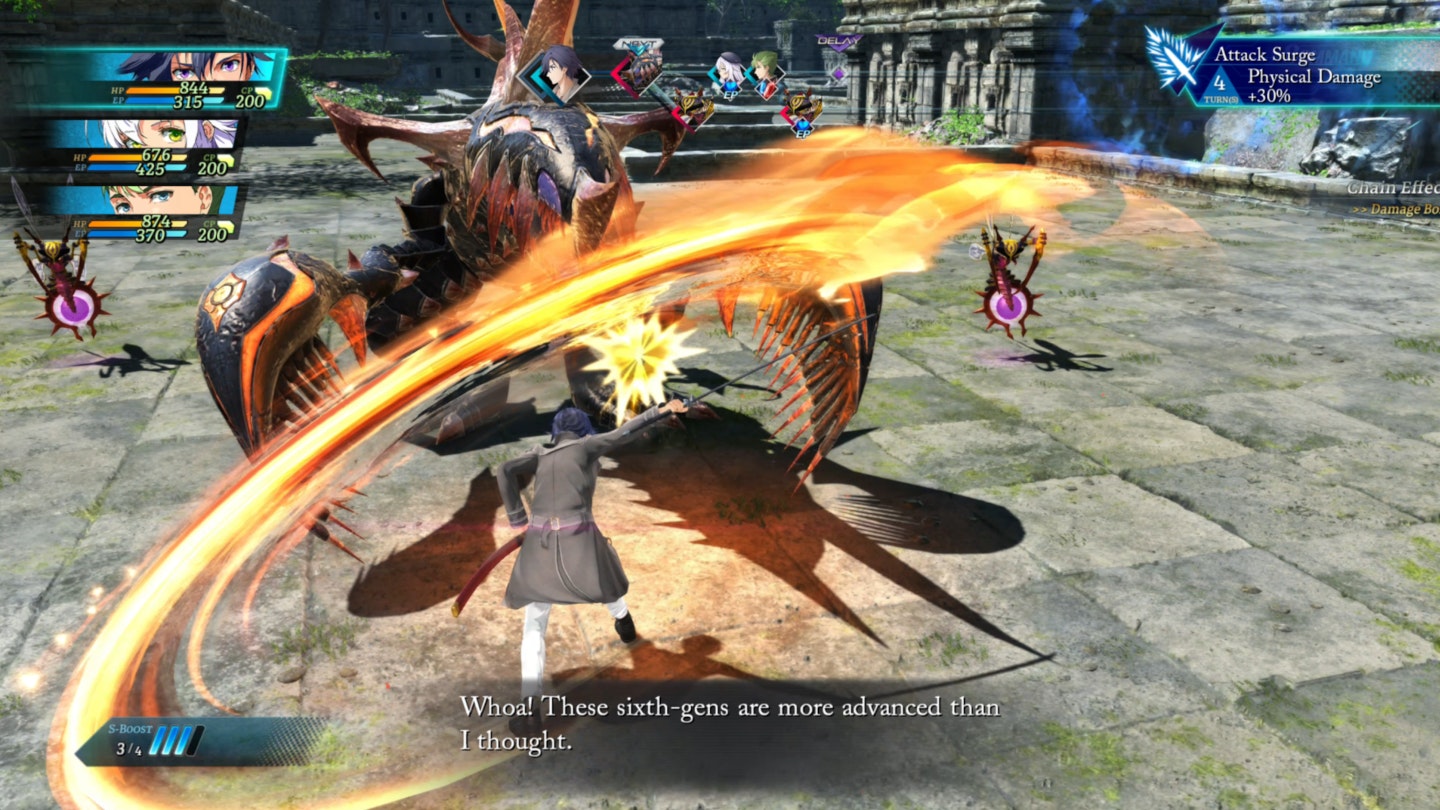
After a lengthy intro, all three leads’ paths can be played at will, although Van’s route gets the most focus. Rean and Kevin’s are likely to be more engaging though. They’re faster paced and more immediately relevant to the grander story, although Van’s focus allows more room for quieter moments of character and world building. Whichever approach you prefer, it’s fun seeing how the threads connect as the endgame approaches.
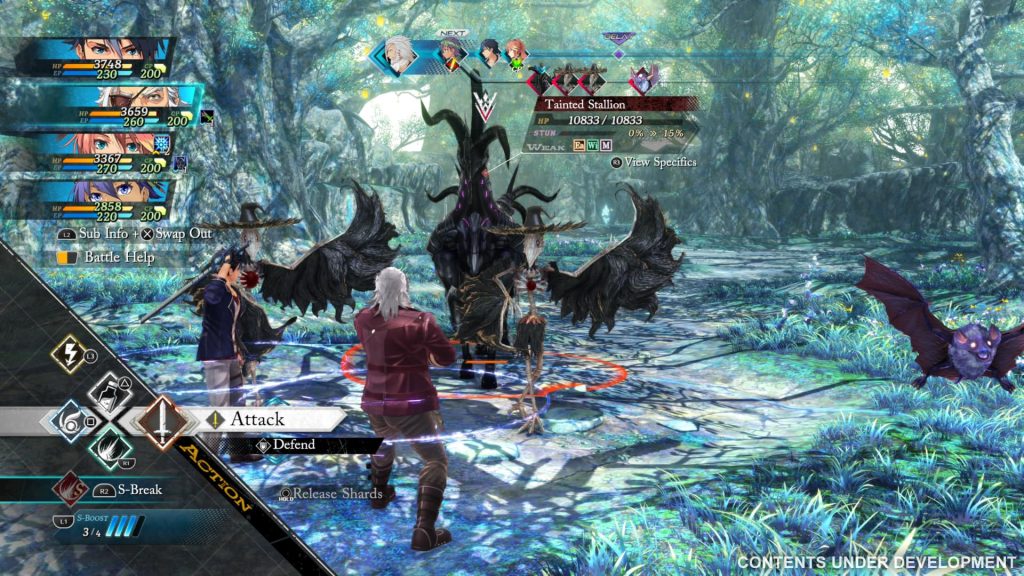
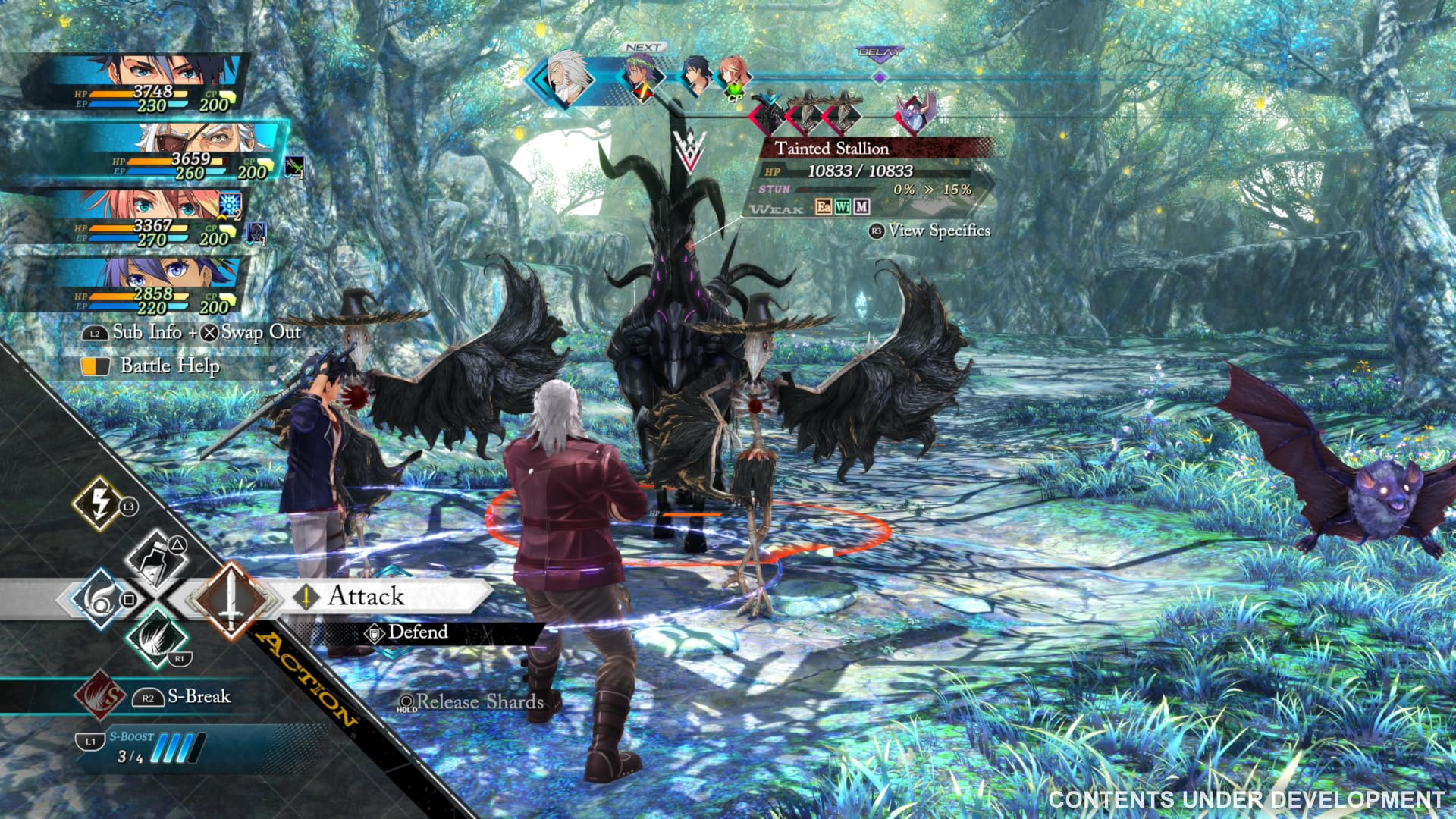
Never let anyone tell you turn-based combat has to be repetitive – Trails Beyond’s battle system constantly keeps you on your toes.
Each main hero will be joined by a host of party members in battle, and while the roster isn’t as dauntingly large as in Reverie, it’s still a little daunting. Thankfully, each team is relatively self-contained through the majority of the game, which makes keeping track of who you’re taking into battle and what they can do a bit more manageable.
There’s still a lot to keep track of in combat though, whichever route or team you’re following. At the core of it is the series’ long-standing tradition of being able to manipulate turn orders. Rather than the oldest of old-school “you hit, I hit” approach, certain actions can interrupt or steal advantage, allowing you to plan ahead and try to shift the flow of each battle, taking boosts an enemy might get on their turn for your own or pulling forward your own moves. Layered on top is a real-time system before you even enter battle – batter enemies enough on the map and you can stun them before switching to turn-based mode, for a massive damage boost.
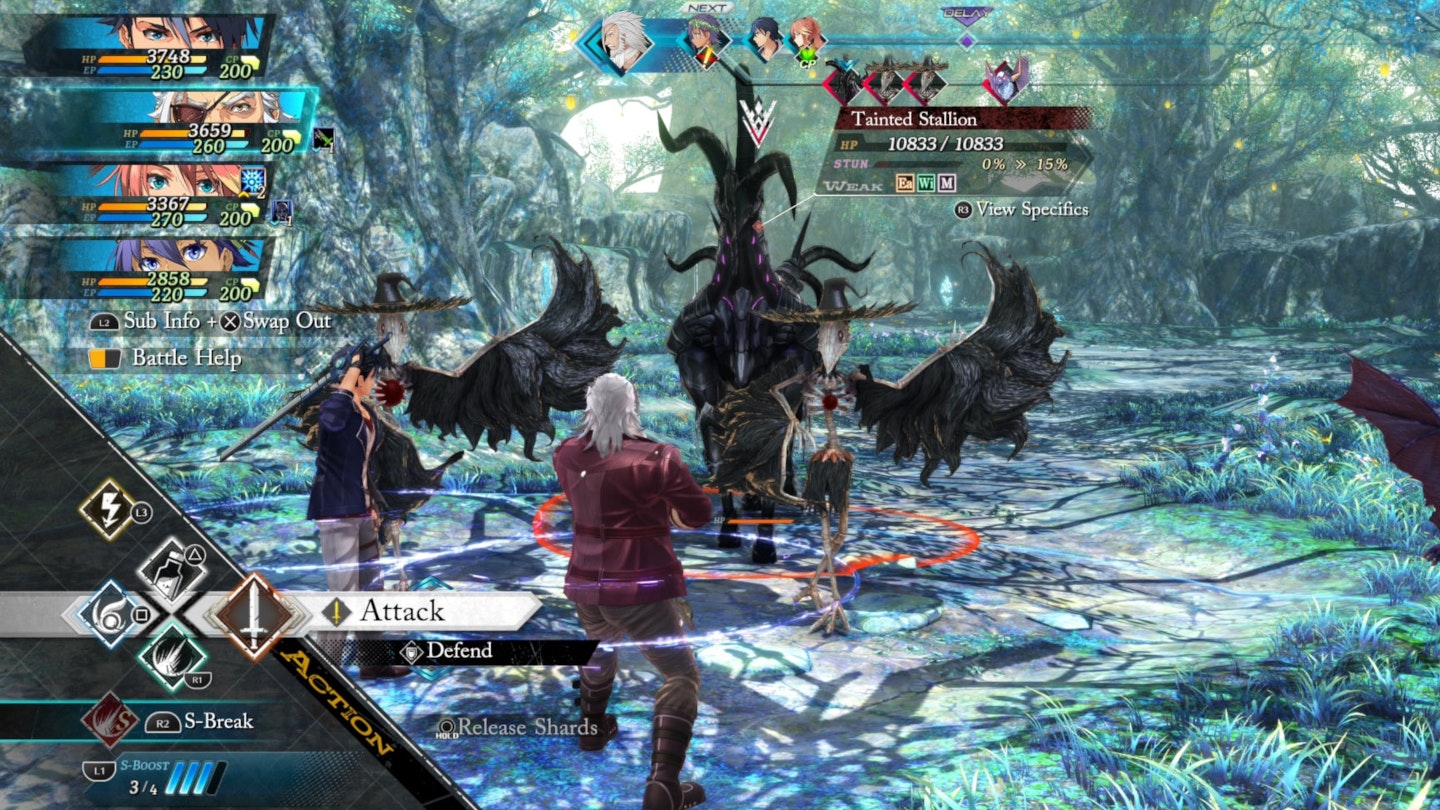
From there, things get really crazy. With free movement on each character’s turn, positioning matters, both in terms of lining up their move’s area of affect and trying to avoid enemies’ likely ranges. A whole heap of secondary mechanics offer flashy ways to dominate, and while the terminology is a lot to master – Shard Commands, Boost Gauges, time-stopping ZOC abilities, team-up BLTZ Chains, and more besides – you soon find yourself juggling all these techniques to control battles. It’s all capped with signature Awakening moves for the prime three heroes, which deliver massive attacks with enough panache and bombast to make Dragon Ball Super look boring. Never let anyone tell you turn-based combat has to be repetitive – Trails Beyond’s system constantly keeps you on your toes.
Outside of its rich combat system, this is a densely packed game crammed with lashings of extra stuff to keep players busy, from optional side quests and minigames, to the “Grim Garten”, a roguelite dungeon that’s almost an entire game to itself. A virtual reality space, this spawns random maps to battle through, earning cosmetics and power-ups, and can even yield some important character moments. It’s definitely worth putting time into, between the main events of Trails Beyond.
So with another engaging story, interesting cast, and a fantastic set of battle mechanics, why shouldn’t players dive in here? Because, sadly, this is all practically impenetrable to newcomers. Despite the absence of any numbers in the title, this is very much the third game in Van Arkride’s storyline, and that arc itself is just the latest in the unbroken history of the Trails series. Trying to jump in here isn’t even like watching Return Of The Jedi without seeing A New Hope and Empire Strikes Back – it’s more like trying to understand The Rise Of Skywalker without even knowing what Star Wars is.
However, for those who’ve been keeping track – or at the very least for those who don’t mind doing a deep dive of the series’ custom wikis beforehand to learn the dramatis personae and what previously took place – Trails Beyond The Horizon is a phenomenal entry in the saga. It’s an RPG of remarkable scope, but its barrier to entry is unfortunately high.