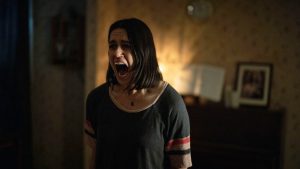

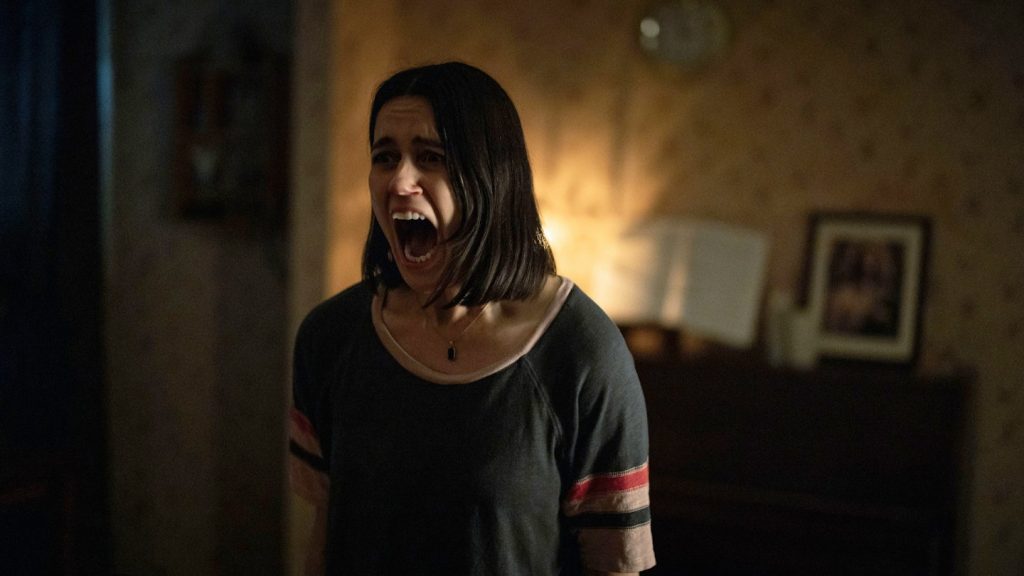
Evy (Nina Kiri) co-hosts a paranormal podcast with her friend Justin (Adam DiMarco), while caring for her dying mother (Michèle Duquet). When the pair are sent mysterious recordings, supernatural forces soon invade the podcast — and her home.
At last: a film which warns of the evils of podcasting. Undertone is a very effective kind of horror, especially in how it tells a story both about, and via, the audio form. While it may trade in somewhat unoriginal genre tropes — the haunted house, the evil demons, the creepy children’s songs, the jump scares — its form and its function feel fresh, fluent and flippin’ frightening. At the very least, it is a deeply unsettling sensory experience.
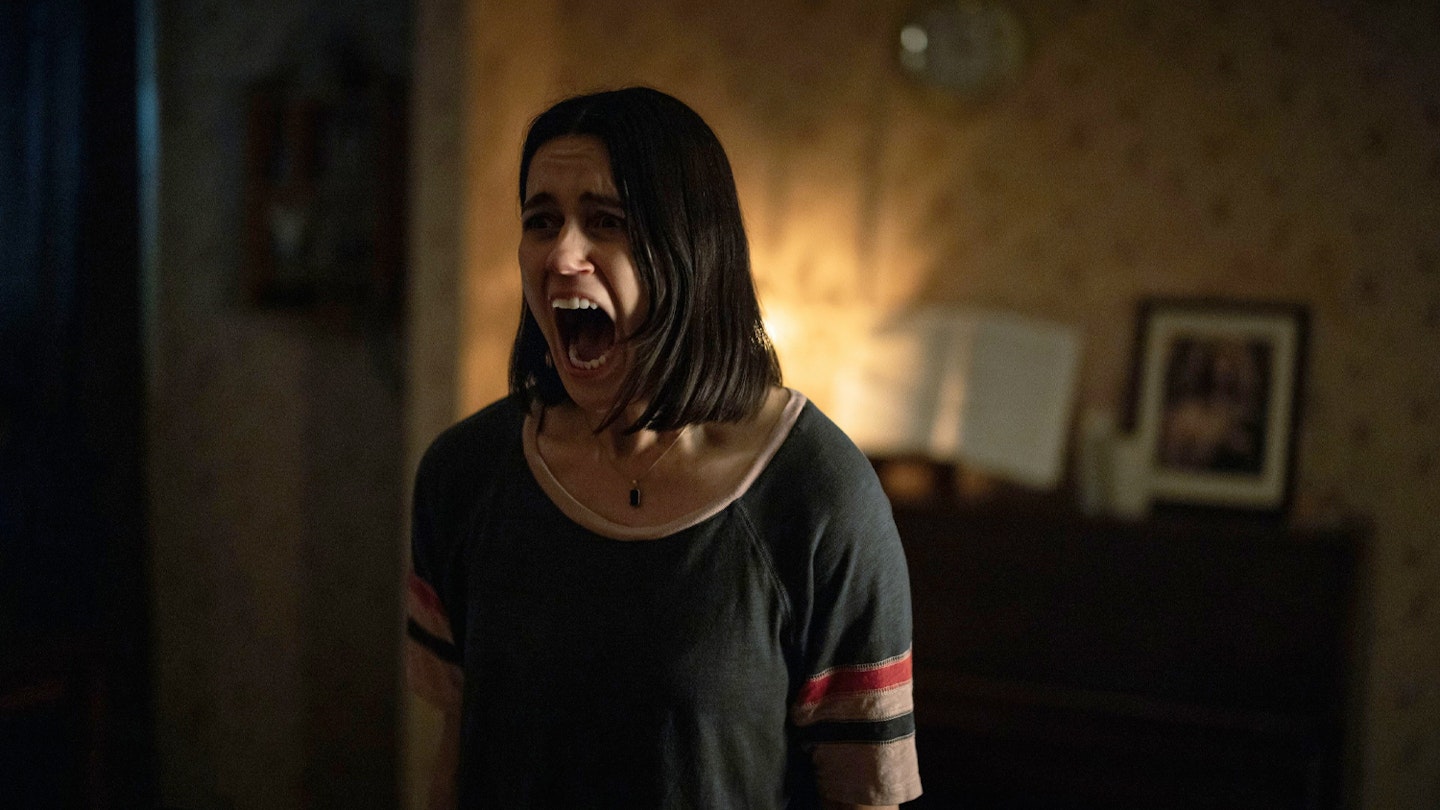
This comes from first-time writer-director Ian Tuason, who partly based the story on his own experiences in caring for his dying parents, and — in a staggering move which must have been at least a little bit psychologically triggering — filmed the entire feature within the walls of his own childhood home in Toronto. Tuason’s set-up is smart, never leaving the claustrophobic walls of that home, its shelves heaving with Catholic trinkets and religious bric-a-brac. A statuette of the Virgin Mary looms with benign menace.
This is the family home of Evy (Nina Kiri), whose mother (Michèle Duquet) is suffering from a terminal disease, bed-bound and nonverbal. Evy is a podcaster who co-hosts a spooky show with her friend Justin (Adam DiMarco; like most of the characters besides Evy, never seen, only heard). While Evy is acting as her mother’s caregiver, she and Justin are in different time zones, hence Evy is conveniently forced to stay up until the inherently spooky witching hour of 3am to record new episodes of the show.
Technically and sonically, this is as sharp as it gets.
Undertone began life as a found-footage radio play, which you can totally see: Tuason and his sound team carefully and deliberately use the aural space as a storytelling realm all of its own. When Evy slips on her expensive-looking headphones, we the viewer slip into the pristine, noise-cancelled space she occupies; when she starts hearing things that may or may not be there — from the increasingly disturbing recordings of a cursed married couple, to the possessed-sounding podcast phone-ins — we hear them too, the entire span of the audio space utilised to full, nerve-jangling effect. (If you’re able to see the film in a cinema kitted out with the most modern, spatially crisp speakers, it makes a difference.) But we are also invited to imagine what we can’t hear, the noise-cancelling headphones generating a unique kind of anxiety, alluded to by Tuason’s camera, which often lingers in unsettling angles and ominous framing.
Technically and sonically, this is as sharp as it gets, buoyed by strong, subtle performances, especially from Kiri, who essentially carries the entire film. This being an A24 horror, the script leans heavily on family trauma (see also: Hereditary, Bring Her Back, Midsommar, Talk To Me) — by now a slightly tired conceit, albeit here given a very specific dose of Catholic guilt to underpin it. Evy clearly cares for her infirm mother but also holds complicated feelings for her, and the strictly religious childhood in which she was brought up. Nods to pregnancy and abortion feel extra weighty with the Catholic strictures they infer — made even more complicated by a demon named Abyzou.
If the ground it treads on feels recognisable, the way in which Undertone unravels its story is distinctive enough to leave an impression. Tuason’s insistence on ambiguity and mystery, to the end, might alienate some, but it is entirely in keeping with the enigmatic mood his film establishes from the off. It’s one thing to be scared of things that go bump in the night; it’s quite another to hear those things go bump in full Dolby Atmos surround sound.
A cautionary tale against the dangers of excessive podcasting, this is a supremely spooky sonic ordeal. As an allegory for Catholic guilt, it’s haunting; as an auditory experience, it’ll fuck you up.