
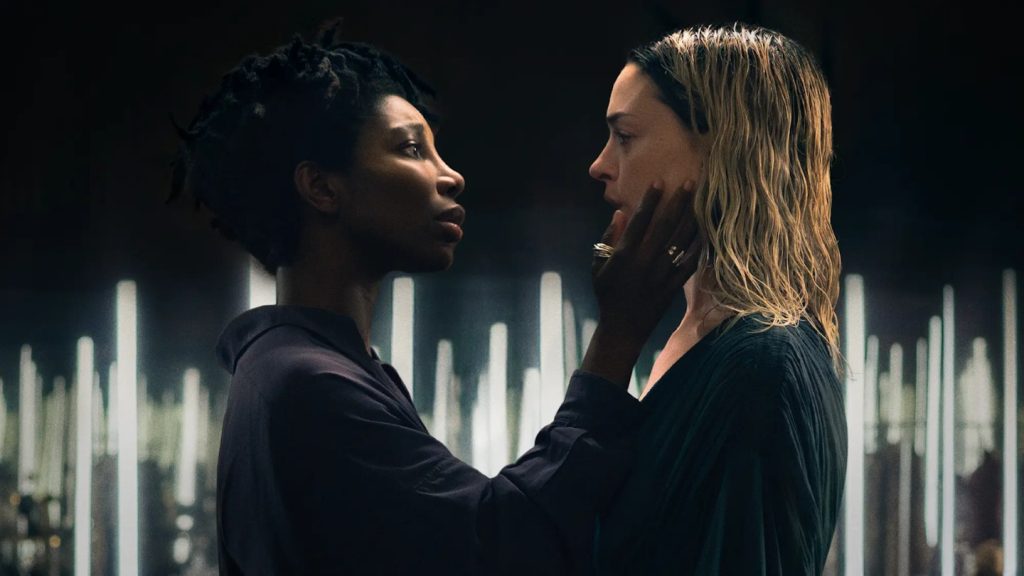
Pop star Mother Mary (Anne Hathaway) begs her former designer Sam (Michaela Coel) to make a dress. But their shared past haunts them — literally.
Who is the real David Lowery? Is it the family-friendly Disney employee, who can make heartwarmingly PG fare such as Pete’s Dragon or Peter Pan & Wendy? Or is it the singular arthouse auteur, renowned for challenging, grown-up work like A Ghost Story, The Green Knight and now Mother Mary? That identity crisis drives the filmmaker’s latest, a fashion fantasy which attempts to understand who we are as creative engines, how our collaborators inform and shape our work, and how the bitterness of bad blood can tremble our very souls. This is, in effect, ‘A Ghost Story 2: Pop Music Boogaloo’.
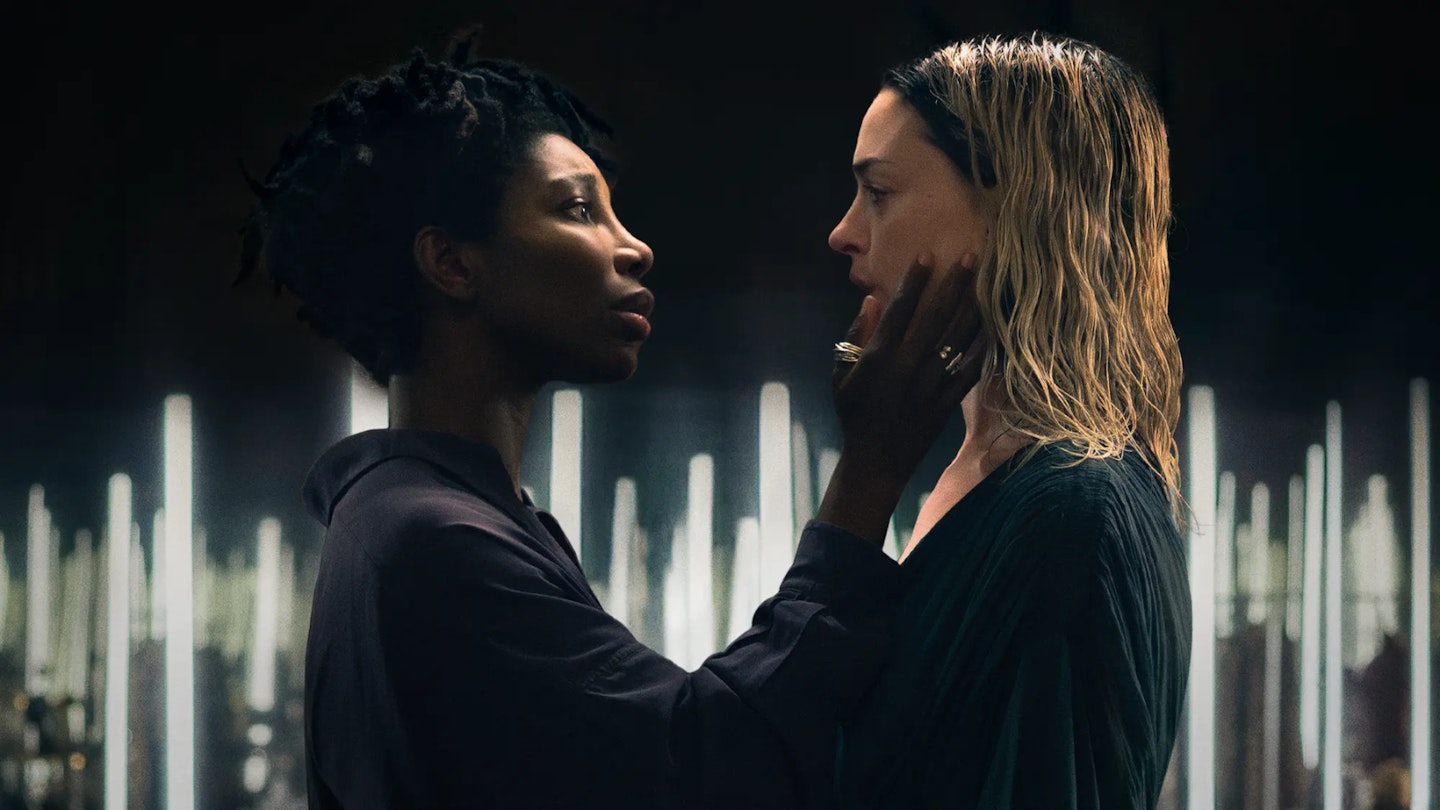
The set-up seems simple. On a Thursday, sad-girl pop star Mother Mary (Anne Hathaway) shows up at the offices of her former designer, Sam Anselm (Michaela Coel), and requests a dress to be made for her headline show that Sunday. The pair, it’s immediately clear, have not spoken in years, and Sam is not thrilled to see her. But against her better judgement, she agrees.
Sam asks the singer to describe her thoughts and feelings, which she will then translate into her fashion, calling it a “transubstantiation of feeling” — the kind of lapsed-Catholic line that might be dismissed as pretension. But it speaks to a profound truism: that the creative process is effectively a search for the divine, for the metaphysical, the world beyond the visible.
A sublime meditation on creativity and collaboration
It’s a fitting line, too, for Hathaway’s Mother Mary, a pop star draped in deliciously beatific religious iconography, from her ever-present halo headgear to her atmospheric songs. But the metaphor becomes literal when both find themselves haunted by a mysterious red, fabric phantasm which appears to connect them both.
This is hardly the first film to find spectral inscrutability in the folds of fashion; In Fabric and Phantom Thread both played with similar ideas, while Mother Mary’s flashes of lurid red and artistic obsession evoke The Red Shoes. But while the ideas here aren’t new, they play beautifully, Lowery executing it with such careful beauty and intention. In a film explicitly about art, every craftsperson is at the top of their game: from the captivating performances of Coel (imperious, stubborn, cruel) and Hathaway (vulnerable, emotionally illiterate, in need of an exorcism), to the songs by real-life pop queens Charli xcx and fka twigs, to the immaculate costume design by Bina Daigeler, to the woozy hyperreal cinematography of Andrew Droz Palermo and Rina Yang.
It plays like a riveting supernatural two-hander. Mother Mary herself demands “clarity” from her design, even as the film itself teasingly plays with ambiguity, the bounds of reality never quite fixed. Yet its intentions and feelings feel straightforward: this is a sublime meditation on creativity and collaboration, one that tries to square the circle of David Lowery’s multiple-personality career, even as it falls firmly on one side of it.
A defiantly avant-garde take on commercial chart-toppers. It’s not for everyone, but it deserves to be: a gorgeous fusion of film, fashion, faith, and certified bangers.