
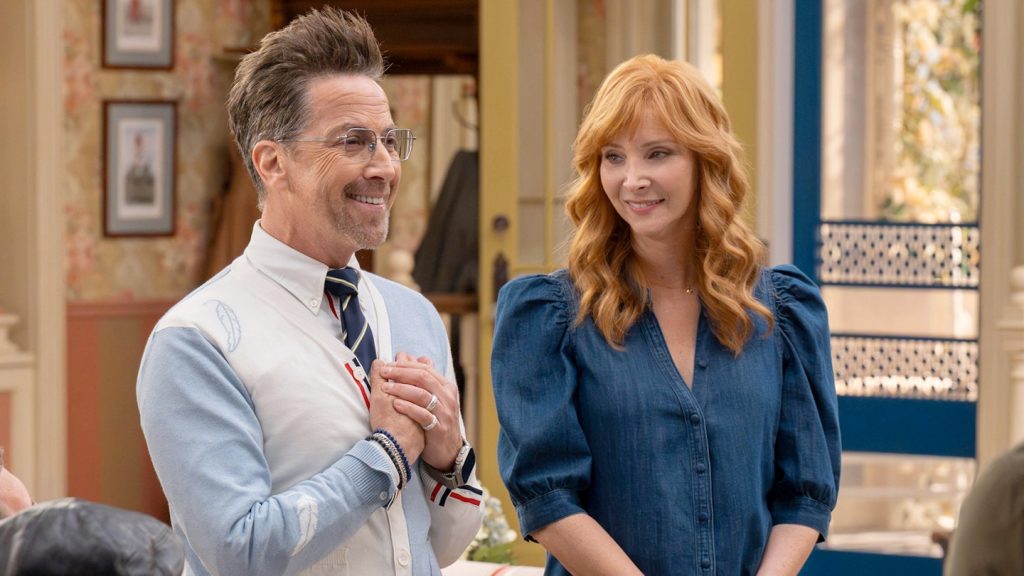
Cast as the lead in a new sitcom written by AI, actor Valerie Cherish (Lisa Kudrow) finds herself becoming the figurehead for a whole new television landscape… for better or worse.
Streaming on: HBO Max / SKY
Episodes viewed: 8 of 8
Lisa Kudrow slips into Valerie Cherish like she’s a second skin. It’s a full-on brain transplant of a performance, Kudrow out of the picture, Cherish taking over, desperation in human form, forever smiling, forever disguising — badly — the pain within. It’s a masterclass in character work, every strained intonation, every psychologically wounded facial flicker, every over-compensatory gesture, and at this point it is practically Kudrow’s life’s work. First arriving in 2005, Valerie has returned every decade to awkwardly find her place in an ever-evolving — or devolving — media landscape, and while she is worlds apart from Kudrow, make no mistake: this is personal. Valerie is Kudrow’s middle name. Literally. It’s her middle name. Lisa Valerie Kudrow. She is not Valerie Cherish. But Valerie Cherish is her.
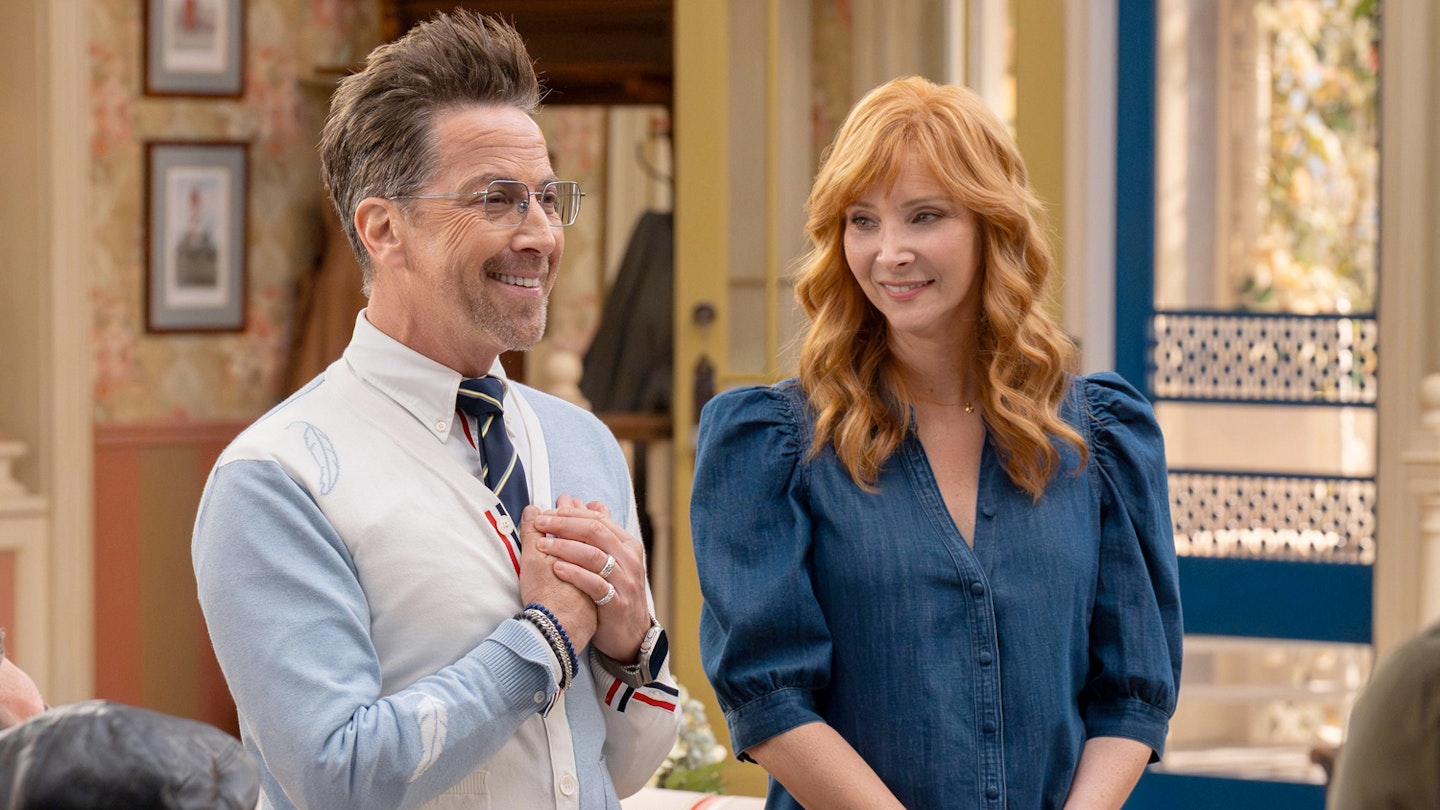
From the germ of an idea by Kudrow, agog at the bizarre blossoming of reality television and the shameless egos populating it, she and Michael Patrick King birthed the character in 2004, when Friends and Sex And The City (much of the latter written and directed by King) ended. Valerie came to us fully formed, and seemed more obviously connected to Kudrow’s early-1990s training with improv sketch-group The Groundlings than Phoebe from Friends (on which she was not a writer) did — it was as if her own (co-) creation was busting to be born. Hungry for stardom and starving for the spotlight, Valerie is excruciatingly performative, a mess of good intentions and horrendous decisions, perpetually in denial as she suffers an endless succession of indignities, some self-inflicted. Often cajoled into debasing herself to further her career, she believes the key to survival, alongside her relentless tenacity, is to project constant chipperness. But she is constantly cracking. The eyes tell the truth, regardless of the Chesire Cat grin.
The exceptional first two seasons found an at first down-on-her-luck Valerie climbing back up the ladder while simultaneously starring in reality shows about her return to television, and triumphing: Season 2 ended with her winning an Emmy, and off screen, Kudrow was nominated too, as she was for Season 1, and will undoubtedly be again for 2026’s third and final season. Now, Valerie is starring in the world’s first sitcom (the perfectly titled ‘How’s That?!’) written by AI, despite superficially protesting against such a thing in the 2023 SAG-AFTRA strike. Throughout the eight episodes, Kudrow and King show us that Valerie has changed. She has learned some lessons. She has accrued more confidence. Not quite the walking carpet she has been in the past, she’s a little more savvy, has a little more integrity, a little more self-respect — and more bite, when she needs it. Twenty-one years older than when we first met her, you’d hope that would be the case. We all grow. Yet many of our hopes and dreams, our fears and self-loathing, remain, as is very much the case with Valerie Cherish, who still suffers from feverish self-preservation, still desperate for affirmation, validation, respect and, now, social collabs with Nivea. And, as cruel as The Comeback can be to Valerie, King and Kudrow write and perform her so compassionately, so delicately. It’s hard to think of another comedy show that tickles the funny bone while tugging at the heartstrings in the same moment.
Says goodbye to the show guns blazing.
Fame is still the game for Valerie, obsessed with relevance, although the commentary on reality TV is less pronounced, as the format has become so commonplace itself: cameras (and phone cameras) are everywhere now in The Comeback, mostly without question. At one point, Valerie is followed by her own behind-the-scenes crew (led, as ever, by Laura Silverman’s crusading documentarian Jane) into her manager’s (Dan Bucatinksy’s increasingly ghoulish Billy) office, where she is ambushed into taking part in some professional couples-therapy, the therapist armed with his own crew for a TV pilot — the result is like a Mexican standoff, but with cameras instead of guns.
Also, this time, everyone is desperate. Valerie’s husband Mark (Damian Young), usually her rock, her voice of reason, has lost his high-powered finance job and now, in his late middle-age, is clinging onto being cool (at least his idea of it), pathetically excited about his new Soho House membership and his stylishly oversized spectacles, and attempting his own reality-TV career by starring in a cretinous creation called ‘Finance Dudes’. Billy, meanwhile, having anointed himself Valerie’s producing partner, is more interested in his own burgeoning industry-sway and status. Some of what goes on with these two characters in particular is perhaps a smidge too broad. Yes, this is the show in which Valerie once — iconically! — puked all over a studio floor while dressed as a giant cupcake — but a couple of the excesses of Season 3 do lessen the frisson of reality the show has somehow always retained.
Still, Mark and Billy’s arcs are a keen comment on the unfortunate state of things in 2026, where so many people are fighting for their own cachet, however egotistical their goals may be. Meanwhile, the institutions and corporations around them become ever-more controlling, here signified by the unscrupulous NuNet, led by Andrew Scott’s lizardy moral-abyss of a network exec, Brandon; a press conference, in which only “friends” of the network (and influencers) are invited to attend, says as much about contemporary politics as it does showbiz.
Genuine despair really does underpin this final season, which offers a compassionate and sad perspective on the havoc that generative AI is beginning to wreak, and the livelihoods that will be lost because of it. Valerie may not be aggressively opposed to it at the start, more concerned with how she might be judged by her peers than with the actual ramifications of it all — when stalwart sitcom-director Jimmy Burrows, returning to The Comeback once more to play himself, lobs some helpful truth-bombs at her, she immediately hurtles into denial. Writers, he tells her, turn their pain into jokes: “Those broken, beautiful souls are what makes something great.” She may well know that that’s true, but doesn’t want to hear it, doesn’t want her dream derailed, so clings onto a questionable second opinion. She soon sees, though, how quickly things collapse without actual human writers on the job.
If this all sounds a little on the nose, well, it is a little on the nose. Kudrow and King are not in the mood to beat around the bush. The Comeback has always worshipped at the altar of good television, and the current threat has them saying goodbye to the show guns blazing. You certainly can’t quibble with their passion, but it does somewhat overwhelm the final few episodes, and as The Comeback reaches its conclusion, the comedy takes a bit of a backseat. Because for Kudrow and King, this is no laughing matter. Nevertheless, even with fewer yuks it is effective, Valerie pushed and pulled about by various powerful forces, her really quite complex quandary challenging her own sense of integrity, and watching Kudrow portray the character with such gusto is rewarding.
And for the most part, her and King’s heart-on-sleeve approach pays off. The early throughline about Valerie’s old friend and hairstylist Mickey, played by Robert Michael Morris, who died in 2017, is hugely touching. Valerie has been hit hard by Mickey’s death, just as Kudrow and King were by Morris’, and you can feel the loss and heartbreak whenever he is invoked. The sequence here in which Valerie scatters Mickey’s ashes from the roof of a soundstage is a stirring tribute to the character and the actor.
Such honesty, the blurring of the lines, the sense of reality, has always been key to The Comeback — it’s been about reality from the start, about reality as a constructed concept, and about genuineness. As such, it is cringey and compassionate, nuanced and broad, sincere and slapstick, all thrown in at once to reflect the messy chaos of Valerie Cherish, and of all of us.
The Comeback’s final season is an open-hearted valedictory send-off for Valerie Cherish, stumbling into the sunset as she goes. Despite a bit more bluntness than before, Kudrow and King give it everything they’ve got, capping an exquisite series of television. There’s never been anything quite like it.