

Heroes of Might and Magic: Olden Era’s primary goal is to return to the form and function of the much applauded Heroes of Might and Magic 3. It picks up some tricks from later entries, sure, but you’ll largely do the same things today that old heads like myself did back in 1999 – and this revival makes a good case for why that era is considered the peak of the series. While its Early Access launch is definitely still under construction, Olden Era captures the essence of that one-of-a-kind turn-based strategy that has gone all but missing in the scene for decades.
If you’re not familiar with Heroes of Might and Magic, the basic setup is this: you and your enemies each manage heroes and towns on a top-down map, taking turns sending your warriors out to scour the land for plunder and power, killing anything standing between you and your prize in tactical grid-based battles. That first part happens on the overworld map, dense with exotic looking buildings and monuments, most of which you can interact with. In them are usually resources you need like building materials or gold, troops waiting to be recruited by anyone who can spare some coin, or magic items that don’t hurt to have, especially if you can accumulate big bonuses by equipping sets of them. It can sometimes feel like regions of the map are dense with stuff to vacuum up relentlessly, with an occasional pack of guardians standing watch to create a firebreak for your raging consumption inferno.
I was never disappointed to find a new building to pull up on, but that feeling of “discovery” – where I’m seeing something that looks awesome or with some intriguing long-term strategic potential in an unpredictable way – dries up pretty early on. What remains is a frillless but enjoyable barrage of decisions that always have to be considered. Do I spend gold to recruit troops from outside of my faction that are decent and convenient, or focus on the ones waiting at home several turns away that would benefit from all of my faction-flavored bonuses? If I don’t attempt to fight the guardians of this crypt now, will an opponent swoop in and steal it out from under me while I wait to accumulate power?
Maps can keep you guessing a bit thanks to an element of randomness that shuffles where certain points of interest are every time you start a new game. The strength of enemies on the map is kept purposefully vague, but unlike in past games where the tooltips would hint at the power of an enemy camp by alluding to its size, Olden Era will just straight up tell you if taking a fight is a good idea or not. Sometimes, stronger monsters will be closer to your starting camp, other times not so much. Though it keeps repeated games on one of the dozens of available maps fresh, it can make trying to capitalize on things like the aforementioned equipment set bonuses feel largely out of reach as you can’t guarantee you’d ever be able to find every piece required before a game ends, if they are even on the map at all.
The unique faction units are a vibrant blast of variety and creativity, though. From the lowly tier one grunts to the mighty tier seven juggernauts, every faction’s cast of soldiers is an expressive joy to field and play. Most factions are remixed versions of old favorites: Temple are the Haven knights from back in the day complete with holy warriors and literal angels, for example. The demonic Inferno is replaced by the insectoid Hive, which answers the question “what if Hell was somehow worse?” My favorite is the brand new Schism, the icy cult of elves who went too deep into the water and brought extraplanar horrors back with them.
All six have distinct identities in battle. The Hive’s molten bugs are an overwhelming melee force, and it can be tough to make it out of combat with them without heavy losses. The Dungeon can do a little bit of everything, as their mix of teleporting dark elves, mighty minotaurs, and scaly dragons cover all bases. This also means that not every faction feels great immediately, even when leaning into their strengths. The Grove has expensive units that can become powerful after significant investment. The Schism’s power comes from its ability to increase the size of their armies passively, but that only happens through winning battles. Tuning and balance is often an expected hurdle with Early Access games, and that’s no different here. Figuring out what is a playstyle choice versus a legitimate concern is going to be an ongoing conversation.
Every faction has the same amount of units across the same tiers, but they are all balanced so differently that you have to approach each of them with a different gameplan. That may sound obvious, but army composition is really the only time you have to approach Olden Era in this way. That’s partly because units can be so mechanically different from one another from tier to tier – the tier one Hive Parasite actually does extra damage to higher tier creatures, making them more of precision instrument versus the tier one Necropolis Skeleton, which is just a cheap and reliable meat… er, bone shield. Many units also have powerful abilities that you can spend focus points during battle to use, which adds another tactical wrinkle to everything.
On top of that, all of these units can be upgraded into two possible alternative options, each with their own potential nuances and changes. I wish these upgrades felt more consistently different across the board, though. While the bow-wielding Sylvan Fauns can upgrade into either a more powerful archer or trade the bow for a sword to become a light-footed menace in melee, relatively few units present a choice that feels so obviously stark. I’m sure the differences between the 80+ options will become second nature when I hit my 100th game, but I wish there was a more illuminating way to see the consequences of these choices in the meantime.
Heroes act as the leaders of your warbands that can influence units with passive abilities or change the balance of battle with big spells. The six factions have a good amount of heroes to choose from when starting, each with their own novel skill, like giving a bonus to a specific unit or having an advantage when casting spells from a certain school of magic. They also get a more generic subclass that can be evolved into a powerful version of itself if you have the right collection of skills. This can be truly obnoxious because the new skills you get are chosen from a random pool every time a hero levels up. Some subclasses can tilt the RNG scales so you’ll see certain options more often, but you can only gain eight unique skills total, so it’s possible that you’ll never actually find the five needed to improve your subclass. I’ve probably only done it twice in the 25 hours I’ve played so far.
Heroes are also sort of bland in general. Their portrait art is great across the board, really evoking a sense of personality that does not actually come out during play. The spells they can cast all come from a wider pool and are learned semi-randomly, which makes magic feel generic. This isn’t to say spells aren’t powerful – some of my best games came from magic-focused heroes devastating battlefields with lightning bolts or powerful disruption and debuffs. But being able to have a spell-based gameplan is completely up to the luck of the draw when you build your magic generating buildings and how many extra resources you’re willing to spend to buy more. Spellbooks rarely reflect the themes or characteristics of the characters casting them.
Settlements serve as your bases of operations out in the field and can also suffer from similar identity issues. Every day (each turn) you’ll be able to build a new structure that either provides new or upgraded units, more spells to your spell book, fortifications against invaders, or general economic benefits. They’re rendered beautifully and at least appear starkly different from faction to faction, but they all provide largely the same functions. You’ll likely build them up mostly the same way regardless of if your home is a temple to the sun god or a demonic beehive.
Factions usually have a unique building or two, but they are not created equal. The Temple’s Scouting Skyship that increases the vision range around the city is nice to have, but pales in comparison to the Grove’s Mycelium Roots that allow heroes to travel to any city you control instantly. Even the new Law system – essentially a research tree where you spend points accumulated passively and by spreading your influence across the map – feels a little copy-paste from faction to faction, with keywords swapped for faction specific details (unit growth buffs and signature stat boosts, to be specific).
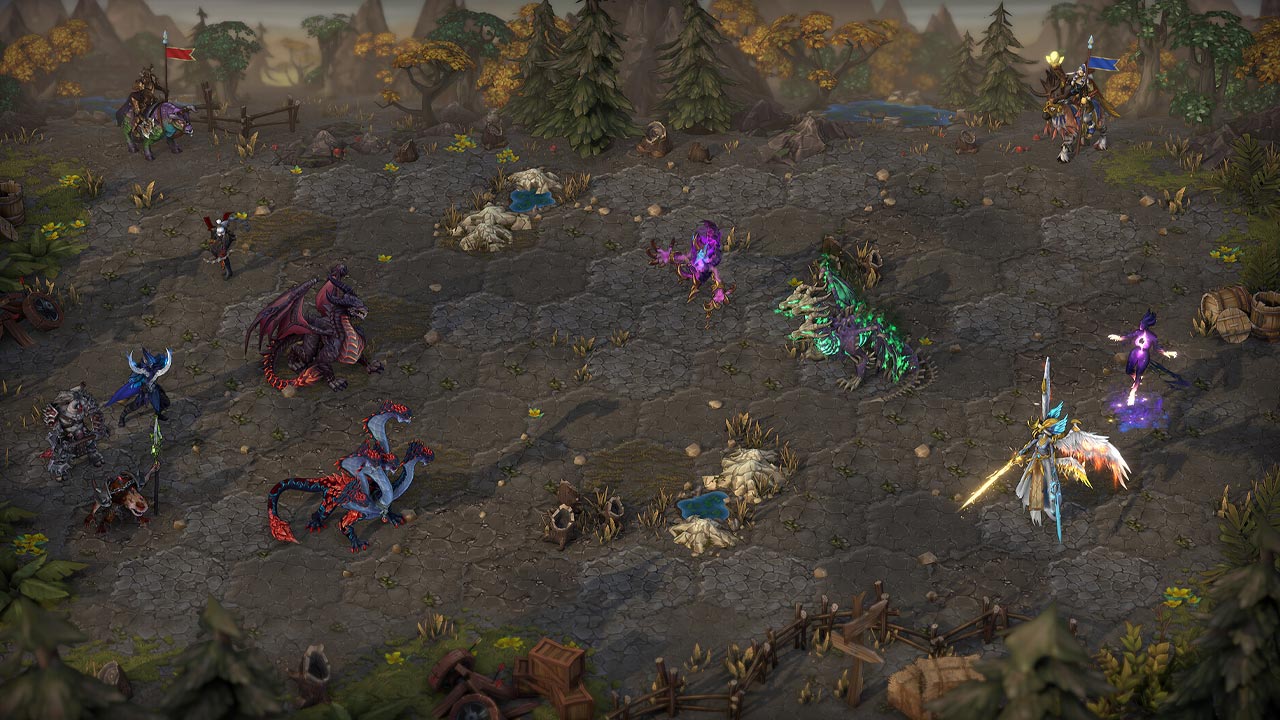
When it’s time to dive into combat, things will seem straightforward at first, but these battles really are the main draw. You move units across a hex grid, avoiding the occasional trap and terrain feature in order to reach the best positioning to get enemies gone. Units are either melee, long-reach (can attack from a space away), or ranged, so there isn’t much fuss when determining how to attack, and every creature will retaliate against a melee attack with one of their own. I love the simplicity of your attack options, though it can be hard not to just lean into ranged army compositions instinctively since melee is such a high-risk endeavor. This doesn’t negate melee units at all, but I did feel naked if I ran a squad of just face-checking bruisers, especially in the early game.
Flanking and backstabbing aren’t a thing here, so much of the depth and nuance of combat comes from initiative, which determines which units act in what order and can be manipulated by having units wait and delay their turns to let others act first. It does often cause fights to feel like you and your opponents will spend the first half of every turn making your most valuable units stare at each other before they’re eventually forced to move, but who you have wait becomes an important tactical choice as battles get more intense. Spells that can alter movement speed and initiative like Web and Ice Bolt can help break these stalemates, and they are way more valuable in Olden Era than I remember similar options being Heroes of Might and Magic 2 or 3, where all you ever really had to do was cast Bless and Stoneskin and send your units on their way. It’s a pretty savvy and interesting combat system this time around, though I do wish the battlefield variety did a little more to spice things up from fight to fight.
Of the modes currently available in Olden Era, Campaign is my least favorite right now. It’s more story-focused than past campaign modes, and even has some opportunities to make choices that will significantly change how you progress through it – specifically who you as Gunnar, a minotaur scout of the Dungeon faction and lieutenant of The Triumvirate, will ally with as you investigate a looming threat to the world of Jadame. That’s neat in theory, but it comes with lots of small annoyances like unskippable cutscenes. Its also where I encountered the most bugs, from a couple weird crashes to a mission branch that asked me to make nice with a faction in order to find its leader, even after I’d already found them and recruited them to my party. My biggest gripe with it, though, is that it renders a lot of the most interesting systems inert. Many city dwellings are restricted and can’t be built, you don’t interact with the advanced subclasses or laws at all, etc. These are obviously so that progression through the more tailored maps can be controlled, but it’s the worst way to play this game, especially if you haven’t gotten any reps in other modes yet.
On the flip side, I really like the new Arena mode, which is just Olden Era combat between two players. You draft a hero, skills, artifacts, spells, and units almost like a trading card game, then square up with an opponent for a fight to the finish. This means you’re subjected to all the ways randomness can affect these things more than anywhere else, but it’s still a great way to learn and test synergies without having to play hours of a full run at a time. I couldn’t try too many Arena matches during the early review window, but im eager to jump in and test my might when the pool of players opens up.
And while Classic mode is the “right” way to play, forgoing story for a pure test against either CPU opponents or other human competitors online, I’ve also been really smitten with the Single-Hero mode, which restricts all teams to just one roaming conqueror who holds all of your army’s strength and the fate of your faction’s survival in its hands. It helps focus the flow, and is perfect for new players who want to learn the ropes without having to think too big at first. But it also appeals to a returning player like myself as someone who is eager to find the line between the creeping grind of faction supremacy and the free time afforded to an adult with a job and a family and friends and…