
Platforms: PS5, Xbox Series X|S, PC
Video games and the works of H.P. Lovecraft are a familiar pairing. No other medium is quite as capable of bestowing upon audiences a first-hand encounter with unknowable horrors, so it’s little surprise developers keep going to that well. Yet while many games tap into the early 20th century settings of the original stories, or the older periods they draw on – from the mad ramblings of Alhazred, author of the Necronomicon in the 700s, to the inconceivably ancient horrors that populate the mythos – Cthulhu: The Cosmic Abyss stands out by exploring what a future world threatened by the impending awakening of the Great Old One might look like.
CREATOR: gd-jpeg v1.0 (using IJG JPEG v62), quality = 100
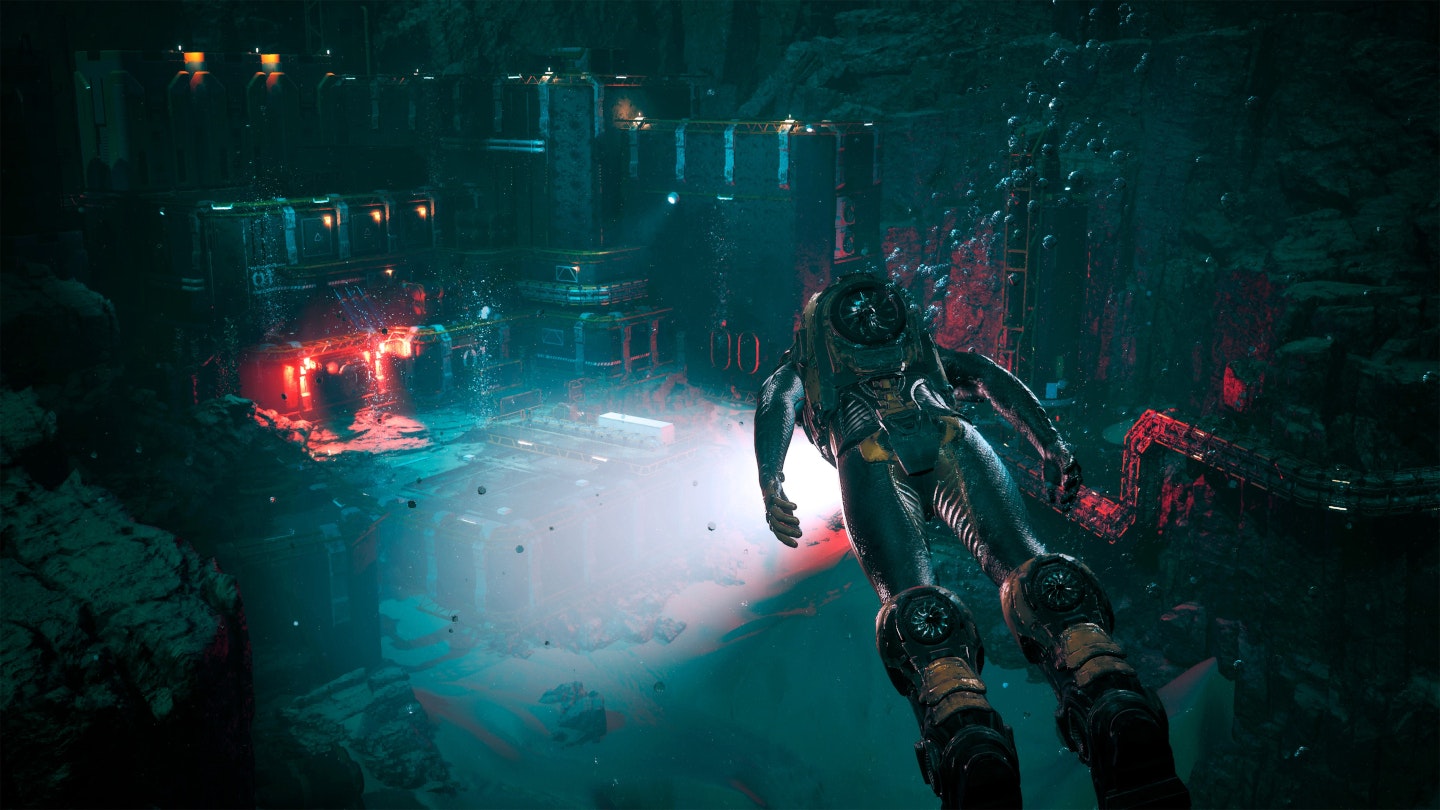
Turns out, that’s a world on the fast track to destruction all by itself. Set in the 2050s, human-driven climate change is running rampant, and extreme weather events are wreaking havoc across the globe. In the midst of this, the occult is still occult-ing, and when a researcher for the Miskatonic University (a Lovecraftian staple) goes missing, the secretive organisation Ancile sends you in to investigate. Cue one unplanned trip to an unknowable plane of reality, a grievous injury, and a few months’ time skip, and before you know it you’re following up that predictable disaster of an opening mission by venturing to a deep-sea excavation facility that’s been unearthing all sorts of forbidden things.
Unfortunately, Cosmic Abyss loses points for how incredibly fiddly it all is.
As Noah (a black man, a pointed undermining of Lovecraft’s notorious racism), you’re part supernatural detective, part cyborg, “upgraded” with an AI assistant called KEY implanted in your brain. Not only is this a nice twist on Lovecraft’s characters frequently being plagued by voices in their heads, but a particularly insidious one, given KEY essentially is the entire gameplay mechanic of Cosmic Abyss. You’re forced to rely on it to the extent you barely flinch when “she” suggests injecting yourself with strange fungal extracts to replenish your energy – for anyone paying attention to contemporary real-world developments in AI, it’s a smart bit of techno-horror running adjacent to the mounting cosmic terror.
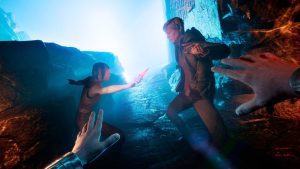
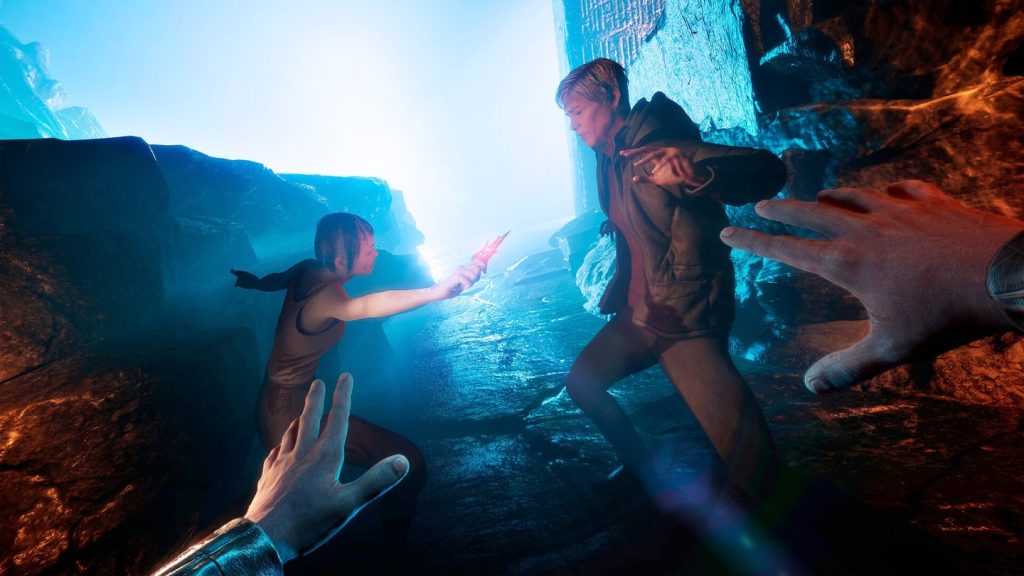
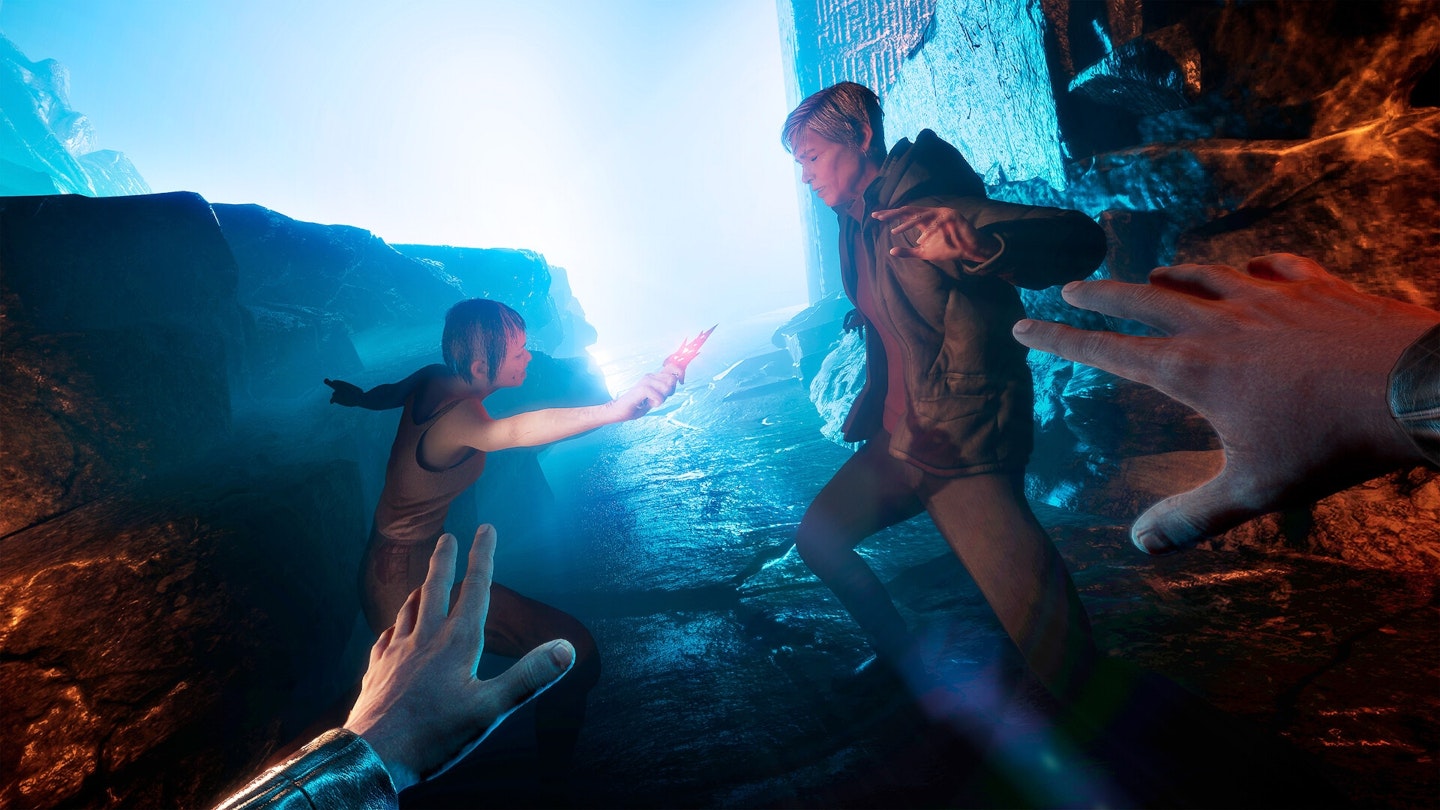
Played first-person, you’ll be exploring a host of unsettling locations – like the abandoned Ocean-I mining facility that’s disgustingly infested with growths of unidentified sap, or crumbling temples carved by forgotten races – piecing together the mysteries of what happened in each area. KEY allows you to analyse clues, revealing information like their material composition, a sonar tool to track other instances of those materials (or combinations of up to three – useful if you need to track down an alien mineral coated in human blood, for a cheery example), and saves uncovered evidence on the Nexus, a mental map allowing you to draw digital threads between pieces of evidence, before deducing the outcome for major puzzles.
However, just as you shouldn’t trust ChatGPT to count the number of “Rs” in “strawberry”, you probably shouldn’t rely too much on a bot in your brain that finds itself inexplicably upgraded every time you stumble upon a primordial altar or antediluvian relic. Sure, those upgrades offer useful boosts like increased sonar range or the chance of replenishing energy when examining clues, but they also expose Noah to increasing degrees of corruption, which impacts choices available and the direction of the story.
Unfortunately, Cosmic Abyss loses points for how incredibly fiddly it all is. Interacting with anything in the world requires lining up an absolutely tiny reticule – practically a single pixel – over items to do anything with them, and it’s all too easy to completely miss an important clue or item because you haven’t clipped the cursor precisely over the right thing. There’s one especially egregious point where you need to find a particular ID badge, which turns out to be hidden vertically in a drawer, rendering it effectively 2D. Even if you’re tracking ID badges using the sonar and can find exactly where it is, it’s actively difficult to pick it up.
Controls are also messy. Both R1 and Circle (on PS5; version tested) are the “interact” button, but sometimes neither works without multiple presses, while movement through underwater sections often feels more like guiding a bobbing head, as if Noah is sinking through floors with no body. Elsewhere, KEY’s Nexus suffers from a cluttered default view, while those important deductions that are meant to feel like you’ve out-sleuthed Sherlock Holmes can be strong-armed by pairing every clue on the board until you get a match.
There are some baked in tools to mitigate some of these problems – an easier “Exploration” mode lets you focus on the story, while a few customisation options allow you to tailor the experience, such as highlighting how many clues are left to find, or allowing you to analyse clues without risking greater corruption. These feel like sops to a game that delivers frustration more than fear, though.
That’s ultimately Cosmic Abyss’ biggest failing – although developer Big Bad Wolf has brilliantly crafted an appropriate sense of pervasive dread throughout the game, the package as a whole is chilling more than it ever is actively scary. Certain moments inspire appropriate awe, like encountering the first evidence of ol’ squidbeard, but as an almost purely investigative game, there are few moments of palpable fear to be found. Still, branching paths – each chapter has two potential outcomes, and Noah’s overall corruption level impacts endgame options – provides enough replay value for anyone whose dreams this Lovecraftian outing manages to haunt.