

True nostalgia isn’t the replication of a specific place or time, but of a feeling. It’s those flashes of emotion that transport us back into memories that have long sat dormant. I was born too late to be a teenager in the ’90s. I grew up thousands of miles away from the schools of Northern California. I’ve barely stepped onto a skateboard outside of a couple scraped knees in the summer of 2003. But none of that matters, and Mixtape knows it. Australian developer Beethoven & Dinosaur fills each and every moment of its coming-of-age tale with incredible music, perfectly hand-picked to set the tone for its free-flowing chapters in a way only nostalgia can. As original as it is reverential, it’s a masterfully constructed dose of new memories hinged brilliantly on how they remind us of our own.
The “coming-of-age story” is perhaps my favourite framework in all of fiction. That longing for a time I didn’t live in, and being given a chance to hang out with friends who never knew me, are sensations I find myself coming back to often. This is far from the first video game to tackle the concept, of course, but it might be the first one to have nailed a tonal balance that hits just right for me. I’ve tried to enjoy the Life is Strange series more than once, but it’s always leaned into corny territory just a little too much for my taste. Mixtape, on the other hand, feels more rooted in how actual people talk, and is all the better for it. Sweet without being saccharin, thoughtful but never forced, and always funny.
The story centres on Stacey Rockford and her group of friends as they look to make the most of their last day together and reminisce about past adventures before she skips town to chase her dreams in New York. You aren’t given choices here, but experience these fully-formed characters’ hijinks and heartaches, warts and all, and they feel all the more realistic for it. That’s not to say their recollection of those adventures isn’t laced with flights of fantasy, though, as they have clearly been embellished in Rockford’s mind, allowing each to be presented with lashings of style as if they were playable music videos.
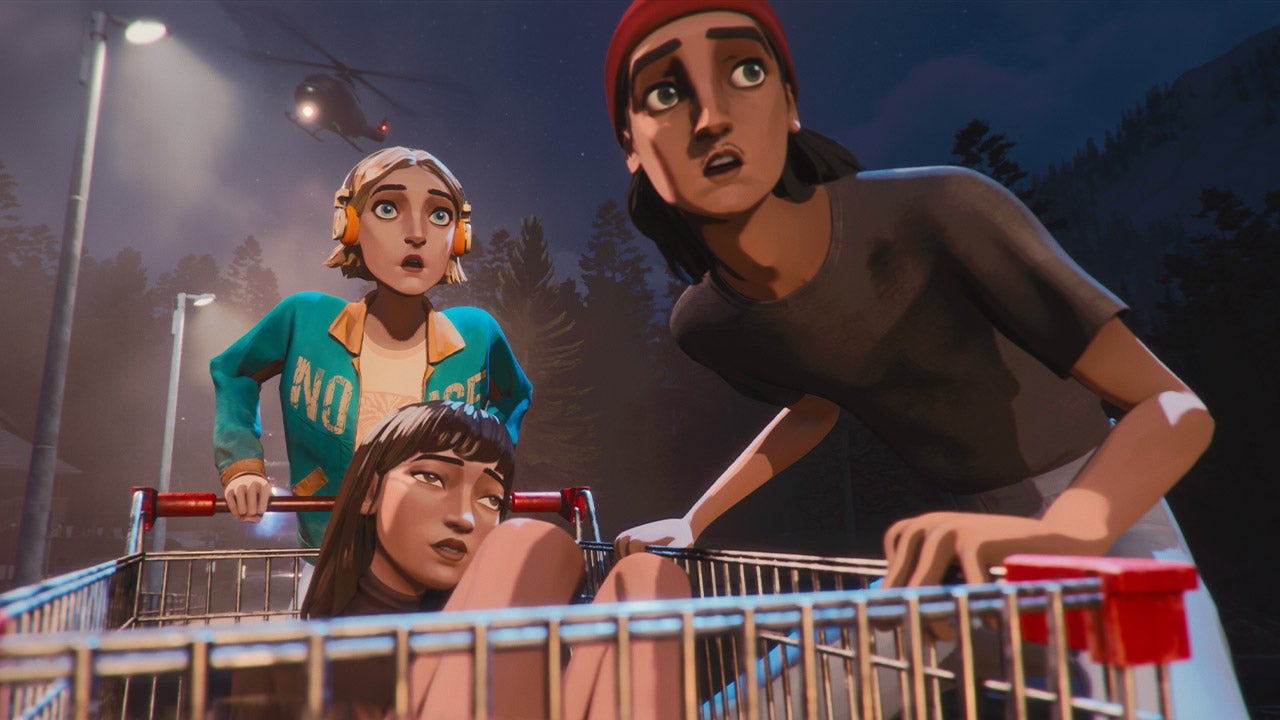
There’s a great sense of spectacle later on that I wouldn’t dare spoil, but particular early highlights include a trippy softball practice session soundtracked by “The Touch” (anything that reminds me of Boogie Nights is an instant winner) and a police raid of a house party that you escape by hurtling downhill in a shopping cart. It’s the most irresponsible, yet highly enjoyable, use of one since Johnny Knoxville and friends barreled along in a supersized cart to kick off Jackass: The Movie. And in some ways, Mixtape shares a similar sense of reckless abandon, zipping along at a pace and smartly reflective of a time in life where you’re so eager to enjoy one moment after the next that you almost forget to savour them fully.
Where Beethoven & Dinosaur’s debut game, The Artful Escape, used psychedelic metaphor to tell a tale of self-expression, Mixtape is far more grounded in its exploration of friendship and how those closest to us help us grow. It’s a story that won’t necessarily surprise, but will comfort, and one that is often hilarious — like those aimless afternoons you’d spend with friends without any specific goal for what the day had in store, but you’d always end up learning something new about them, whether they’d planned on revealing it or not. Obviously, those unlocked memories aren’t yours; they’re Rockford’s, but these moments are just so well observed that they come across as universal, as if they could be ripped straight from your teenage Facebook or MySpace page. In many ways, it’s best to treat Mixtape, well, like a mixtape — with no knowledge of where it will go next beyond a trust placed in the creator.
There’s no interest in fail states or high score chasing here, instead prioritising existing in and enjoying the moment. Its simple mechanics match its simpler times, with each twist aiming to elicit a fresh emotion through interactivity in a way that only video games can. That can be as simple as hitting a series of buttons to headbang in rhythm to Silverchair’s “Freak” blasting out of a car radio or designing your own slushies from a selection of flavours. Some, though, are a little more out there, such as the recollection of Rockford’s first kiss, where you take control of a pair of tongues (one on each analog stick) and awkwardly navigate some brace-caged teeth. That an option to press a button labeled “That’s Enough” almost immediately popped on screen is a very funny, and merciful, touch.
Each memory sequence spawns from a keepsake found around the world that smartly serves as the key to unlocking cherished memories. In this regard, Mixtape is somewhat similar to What Remains of Edith Finch, although I’d never say it carries the same emotional weight as Giant Sparrow’s masterpiece, instead sidelining deep-rooted familial trauma for a focus on youthful joy. Any replay value is found in wanting to revisit these short pockets of fun. They won’t change, nor will the relationships or conversations within them, but familiarity is at the core of nostalgia, and I can see myself treating Mixtape like one of those comfort films you pop on every couple of years. You know what’s going to happen, so the surprise factor is gone, but spending time with characters whose lives are only a few hours long is still valuable. That’s probably why I’ve played it through its roughly three-hour campaign a full three times already.
Best friends Slater and Cassandra are excellent foils to Rockford, too, with an instant sense that these three have been a close-knit group instantly delivered via quick-hit, sarcasm-fuelled jabs at one another and the sort of goofy noises spilling out of their mouths that only occur when you feel completely comfortable around someone. Referring to a T. rex as “the Barry Manilow of dinosaurs” is one such amusing observation among many. It’s yet another example of the writing and performances coming across as almost effortlessly natural, which is such a difficult thing to accomplish. Cassandra, in particular, has some standout scenes and ended up being my favourite of the bunch, even if some aspects of her character change a little too abruptly to be 100% believable at certain points in the story.
Rockford herself is an aspiring Hollywood music supervisor, and as such, pop songs from the early ’90s and decades before propel much of the adventure. Big artists are here, but not always alongside their biggest hits. It’s a nice touch, as if someone like Rockford — a music connoisseur who dreams of a profession centered on unearthing audio gold to match a mood — has curated the soundtrack. I particularly enjoy the way you can walk around her bedroom and get treated to amusing analysis of the albums strewn around the furniture in the style of Patrick Bateman, though with far less violent undertones. The opening skate to Devo’s “That’s Good” is the perfect high-energy pace-setter, whereas the scuzzy “Love” by The Smashing Pumpkins provides a fantastic backdrop for some explosive angst. And then there are songs like John Paul Young’s “Yesterday’s Hero” which I had never heard before, but now can’t stop listening to due to the way it’s used here. I’m not sure I’ve felt a game connect so intrinsically to its music in such a charming way since Simogo’s excellent Sayonara Wild Hearts, and I simply couldn’t get enough.
It consistently hits a delightful cross section of games, music, and movies. From Dazed and Confused to Ladybird, it reminds me of some of my favourite coming-of-age stories, without ever feeling like pastiches of them. Mixtape does this elegantly and with a genuine love for a genre its creators clearly hold close, as Beethoven & Dinosaur itself comes of age with its sophomore effort. But it isn’t just tonally looking towards cinema; it plays with the form, in turn becoming a mixed-media wonderland of a video game. There’s the glorious, painstakingly handcrafted Spider-Verse-esque animation that enraptures at a glance, along with the use of grainy live-action stock footage, music-video-like editing rhythms, and fun fourth-wall breaks. It’s not afraid to experiment and nerd out when it comes to stamping different styles on different scenes, and is all the better for it, keeping things constantly fresh.
Look, I was always going to be a mark for Mixtape. As a coming-of-age movie lover with an ear lent to guitar music of decades past who often indulges in the bittersweet sensation of melancholy, Beethoven & Dinosaur may have made it just for me. I mean, it even references David Shire’s unused Apocalypse Now score in an early scene — I can’t help but fear I have been actively spied on. But the beauty of Mixtape is that you don’t need to be exactly the type of person it’s for to get a lot out of it. Much like nostalgia, it brings out feelings you may have long forgotten, through faces and songs you may have never seen or heard before, but which bring familiar, faded emotions with them all the same. It reminds me of times I once enjoyed, but in hindsight wish I had held dearer in the moment. It’s a mistake I didn’t let happen again with Mixtape, as I savoured each and every minute, all the way to its final, powerful button press.