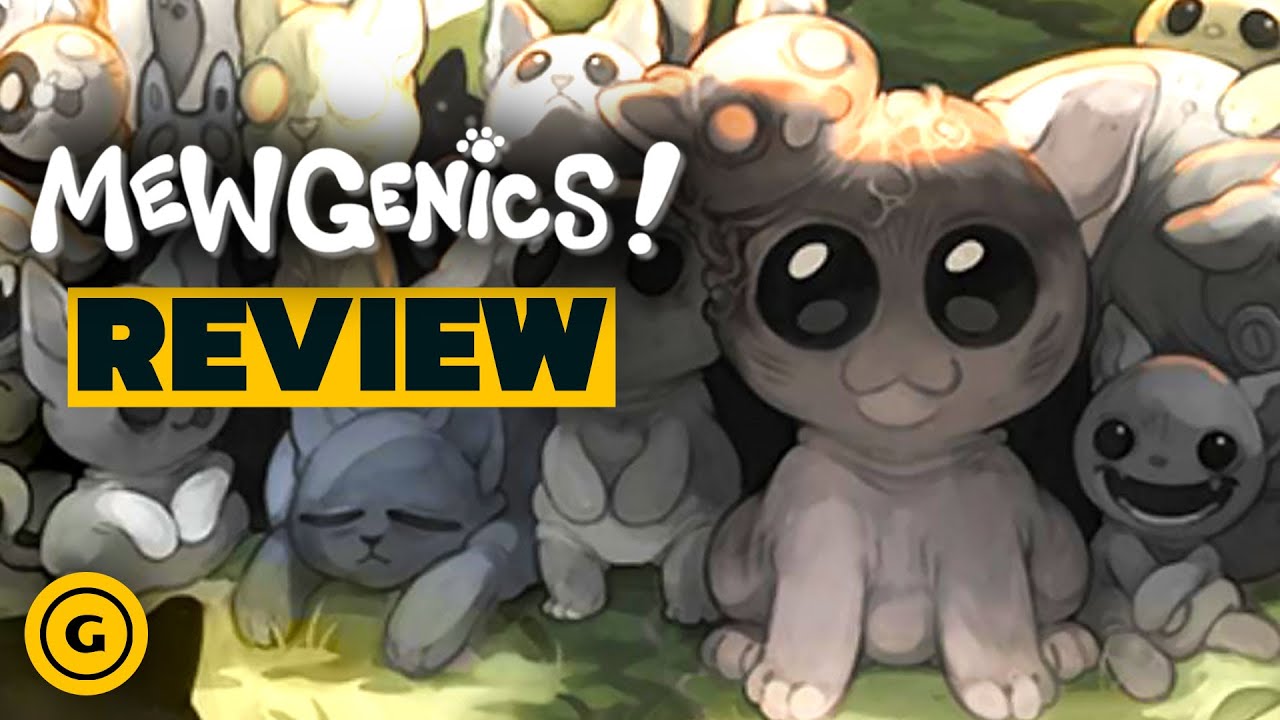


There aren’t a ton of games that I’ve happily put more than 100 hours into as quickly as I have with Mewgenics. This feline-flavored, turn-based, roguelike tactical RPG takes place on a 10×10 grid, with mostly traditional classes like Fighter, Mage, Hunter, Tank, and Necromancer, among others. What sets it apart, aside from the cutesy macabre art style that slathers its creative zones with blood and poop, is that so many of the skills and attributes that your team will end up with are randomized and for the most part out of your control. That all but ensures no two runs will play out the same way, forcing you to improvise and play the hand you’re dealt. Combined with the absolute mountain of content here – so much that I’m still seeing entirely new enemies, skills, mutations, and loot pop up after more than 150 hours – it’s been able to draw me back in time and time again by dangling the possibility of an absolutely wild team coming together and bulldozing through the boss who turned my last party into kibble. I still haven’t seen the final ending after all that time (this game has several) but I can’t imagine I’ll be tired of it before I do.
Mewgenics is a game about cats, but it’s not necessarily going to appeal to people who passionately love them because it’s a dark comedy that treats them as meat to be put through a grinder. The name itself is a play on eugenics, a morally appalling practice of selective breeding that has historically led to things like forced sterilization to remove undesirable traits from the gene pool, so you know going in that it’s going to be a little spicy. If you’ve played any of Edmund McMillen’s previous work (here he’s collaborating once again with Tyler Glaiel), such as the infamously difficult Super Meat Boy or the infinitely replayable Binding of Isaac, you’ll have a sense of the type of humor to expect. It’s delightfully gross and endlessly weird at every turn.
Even knowing that, as a long-time cat owner myself, I was perhaps a bit too conservative with just how unsympathetic and detached you’re expected to be. I probably took longer than I should’ve to unlock crucial upgrades for my house because doing so requires shipping dozens of cats off to live with a set of goofy weirdo NPCs, never to be seen again. One of the most important and flamboyant, Tink, will only take newborn kittens, and in exchange he’ll give you tools that provide more information on how to breed more kittens – and he needs a lot, so you have to get accustomed to parting with them right away. Other characters want older cats, mutated cats, injured cats, or cats who’ve been on runs to specific places in order to improve stores or add new rooms to your house, among other things. Traditionally an RPG like this is about nurturing your characters and developing them until they become more powerful, but Mewgenics requires a different way of thinking: cats with low or unremarkable stats are lost causes who will weigh your squad down, so you’re best off spending them like currency and keeping only the picks of various litters.
Selectively breeding your cats takes place in the fairly simple house screen, a 2D side view where your cats chaotically mill around while you arrange furniture pieces that you find as loot or buy from a shop, inventory Tetris-style. The goal here is to improve stats like Stimulation and Comfort in order to get your cats in the mood to produce high-quality offspring and improve the chances they’ll come out with favorable mutations. Those can be things like a messed-up tail that makes their basic attacks inflict burning, or fur that gives them more health regen when they’re wet, or leech eyes, among tons and tons of others that are all represented visually on your increasingly weird-looking cats.
(You also have to clean up cat poop daily to keep your Health stat up by simply clicking on piles of various shapes and sizes. It’s a bit of a chore after a while, especially when it gets crowded and you have to move cats out of the way to get to it – somehow, of all the furniture items I’ve gathered, I’ve never seen a single litter box.)
When everything’s arranged to your liking, you hit the End Day button and your cats will choose their own mates based on who’s in a room with them, as well as their own genders, orientations (yup, there are gay and bisexual cats), and libedos. Then, out come the kittens after some bizarre cat humping and gooey birth animations that take obvious pleasure in being unsettling. (You can tone that down if you need it to be safe for work.) Optimizing this to produce the most powerful cats possible while also avoiding too much inbreeding (which, as Tink will tell you, isn’t cool even though it has the word “breeding” in it because it causes birth defects) is tricky – but you can’t really fail at this part because, even if you lose all your cats, you can just start again from scratch using the randomized strays who show up every day.
The real challenge is in finding the traits you want and ensuring they’re passed down to new generations without too many side effects, and that definitely takes some planning. Mewgenics doesn’t make it super easy, since there’s no way to view all your cats in a list or spreadsheet – you just have to tediously cycle through them one at a time. You do unlock some tools to label them (and view their gnarly family trees), but when you have 40 cats roaming around it can be a pain to find one with the stats and abilities you’re looking for when you go to put together a four-cat party (or fewer, if you want to live dangerously and level them up faster) for an adventure.
Building your team is another area where Mewgenics is unconventional and unpredictable because when you’re picking cats and assigning their classes you can’t see what all of their starting abilities will be. You’ll get their base stats, mutations, and basic attacks, and sometimes they’ll come with a spell or passive ability from one of their parents’ classes, but it’s not until you lock in their class that you’ll learn what you’re really working with and if they’ll synergize well. Considering that each of the 12 classes has 75 abilities that might pop up (even after all this time I’m still seeing new ones), I get the same thrill from this reveal that I do from picking up my hand in poker or seeing the modifiers on a daily run in Slay the Spire or Monster Train 2: sometimes it’s good news and I’m excited to see where it takes me, sometimes it’s not and I brace myself for a thrashing and hope for a surprise turnaround if I can survive long enough to level them up and unlock some better skills.
What’s inconvenient at this stage is that while you can see what items you have available in your house inventory before you set out on an adventure, and after you lock in your classes you’re taken to the equipping screen to deck your cats out with up to five pieces of potentially build-defining gear apiece, you cannot see those items when you’re actually picking your classes and your starting abilities are first revealed. That might be fine if you have a fantastic memory, but for the rest of us it’s frustrating to not be able to check if I have a good piece of gear to boost the stats of my summoned familiars at the exact moment I’m deciding if I should go with an animal-friend Druid or a robot-building Tinkerer, or if I should go with a Fighter or a Tank instead.
It’s tricky to keep track of what you have on hand because gear in Mewgenics doesn’t last forever. You can expect to get three, maybe four runs out of something before it breaks, and that’s assuming you don’t wipe and lose everything you took with you and picked up along the way (except for your choice of one item from several that a helpful weirdo saves for you after a failed attempt). If weapons breaking in recent Zeldas rubbed you the wrong way, you probably won’t enjoy that aspect of Mewgenics, but I actually do like the way it prevents me from relying too heavily on any one strategy. You can get something incredibly powerful and play with it more than once, without letting that item define every run you’ll do from that point on.
Taking gear on only two or three runs may not sound like much, but that’s more than the actual cats get. Another reason you can’t count on the tricks you used in the previous run working just as well on the next, even if you use the same classes and gear, is that each cat only gets one adventure in which to level up and develop their skills. (You’ll be able to use them in combat one or even two more times during special battles where major monsters attack your house.) That was tough to get my head around at first, because I’m accustomed to my RPG party members sticking around, at least until I get them killed.
Maybe this is why you’re not allowed to name your own cats, and instead they come pre-named from a pool of (I estimate) a billion different silly possibilities: Mewgenics doesn’t want us to get too attached. After a while I stopped paying much attention to their names except to chuckle at them, preferring to think of my squad members as their classes rather than individuals. Only the ones I ended up using as my primary breeding stock really stuck with me. (Man, talking about this game makes you say some weird stuff.)
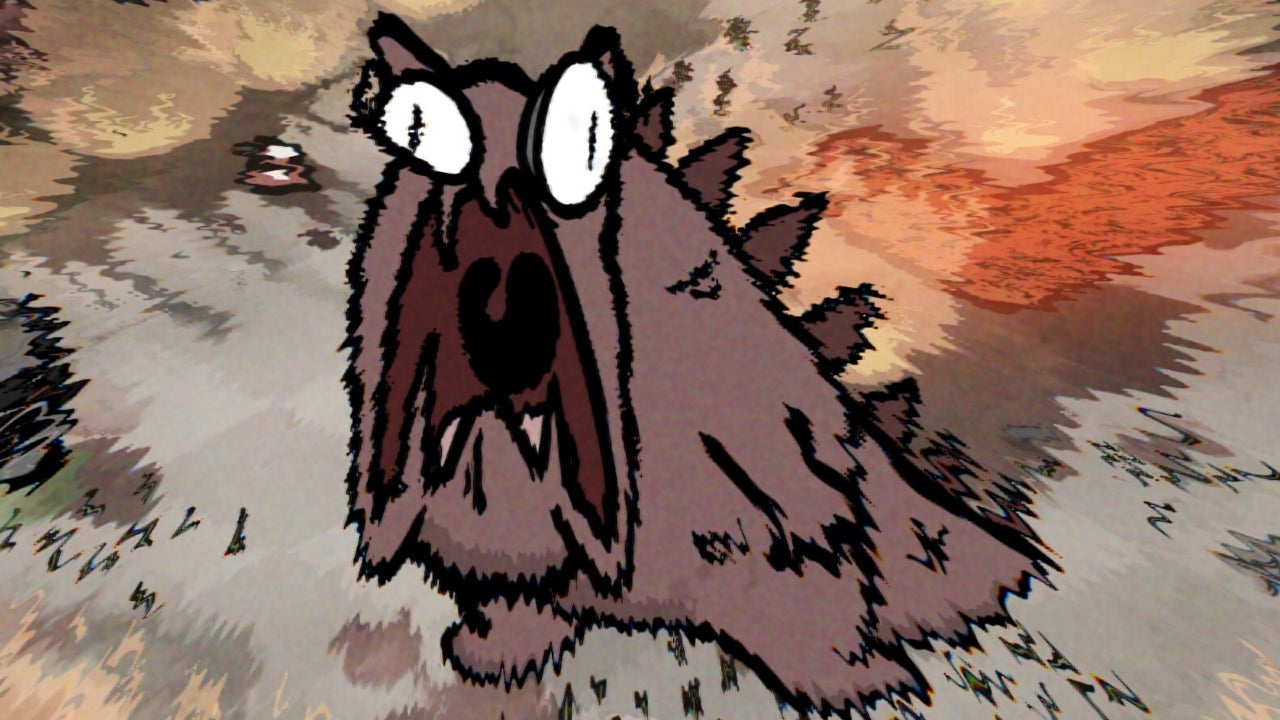
When you head out to one of the three acts’ adventure maps, which are all drawn in a jerkily animated, charmingly childlike style, you start with a single path that then branches off into two, each of which has two completely different stages packed with their own unique sets of enemies – so many you definitely won’t see them all even after several runs. You’ll definitely want to mouse over them and read their descriptions before diving into battle, because some of them have some extremely nasty tricks up their sleeves – including a few that can instantly and permanently kill a cat or infect it with a parasite that takes up a gear slot. The stakes are already pretty high given your cats are permanently injured every time they get downed, and can be outright killed if their body is destroyed by attacks or eaten by zombies, so you don’t want to get surprised if you can help it.
Each zone is also stocked with multiple bosses that range from powered-up versions of your own classes to huge, nasty monsters with their own creative game-changing mechanics, and one that’s basically just an evil Kirby. Yes, a few of them are annoying (I avoid going to Act 1’s Boneyard unless a quest demands it because that boss is a total jerk), but on balance they’re excellent battles that often make me think differently about how to manage my team’s turn order and abilities.
One thing that stands out to me about the structure of Mewgenics’ runs – aside from how they can take as long as two hours once you’ve unlocked all the zones (and some secret ones) – is that unlike most roguelikes, you rarely get to make decisions about the path you take between battles. You mainly get to choose between the default path and a harder one with better loot and one more battle to level up a cat in, and then very occasionally between two types of rewards (usually an equipable item or a piece of furniture for your house). That makes the between-battle encounters feel a little less interesting than in a lot of similar games, especially when the random encounters turn out to be basically a coin flip where you’re picking between a red pill or a blue pill, or pushing a button vs pulling a lever without any indication of which will give you a bonus and which will give you a debuff.
There are, of course, some more in-depth, multi-stage encounters where you’re picking between a set of options in a choose-your-own-adventure story where your chances of success for each one are determined by a cat’s stats. However, since the cat whose stats you’re working with is chosen randomly, there are two layers of luck involved before you get a shot at a good outcome. It often feels completely random, but that’s alright because so much of Mewgenics is doing the best you can with circumstances beyond your control.
During combat, there are so many different things in play that the interactions between cat mutations, passives, spells, gear, environmental modifiers, and enemies can get crazy complex, and figuring out exactly what happened – or predicting what will happen – can be like investigating a crime scene (often with just as much blood splatter). Why did that enemy pingpong between two trash bags, with each bounce doing one point of damage, until it died? How did one of my cats just straight-up eat a boss without me even telling it to move? Or, why did that giant Daddy Shark get to take another move and insta-kill my Cleric when I’d carefully placed him just outside what should’ve been his projected attack range? (That one stung.) All of those answers are in there somewhere if you know where to look and study the rules carefully. In one of those cases, it was related to – you guessed it – poop. The map does get chaotic when there are a lot of enemies and fire or plants or ice on the screen, but thankfully there’s a tactical view that usually clears things up… mostly.
Most of the time, if you think something might work, it will. Water and ice spells and spells will put out fire, water will conduct electricity and zap everything standing in it, that sort of thing. However, sometimes its rules aren’t super logical: a couple I’ve noticed is that robots are susceptible to bleeding, poison, and parasite infestations, and the Butcher class’s innate meat hook weapon can’t actually hook meat unless you luck into the right upgrade for it. But again, most of the time it works like you’d expect it to.
I do love when a powerful team dynamic emerges as you earn new skills (your choice from a random selection of three) or raise one cat’s stats after every battle. Recently I had a squad with a Monk who could toss out meat pickups that typically just heal the team, but when combined with a Butcher who can turn all of those meats into minion fly familiars and a Druid who can boost those flys’ stats and turn them into killing machines, it became a way to raise an army in a single turn. On another run I had a Cleric whose health regeneration applied to the whole team and an item that let me continually boost that regen multiple times per turn, allowing my Necromancer to run wild with a high-damage attack that also drained half of his own health. There are countless examples like this, and while you won’t win the lottery with a great combo every run, they happen more than often enough to make me excited about what might be next.
What’s a little frustrating when I’m planning out my moves in a tough fight where every action matters is that there’s no way to access a cat’s full character sheet while you’re in a battle, so you can’t see their list of mutations or all of their equipment’s full effects when you need that information the most. It’s almost all represented visually on your cats, at least, but you have to remember, for example, what a cat having a second head growing on its butt means. When the rules are changing so dramatically from run to run, I would love to be able to reference all of them at any time.
As if all of those variables weren’t enough, Mewgenics throws yet another curveball at you when it sends you on one of its story or side quests. Those all revolve around a unique and powerful item that changes the rules in a big way and telling you to take it to a specific zone. One of the most memorable gives you a five-second time limit for every action – and if you don’t make a move, the AI will take over and move for you. (I was glad I wasn’t playing that one on my Steam Deck because the controls there are serviceable, but not nearly as quick as with a mouse and keyboard.) Another shook things up by giving my cats random selections of abilities from every class when they leveled up, creating powerful hybrids that are usually rare. There are tons of these available, though it’s kind of a bummer that if you fail a side quest you don’t get a second attempt at that unless it randomly comes up again once you’ve paid enough cats. The story itself is pretty silly and light – don’t expect any Hades-style epics here – but good for a few yuks as you do the bidding of an incompetent mad scientist.
Another area where Mewgenics is truly exceptional is in its sound and music, which are fantastic in both big and subtle ways. It comes with a collection of original and hilarious songs that accompany each level and culminate in major boss battles that are designed to loop for as long as a battle takes, and there are multiple variations on each that include instrumental versions – your cats will even meow along to them sometimes. (My favorite is probably “Where’s That Smell Coming From?”) And those meows come from a vast selection of different randomly selected voices, including some celebrity cameos.
One of the best touches, though, is the crowd sounds. Mainly you’ll hear this after beating a battle: there’s cheering and clapping with varying enthusiasm based on how quickly you pulled off your win. That’s fine, but the best part is the shocked gasps when one of your cats is killed in action. That gets me every time – and trust me, I’ve heard it a lot.
Lastly, Mewgenics has a fun and surprising approach to the practice of “save-scumming,” where you quit out of a battle you’ve messed up and restart it with knowledge of what not to do. I won’t spoil what happens, but there are consequences if you abuse it. Thankfully, you do get some flexibility in case of a power outage or spouse demanding you stop playing that game you’ve been playing for 150 hours and do the dishes, and it’s kind of implicit that you have permission to save-scum once per run – and yes, I use it regularly.