
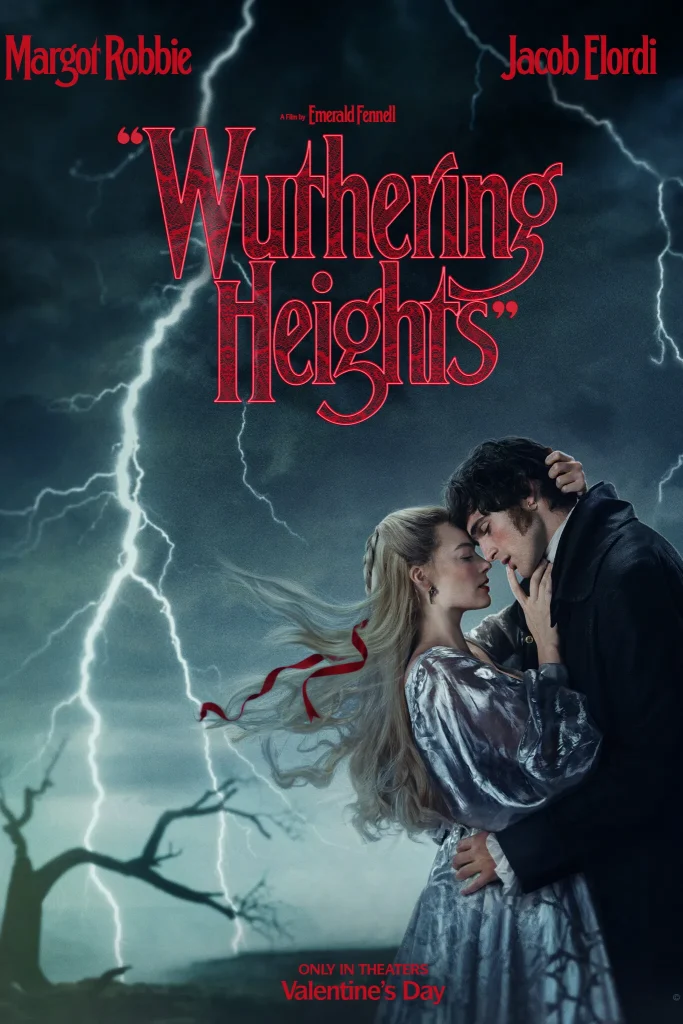
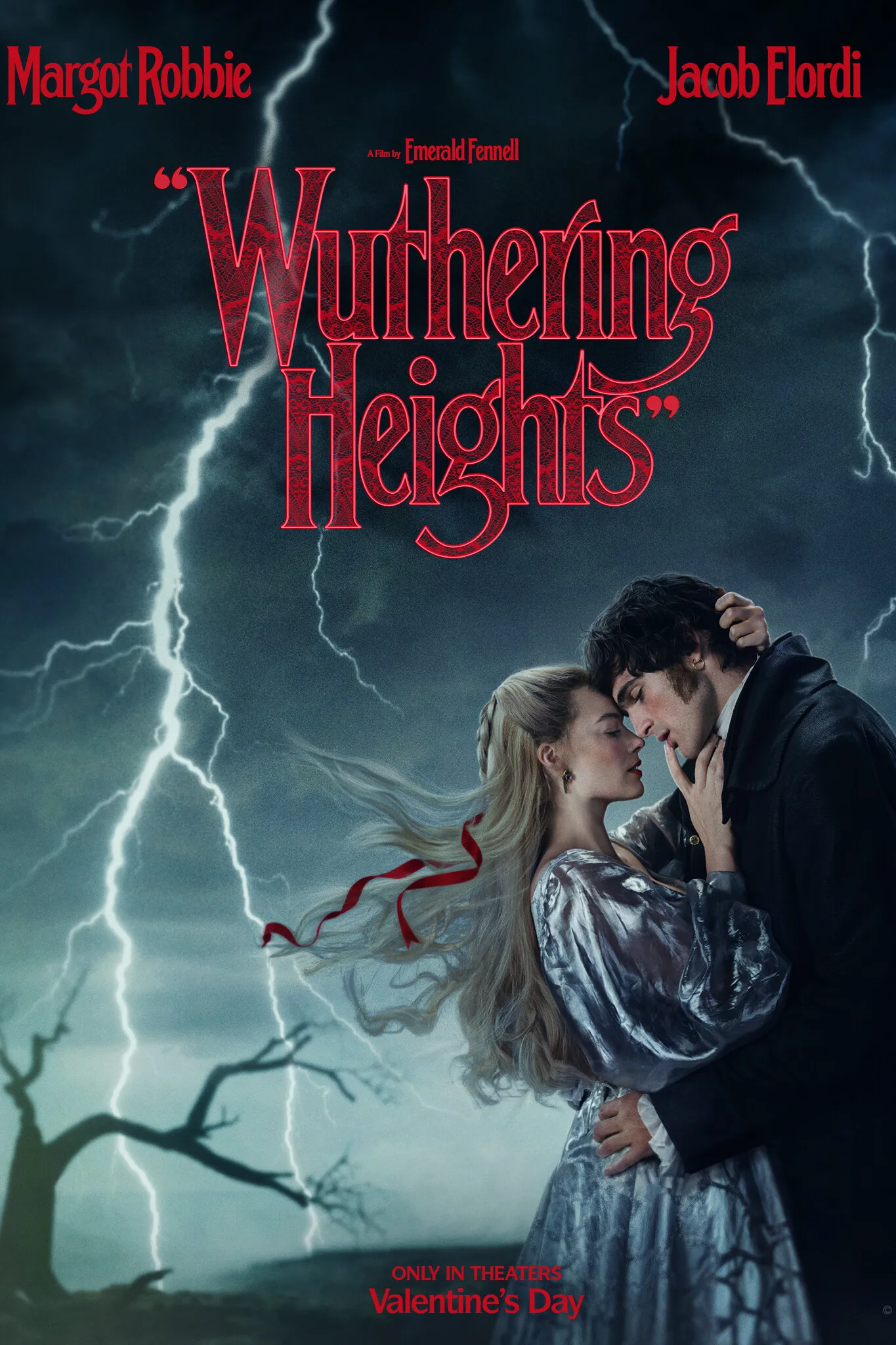
In 18th-century England, a tumultuous romance develops between wealthy Catherine Earnshaw (Margot Robbie) and Heathcliff (Jacob Elordi), a poor boy adopted into her family.
“I hated you, I loved you, too.” So goes Kate Bush’s lyrical interpretation of Emily Brontë’s twisted anti-love story for the ages. Set against mist-cloaked Yorkshire landscapes, Wuthering Heights is strongest at its most primal; where passion erupts from the great friction caused by wealth, greed, possession and deep-rooted, blood-boiling love. It’s a foundational text in mood and social critique that stirred controversy upon publication in 1847 for the cruelty depicted within its pages. And so it’s unsurprising that a filmmaker whose provocative work has sparked everything from an Oscar win (Promising Young Woman) to semen-bathwater-inspired candles (Saltburn) would sink her teeth into a big-screen adaptation.
This is the first time Emerald Fennell is not working from her own script, although a faithful retelling this certainly ain’t — unless there’s an earlier edition of Brontë’s novel which begins with a hanging man’s member ironically springing to life in front of a crowd of feral spectators. The film that follows is, thankfully, less concerned with shock value. We meet young Cathy (Charlotte Mellington), whose fragile and abusive father (Martin Clunes, a genius stroke of casting) brings home a local foundling to be a servant (played by Owen Cooper, with the kind of powerful pensiveness that proves his talent stretches beyond the Adolescence phenomenon).
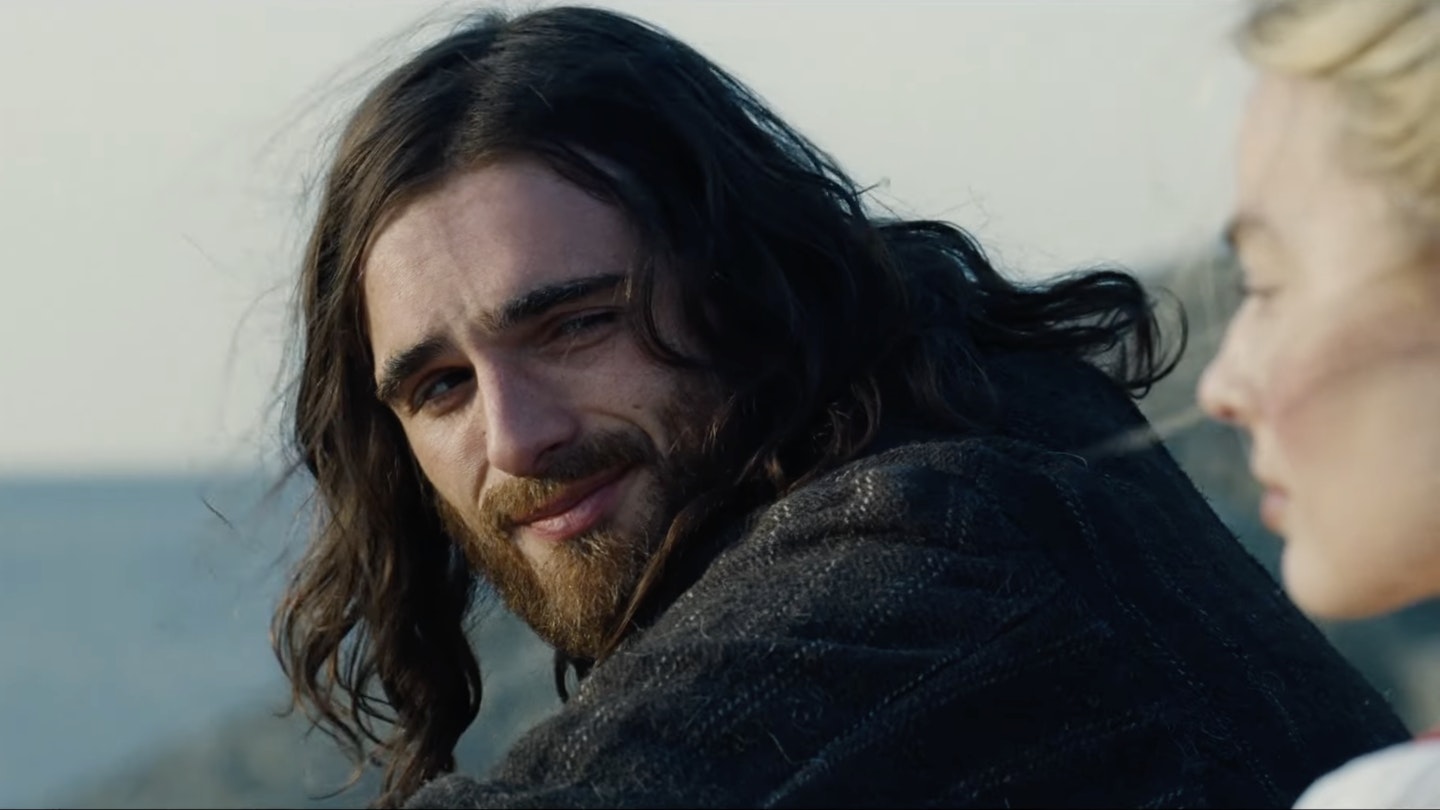
Coming to Heathcliff fresh from another intensely physical role (Frankenstein), [Jacob Elordi’s] gravitational pull is immense — a giant even set against vast soggy vistas.
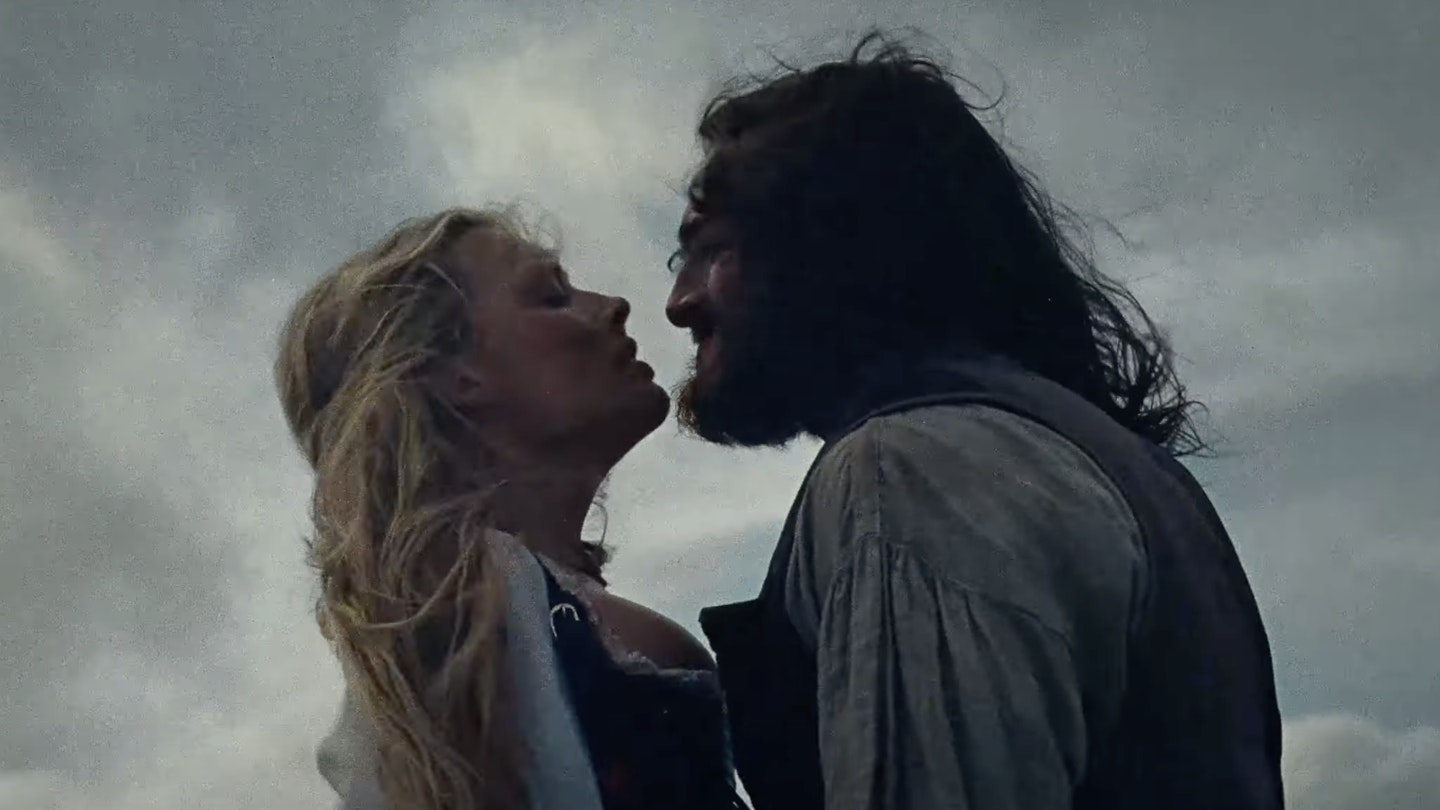
Before Margot Robbie and Jacob Elordi even enter the picture as adult Cathy and Heathcliff, we see Fennell’s filmmaking at its strongest. She summons gothic romanticism against the rough and wind-swept Northern terrain, and viscerally portrays the raw young love forged between the pair, before status and duty intervene. It’s refreshing to watch her work in a barren, near-wilderness environment, a desolate canvas in which Elordi and Robbie are given free rein to play.
There’s a bratty edge to this iteration of Cathy, Robbie playing her as a woman with priggish quirks. But her mannered take on the character somewhat jars compared to Elordi’s incendiary, guttural performance. Coming to Heathcliff fresh from another intensely physical role (Frankenstein), the actor’s gravitational pull is immense — a giant even set against vast soggy vistas. Somewhere in among the torment and testosterone are flashes of cruelty that we’ve seen Elordi unleash before, in Priscilla and Euphoria. As Heathcliff’s love for Cathy is, for a moment, dashed to the rocks, the actor skillfully switches between boundless desire, tenderness and something far flintier.
As with many great love affairs, the anticipation is the best part. Desperate to be rid of her noxious father and create a better life for herself, Cathy accepts the proposal of the wealthy and well-meaning Edgar Linton (Shazad Latif) and enters his opulent world. Here Fennell reverts to the energy of her previous films, conjuring a dialled-up, meme-able vibe, from the interior textures and bright colours to lavish PVC-enhanced costumes and Charli xcx’s string-electro-screaming-orgy score. It’s all satisfyingly sumptuous, but some of that megawattage eroticism that had been coarsing through the film suddenly feels diluted. (Kudos, though, to the live-wire presence of Alison Oliver, as Edgar’s simpering sister Isabelle, who steals every scene she is in.)
There is notably more plot to Brontë’s novel than in Fennell’s reimagining, and while the film doesn’t need a denser narrative, it could benefit from feeling more grounded — especially when Cathy and Heathcliff fight and fornicate like teenagers, ricocheting between lust and loathing. “I hated you, I loved you, too” is all well and good, but here the stakes become more subdued as style takes over. The film is undeniably expertly crafted, and Fennell — who has quickly risen to become one of Britain’s buzziest Hollywood exports — has certainly stepped up as a filmmaker in terms of scope. But had Wuthering Heights stayed closer to earth, the weight of this tragic romance would hit harder.
Fennell throws everything at this fever-dream adaptation, which massages the senses while showcasing Elordi’s ever-growing star power. If only its electrically erotic energy was sustained to the end.