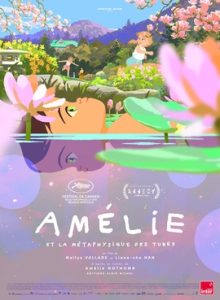

At the tender age of two, Amélie (voiced by Loïse Charpentier) — a Belgian girl living in rural Japan in the late 1960s — is roused from a vegetative state by a bar of white chocolate. Newly awakened to the world around her, the curious toddler, believing she’s a god, explores life’s joys and dangers.
Loved, feared, obeyed, revered, and yet existing almost entirely beyond the comprehension of us mere mortals, what is a toddler if not a sort of pint-sized god? In Japan, there is a belief that, until the age of three, a child more closely resembles the divine than the human. And in Oscar-nominated French animation Little Amélie Or The Character Of Rain, Liane-Cho Han Jin Kuang and Maïlys Vallade’s hand-drawn adaptation of Amélie Nothomb’s unconventional 2000 memoir, that belief is the animating force driving a rapturous 78-minute exploration of the world — in all its infinite beauty and unfathomable terror — as seen through the eyes of one such child deity.
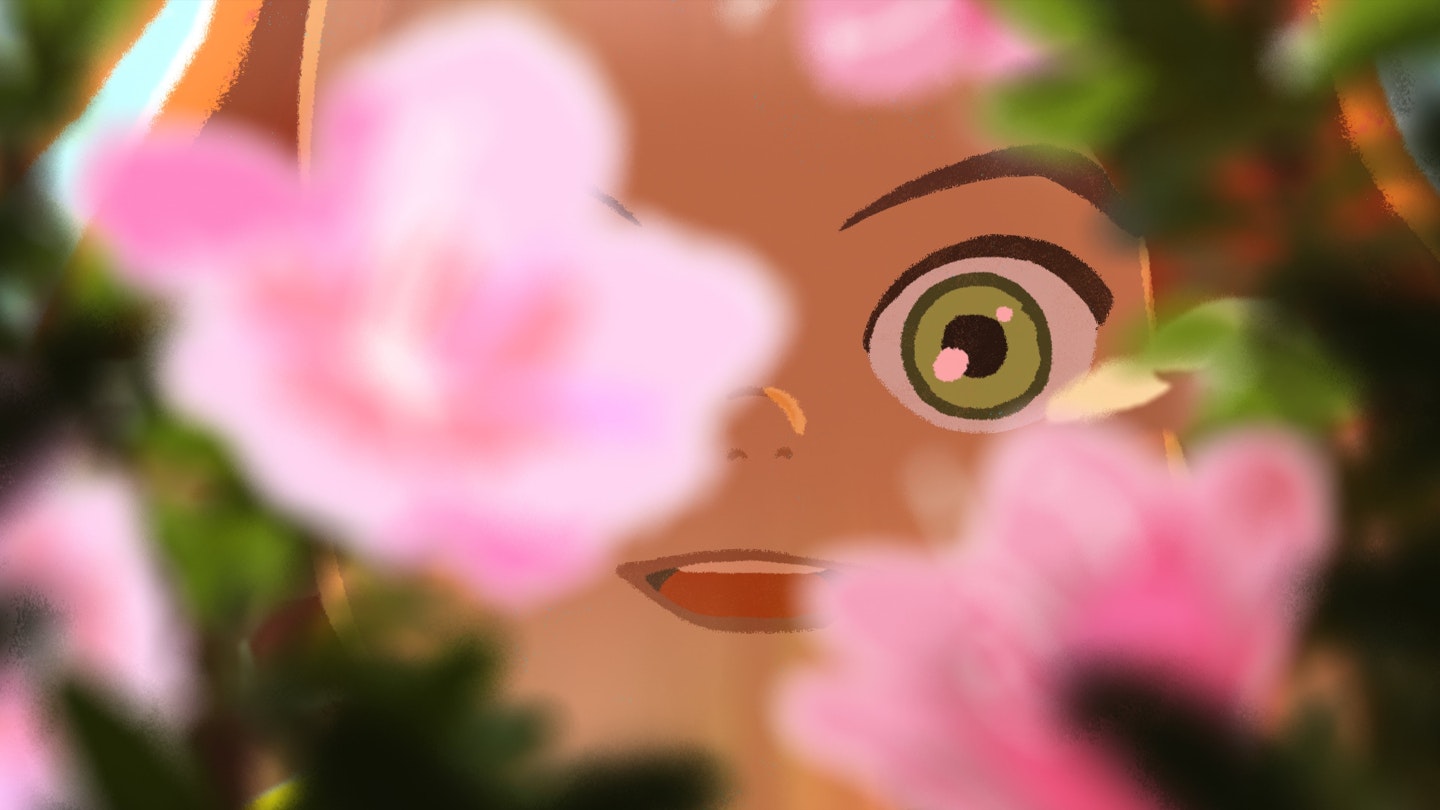
As you might have guessed, Kuang and Vallade’s movie is not exactly your average Bildungsroman. At its core, Little Amélie is a story about a Belgian child (that’d be Amélie, voiced by Loïse Charpentier) living in 1960s Japan. Having spent the first two years of her life in a vegetative state, Amélie finds herself awakened to the world by an earthquake, and then to her apparent godliness by a bite of grandma-gifted white Belgian chocolate. As her mother, father, and siblings marvel at Amélie’s sudden eloquence and observational acuity, the precocious toddler — hand-in-hand with doting nanny Nishio-san (Victoria Grosbois), shadowed by Mrs Danvers-like landlady Kashima-san(Yumi Fujimori) — dives into her new existence with wide, wonder-filled eyes.
Even when the film does touch darkness […] there’s an abiding softness to Little Amélie’s line-light animation, an authentically child-like internal logic guiding the writing, that shines through.
Through vivid, watercolour-style 2D animation, Little Amélie visualizes the malleability of childhood memory in its form while celebrating the tangible magic of childhood in its content. While there is no shortage of films about being a child out there, few capture the experience quite like this one. Whether we’re witnessing Amélie’s slack-jawed discovery of “disappearing machines” (vacuum cleaners), marvelling alongside her at the flowers blossoming in her family’s Edenic garden, or seeing star-like lanterns glow at Nishio-san’s side, the movie’s bright pastel palette and painterly soft edges invite us to reconnect with the innocence of youth — to recall a life unburdened by age and experience. Even when our mini deity’s more Old Testament inclinations surface, as in her comical disdain for carp and her brother André (Isaac Schoumsky), it’s fun to remember what it was like to be furious at trivial things.
For some, the movie’s overwhelming commitment to its own joie de vivre and unapologetically sentimental streak may come off as twee. But Little Amélie’s world — shaped, as with all gods, in her own image — isn’t all sunshine and rainbows. Rather, when the film does touch darkness — as in narrative episodes where Amélie encounters grief, questions death, and is confronted with how World War II continues to haunt her Nishio-san and Kashima-san — there’s an abiding softness to Little Amélie’s line-light animation, an authentically child-like internal logic guiding the writing, that shines through. A scene in which Nishio-san explains the horrors of bombing raids to Amélie via a rice cooker, familial separation crudely but accessibly symbolised in violently parted grains, is a real stand-out.
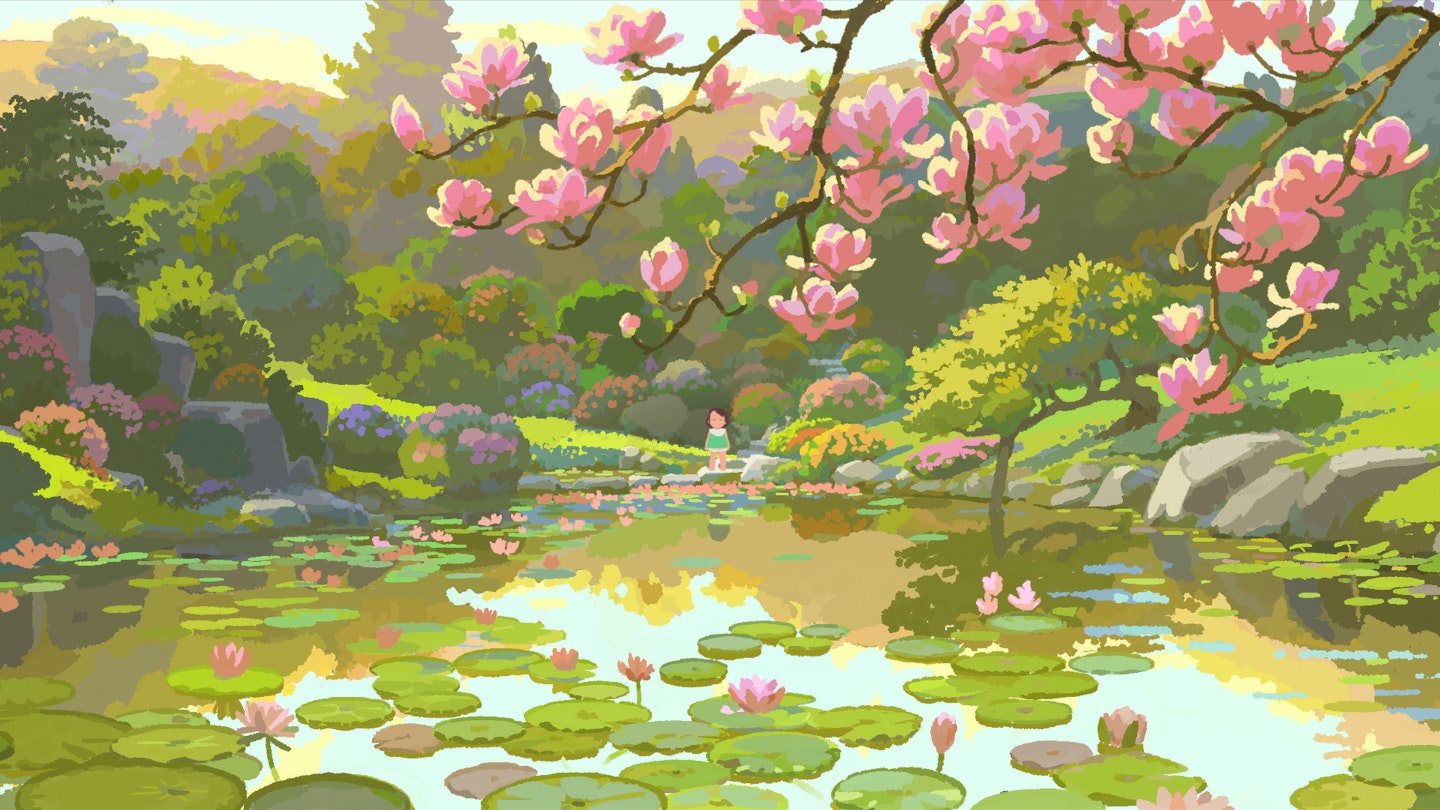
Perhaps part of the key to the success of Little Amélie’s tonal balancing act is its embrace on a foundational level of its East-meets-West positioning. Kuang and Vallade’s previous work in the art departments of French animated offerings The Little Prince, The Illusionist, Long Way North, and I Lost My Body guide their aesthetic sensibility towards the Impressionists and Monet. The movie’s rural Japanese setting, narrative elasticity, and magical-realist approach to youth and memory, though? Well, that is where the influences of Hayao Miyazaki’s My Neighbour Totoro (there’s more than a touch of Totoro‘s Mei in the similarly strong-willed Amélie), Isao Takahata’s My Neighbours The Yamadas and Only Yesterday, and Mamoru Hosoda’s Mirai can be most keenly felt. It’s in the nooks and crannies between these myriad points of reference that Little Amélie moves, however, and to thrilling effect.
The film builds at its own leisurely, lilting pace, ultimately towards a life-changing event in our young hero’s life: her third birthday. Three is an age, explains our infinitely wise narrator, where “you see everything and understand nothing”. It’s an age, too, where the realisation dawns upon Amélie that while she may not in fact be God after all, she is most assuredly, emphatically, and uniquely human — just like her beloved Nishio-san. And what is that, Little Amélie contends and its little Amélie embodies, if not divine?
A beautifully hand-crafted love letter to childhood, self-discovery, and the life-changing power of really good chocolate, Little Amélie is 78 minutes of pure animated joy that welcomes one and all.