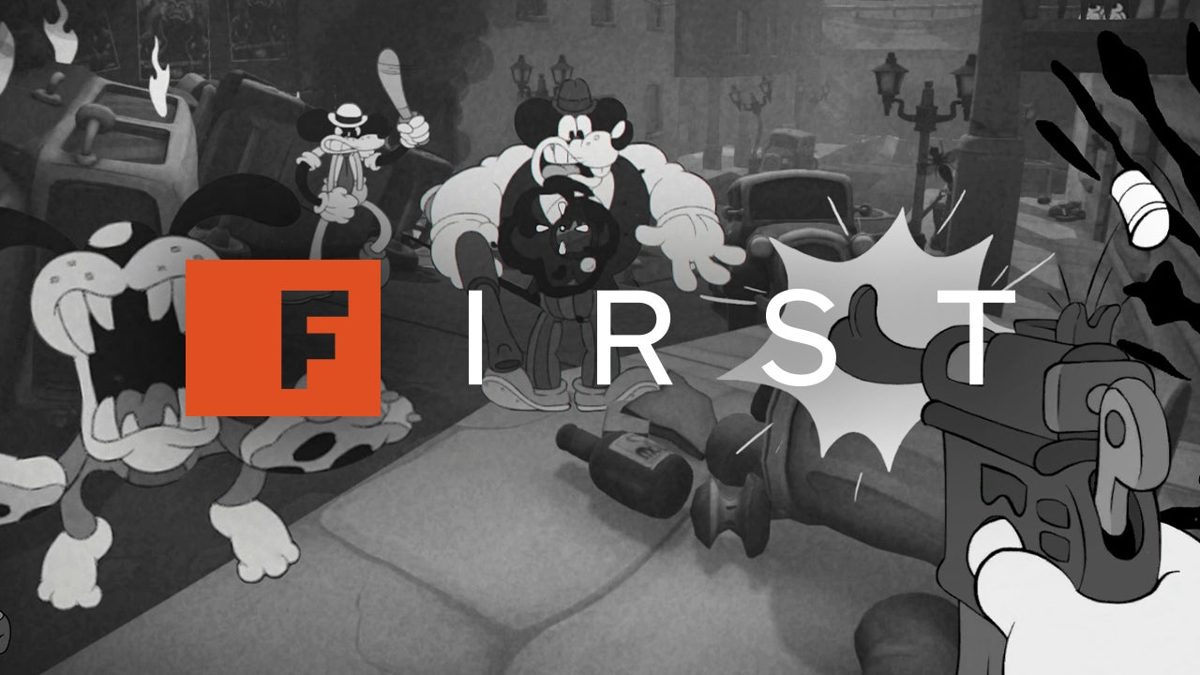


As our exclusive, all-February-long IGN First “cover story” on the upcoming black-and-white, hand-animated first-person shooter MOUSE: P.I. for Hire continues, we wanted to learn more about the origins of its unique 1930’s rubberhose-animated style. And so we sat down with Fumi Studios CEO and Founder Mateusz Michalak as well as Art Director and Lead Animator Michal Rostek to go behind the scenes of this unique game. Read on for a lightly edited transcript of our conversation, or watch the video version below. And you can wishlist MOUSE on Steam if you’re interested.
IGN: What came first here, the idea for the game itself or the desire and idea to use this 1930s Rubber Hose animation style?
Mateusz: Yeah, I think this is the question more for Michal right now because he was one of the original creators and the guy who created the first art for the MOUSE.
Michal: I came from the animation industry and I’m really passionate of the animation and especially of history of animation. The MOUSE is like my little passion project that I started inside of my regular animation work. When we started to make video games, I came into the matter with the idea of the boomer shooter with the style of the 1930s Rubber Hose animations, and he loved that idea and give this idea opportunity to make it happen. We started with five people on the small team of this project. Our programmer put a video of making the game on TikTok then it goes viral and resonates all around the world. I remember that day when I was going to work and met my friend in the subway and he told me, “Hey, I read the article, the gaming website, that some guys make a game that looks like the game that you want to make.” And I said, “Really?” “Yeah.” Then he showed me the article and that was MOUSE.
Mateusz: Yeah, I can add that from the beginning. It was passion project. We’ve done most of the work after hours. We started prototyping the game. The first prototype that Michal showed to me was really, really basic. Then we hired a coder/programmer, David, who joined the team and we started the first full small production and the game came out of this small teaser that he showed on TikTok.
IGN: That’s cool. So my next question, was it always going to be black and white or was color in this animation? Was that a debate at all amongst the team?
Mateusz: It was never a debate among the team. It was debate in the community because when people first saw the art or the trailer, they thought, “Okay, it’s quite original, but you need color.” Because no one ever made an FPS cartoonish game in fully black and white. It was something unusual back then, but we sticked with our roots in our original design and we never wanted to add any color. It’s challenging. It’s really challenging, especially in player guidance, in patch finding because you can always add a yellow color if you have a color in game or any other color, and I think that we’ve done a pretty good job. It was really, really challenging. We learned a lot of new skills, managing only basically two basic colors, black and white.
IGN: Help me understand how much of this, of the animation of the art, was done by hand?
Mateusz: I think all the animations that you can see in the game are done by hand. It’s not easy process, but having computers right now, we can speed up some elements in the whole pipeline. Of course, we used techniques from the 1930s, 1940s Rubber Hose techniques. But having computers, we could speed up the whole process. It was much, much nicer and we could basically see our effects not instantly, but quite fast in the game. So if you would use the old techniques, so using paper, pens, scanners, and so on, the whole process would take not months, but years. And in the game development, they don’t tend to wait for games, they want games right now. That’s why the whole development process of games is shortening every year and we couldn’t tell people that, “Okay, you saw teaser, then you need to wait at least 7, 8 years to see the final product.” That’s why we used computers. And I think Michal can say something more about the whole pipeline of the animation.
Michal: Yeah, so the animation pipeline is really similar to the pipeline that we use in the animation industry because game is based on animation. So it’s really similar but not 100% the same. So for example, we started with the concept that we took from the design department. They’re giving us a idea and we made our first concept arts for the character, for the NPC, for the weapons of the game. And then we came to the process that, in the film industry is like a storyboard process when we made a limited animation to put in the game and look how this work.
And if it’s good, it comes to the animation process when we put the life on the animations, on the characters, on the weapons and all of the interactive elements in the game. Then to clean up process, when we clean all the outline to not look rough, but to look good, put the colors on it, and the last final step on making animation for the game that is different than making animation for the film is to render all of these things, put it in the engine and pack it and make the magic go on.
IGN: Michal, were the weapons the most fun thing to animate in the game because for me, what I’ve seen and experienced of the game so far, I mean it’s all gorgeous, I just love the entire look, but the weapons, I just love how alive the weapons are.
Michal: Definitely, it was a very fun thing to do, but for me, one of the most challenging things. And we couldn’t make such a great design, such a great animations without our two animators and with our two artists, Abraham, who made the great concepts for the weapons on the game and Igor who animated all of the things. So it was also credits for our game design who put all the mechanics, all the specific timing for the weapons to look good because this is one of the things that we need to focus when we making animation for the video game is that it should fit the mechanic, it should fit the interactive aspect of the game and do it in the… right tempo because when you have a game hardly based on the animation, they should look good, but also be useful for the player and not be player shouldn’t feel frustration when he uses an animated gun.
IGN: How did the animation influence the tone of the game? It seems to lean a little more playful and I’m just sort of curious how you guys balance that of matching the animation to the tone of the game?
Mateusz: Animation, it’s crucial for the whole game, so it’s connecting also with the whole narrative element. It’s like when they think about MOUSE, they think about animation, they think about art and it’s a really great thing because we have a hook, we can hook them, interest them in the game. But beneath that, this art animation elements, there is a deep vibrating story and I believe that we’ll surprise a lot of people when they will play the game.
IGN: So you talked about the engine earlier. You guys are using the Unity engine here underneath the animation system. How much custom work had to go into Unity to get it to cooperate with the uniqueness of what you guys are doing with the animation?
Mateusz: The first prototype, however, the first prototype was done in Godot, but the proper development is we are doing in Unity. The unity is really good in managing the 2D animation sprites, it’s really good. But our game has thousands of thousands of animations and this was the most challenging part because still, you can put as much assets in the game, 2D assets, as you can, but your game can grow having 200 gigabytes, 300 gigabytes. So the most challenging part was the optimization process of the whole animations and we needed to develop a special tools that will compress 2D animations to have a better performance for the whole level because there is tons of animations, different kinds of animations through the whole level.
IGN: Can you talk about, on a similar note about if there were challenges of using 2D animations in a 3D game? We don’t see that very often. I imagine that had to present some sort of challenge either in the animation itself and maybe the level design as well.
Mateusz: I think it would be much easier to make everything in 3D. The most challenging part, managing 2D assets, especially enemies in 3D space is to animate all directions. So we need to animate front, front left, left side, back left, back. All the bosses, all the enemies, every skills, every objects, so not objects, every enemies, bosses and some interactive objects, they are animated in 9 or 8 directions. So it was challenging and really time-consuming. Also, having 3D animations, it’s much easier to add every bit of animation to the game. Having 2D animations, we needed to think really carefully what we want to add because we don’t want to spend weeks animating things and then we will just delete our work. We wanted to have the whole 2D animations into the foreground, not in the background. So we use flat colors as in the old Rubber Hose animation. So there are all flat colors and you can spot really easily every 2D animation, walking around the level. Either this is enemy or 2D animation objects, interactive objects, you can’t really easily spot it.
IGN: I have to imagine that this project has been more difficult than maybe you initially thought. And I only say that because I mean making any video game is clearly not an easy thing, but nobody else does this. You guys are the only studio making a game in this way. So how much more difficult, how have you found the process over time? Have you really, I imagine you’ve learned a lot in the course of development.
Mateusz: We made a lot of mistakes, a lot of mistakes. And going back and forth, back and forth with numbers of things. I think that there are few FPS games that using sprites or using to the animations, but I think our project is unique that we are using a lot of frames, a lot of images in our animations to show that the Rubber Hose animation style is really unique and the whole animation is really unique. And I know that right now there is a debate if hand skills not be useful in the future or they will be replaced with some tools. I believe, and I think that we showed it, that having a great hand skills, having a great artist, it’s only beneficial for your game and the project itself.
IGN: I’m curious as to maybe this might be a good one for Michal, your inspirations for this because Cuphead, I think of very quickly, for obvious reasons, the other really amazingly hand-drawn game, totally different kind of game of course than your boomer shooter, but I also, I get a little bit of Who Framed Roger Rabbit from this too. I’d be curious to hear your inspirations.
Michal: I think the biggest over overall our inspiration, our biggest inspiration is the Rubber Hose art style as a whole. Our biggest inspiration is the animations from the Fleischer Studios, the people who create such a characters as Betty Boop, Popeye, Coco the Clown, or Bimbo the Dog. Fun fact, we probably watched every available Popeye episode during the pre-production, took the best inspirations for the environments for the characters. But also how they inspired by works of Ub Iwerks. He was a lead animator in Disney. He was animating for example, Steamboat Willie but then he became a solo animator and became a solo career and make characters such as Flip The Frog or Willie Whopper, but also other animation studios for that era. Like for example, Paul Terry, Charles Mintz, but also the old cartoons that were quite violent for that era. But it was a good inspiration for the combat and fight for our game. So we took a lot from them.
IGN: Awesome. The last question I have for you guys, maybe for either or both of you, so now you’re almost there. The game is nearly complete, it’s almost out. Moving forward, do you guys want to stick with this animation style for your next project or was this a one-time fun experiment, fun project or is the Rubber Hose animation going to be the Fumi Studio signature moving forward?
Mateusz: I think that the overall hand-drawn style will be our studio signature. I believe in the craftsmen of artists and I think that we will surprise people in the future with our next project.
Ryan McCaffrey is IGN’s executive editor of previews and host of both IGN’s weekly Xbox show, Podcast Unlocked, as well as our semi-retired interview show, IGN Unfiltered. He’s a North Jersey guy, so it’s “Taylor ham,” not “pork roll.” Debate it with him on Twitter at @DMC_Ryan.