

This article includes mild spoilers for the Rhodes Hill Chronic Care Center section of Resident Evil Requiem.
With Resident Evil turning 30 this year, it’s no surprise that Requiem leans into nostalgia. Leon S. Kennedy is back in a starring role, and the game’s trailers feature ominous shots of a crumbling Raccoon City police station – the labyrinthine haunted house that our floppy-haired hero had to fight through back in 1998. But while this latest edition of Resident Evil features its fair share of direct nods to the past, it’s Requiem’s new ideas that actually feel the most nostalgic.
The story’s early sections, in which you play fresh-faced protagonist Grace Ashcroft, are where Requiem most successfully evokes the earliest days of Resident Evil. Despite using the series’ modern first-person perspective by default, it’s classic ‘90s survival horror in the truest sense, right down to the ink ribbons, should you wish. The building that Grace explores, the brand new Rhodes Hill Chronic Care Center, is a next-generation echo of Resident Evil 2’s Raccoon City Police Department, complete with a puzzle-locked exit and deadly stalker prowling the halls. As much as it relies on the triumphs of the past, though, this RPD tribute demonstrates the timeless qualities of Resident Evil, and how the old hits can be made to feel like modern breakthroughs.
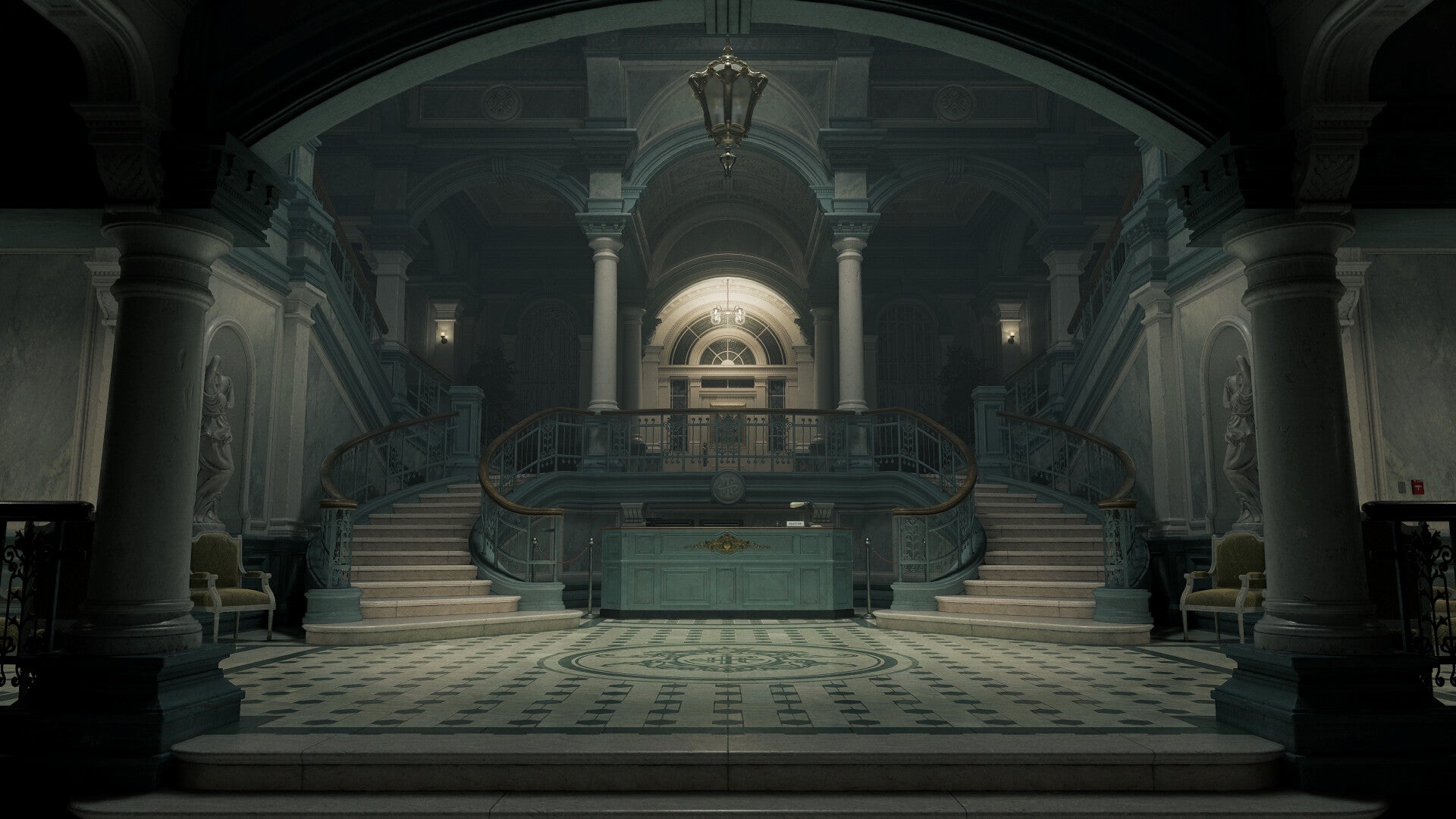
Within just a few steps, it’s clear that Rhodes Hill takes all of its foundational cues from the RPD. The first locked door you encounter yields only to an ornate key. Around the corner, a metal shutter prevents access to the wider facility, the nearby empty fusebox signalling that you’ll need to find a replacement component to progress. Beyond awaits a reception desk flanked by sweeping stairs, the very model of Raccoon City’s extravagant main precinct. And, like Resident Evil 2’s classic location, Rhodes Hill is split into two halves, the west and east wings, through which you need to scour eerie chambers – many of which must first be unlocked using a steadily mounting collection of keycards – in search of a means of escape.
Requiem, if it’s not clear by now, is less reverential to Resident Evil 2, more indebted to it. That’s thankfully not too much of a problem when developer Capcom owns the original bank of ideas, but it does walk the knife-edge between remake and reimagining just a little too dangerously at times. For instance, the center’s final exit is unlocked using a trio of quartz cubes, each dispensed by ornate machines upon solving a three-symbol puzzle. Yes, it’s the RPD medallion puzzle in an ill-fitting mask.
And yet this approach never feels like creative bankruptcy, nor does it feel like cynical nostalgia. That’s partly due to Capcom’s original survival horror formula having endured the test of time – Resident Evil 2’s fundamentals felt as fresh in the 2019 remake as they did two decades prior – but mostly because Rhodes Hill is arguably the strongest version of this environment format that the series has offered up since we visited the RPD. More expansive than both the Baker Estate and Castle Dimitrescu, and possessing a myriad of interesting loop routes and shortcuts, navigating its corridors is a fully engaging experience, regardless of whether you recognise the rough outline of Raccoon City’s police station or not.
The facility’s layout and the way you engage with it are undoubtedly classic Resident Evil, but Capcom isn’t afraid to bring some subtle modernity to the proceedings. Requiem pulls a trick I’ve never seen in a Resident Evil before: many of the center’s zombies are genuine characters, rather than generic enemy fodder. There’s the broad, burly chef whose methodical chores have you second-guessing your route through the kitchen. Out in the adjoining corridor, there’s the man I know as “Flick”, who obsessively turns the lights on and off. Elsewhere, a rotting maid continues to scrub the floors, moving from room to room to clean up all the blood I’ve spilt. And above the dining room, a would-be opera star warbles from the balcony – a shrill sound that sends one of the centre’s noise-sensitive patients into a murderous frenzy.
Such distinct personalities are made possible thanks to Requiem’s emphasis on old-school survival horror. Despite the Resident Evil 2 homages, playing as Grace feels more akin to exploring the Spencer Mansion in Capcom’s bold 1996 original. This is a brutal environment where avoiding confrontation is the much smarter play (especially since, in a nod to the 2002 remake, defeated zombies can return to life as much more aggressive “Blister Heads”). But where the comparatively simple original Resident Evil often saw you fleeing threats and running past zombies, the more advanced enemy AI systems of today mean Requiem adopts a more stealthy approach, encouraging you to cautiously tiptoe around foes – something horror games in general have adopted over the past decade or so.
By shifting the engagement style away from careful shooting gallery to tense stealth, the environment requires far fewer enemies, thus allowing the development team the time and resources to make each zombie feel unique. And, since your tasks have you looping and backtracking through the building, you repeatedly sneak by the same zombies, contributing to the sense that you share the space with very real (albeit also very dead) people, rather than a bus load of replicated video game assets.
This approach lends Rhodes Hill a very different atmosphere from any other Resident Evil location, including those that await in the second half of Requiem. While there is admittedly a comedic element to these creatures retaining elements of their living personalities, it’s also unnerving, and the idea of contending with a person rather than a faceless enemy is inherently more frightening – that’s part of what makes the series’ stalker characters, like Jack Baker and Mr. X, so scary. He may wear that funny little hat, but you’d never dare to stop and laugh at it. Requiem’s retooling of the atmosphere here is proof that honing that iconic survival gameplay is as much in the immaterial as it is in the physical things you do.
Of course, Capcom knows that characterful enemies are no replacement for terrifying stalkers, and so Rhodes Hill has a couple of its own. First up is “The Girl”, a towering, gangly, bug-eyed hag that ensures your first impression of the Chronic Care Center is suitably horrifying. Later, you’ll have to contend with the east wing’s guardian, “Chunk” – a colossal, baby-faced, hallway-filling mound of flesh that moves faster than his weight should logically allow. Both operate in the classic stalker fashion of prowling the corridors and dynamically impeding your progress. There are interesting alterations to the formula, with The Girl using Alien: Isolation-style hidden pathways to take you by surprise in a manner Mr. X could only dream of, but these enemies are undeniably adhering to the horror playbook originally written for 1999’s Resident Evil 3 and its relentless Nemesis.
Unlike Nemesis and his more modern relatives, though, one of Requiem’s stalkers isn’t an invincible obstacle. Against all odds, the gargantuan Chunk can be killed, removing this terrifying chess piece from the board. Such a feat is a tall challenge… well, for Grace at least. Leon is much better equipped to take down not just Chunk, but all of Rhodes Hill’s zombies, and his arrival on the scene following Grace’s lengthy expedition makes for a fascinating spin on one of Resident Evil’s most beloved classic features: the dual playthrough.
The series’ early games put a lot of emphasis on playing through the story twice, seeing the same environment from two different perspectives. Exploring the first game’s Spencer Mansion is a notably different experience depending on whether you play as Jill Valentine or Chris Redfield. Capcom would remix this approach for Resident Evil 2, using the “A/B” playthrough system to ensure Leon and Claire’s runs through the RPD had interesting differences. While Requiem doesn’t adopt this idea wholesale, you can see the shape of it when Leon arrives on the scene. After tiptoeing around Rhodes Hill as Grace, carefully picking your battles and conserving ammunition, you get to explore the area again as the practically superheroic Leon. With a new move set seemingly modelled after John Wick, Agent Kennedy can blast, kick, and hack his way through all the zombies that previously saw you fleeing for the safety of the well-lit safe room.
This switch is undeniably cathartic. Because the location remains in situ, all the problems you encountered as Grace can now be tackled head-on by Leon. Those Blister Heads that were clogging up the lounge and forcing you to take the long route? A shotgun blast to the lumpy face will make you feel better about all the trouble they caused you. Leon’s deadly arsenal can make short work of that burly chef, turn Chunk into a puddle of mush, and break open locked cupboards that were inaccessible to Grace. In short, Requiem is able to use the same location to offer a completely different, complementary experience by shifting the perspective and toolset.
If it weren’t for the fact that Leon’s time at Rhodes Hill was so brief, I’d say this was the ultimate version of Resident Evil’s dual playthrough idea. As it stands, it’s simply the best idea of it – which still means his swift, bloody crusade through what minutes earlier felt like the most frightening place on Earth is one of Requiem’s high points. A peak rooted in a classic idea, but elevated by a modern twist.
It’s that philosophy that makes the Rhodes Hill Chronic Care Center work so well: this is classic Resident Evil at its most nostalgic, but rendered with the full knowledge that the past isn’t quite enough to create actual magic. The injection of subtle modern ideas, from Leon’s action-fuelled retread of the halls to the characterful zombies and increased emphasis on stealth, elevates the series’ greatest hits, making it feel like experiencing them for the first time all over again. Rhodes Hill may deliberately evoke your cherished memories of the RPD, but by galvanizing the old with the modern, Capcom has made the ultimate tribute to the past: something new.
Matt Purslow is IGN’s Executive Editor of Features.