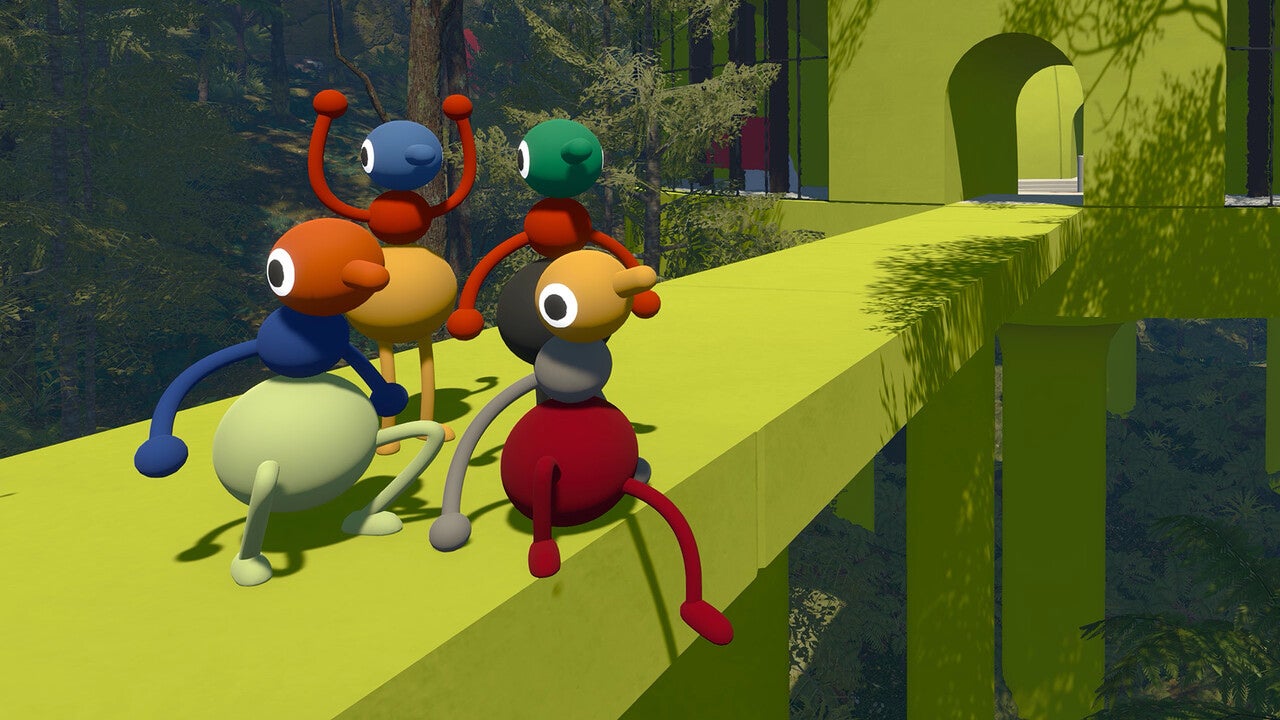


If the absurd silliness of 2019’s Untitled Goose Game is the type of thing that floats your boat, then the upcoming multiplayer puzzle game Big Walk by the same developer should rank pretty high on your list for 2026. This wacky adventure occupies the growing number of games lovingly dubbed “friendslop,” in the same vein as Lethal Company, R.E.P.O., and most applicable here, Peak, making use of proximity chat and goofy gameplay to create memorable times with friends. And if the opening hour is any indication, then Big Walk stands a strong chance of capturing the attention of those, like myself, who will happily jump online to joke around with their buds during some low-stress shenanigans.
Big Walk is a cooperative puzzle game meant to be played with friends that emphasizes creativity, silly scenarios, and limited communication options as a core game mechanic. Unlike many games in this genre, you’re not stuck in a survival horror scenario, but instead solving a series of increasingly challenging puzzles that require your team to work as a group. Playing as weird, birdlike creatures, you’ll run around searching for oblong key items hidden throughout the island, tackling puzzles that have you doing things like describing hieroglyphs to your friends while they enter them into a codepad, or stacking up on top of one another like a circus troupe in order to get to areas unreachable on one’s own. The goofy and low-stakes nature of these obstacles means that, if you’re anything like my group, you’ll spend most of your time messing around and making very little progress while you crack jokes and come up with lore for the completely unexplained and odd world you find yourself in.
Talk About It
Like other multiplayer-focused indies of its kind, you’ll be limited strictly to proximity chat and won’t be able to hear your co-op partners if they’re standing more than a few feet away, so will have to make use of signs, hand signals, and other non-verbal forms of communication. This creates some unique hurdles, especially when players are required to split up to solve a puzzle. For example, in one scenario where one player had to hold down a button while I ran a long distance away to grab an item that was only accessible while said button was being held, my teammates had to keep an eye on me with binoculars so they could verify that I’d recovered the item.
To help ease the communication limitations, a whole bunch of the controls are dedicated to your character moving their arms about, including raising them in the air, holding them out at your sides, or pointing directly forward, and individual buttons are assigned to your left and right arm as well, allowing you to get quite specific with the different combinations. All of the puzzles placed before us in this demo were simple enough that we weren’t really required to get fancy with hand signals, but I could see the building blocks there that could lead to more complicated scenarios.
Stick Together
It’s also notable that in my time with Big Walk I encountered no puzzles that could be solved without the assistance of my companions, which I learned early on after becoming separated from the rest of the group and stumbled upon a puzzle and tried to solve it myself, only to quickly discover that I needed at least two players to complete it. Not only is solving puzzles with friends just fun to begin with, but I think it’s a good decision to make it so your friends can’t take off in different directions and make progress on their own, since it meant I never had to worry about missing out on any of the puzzle solving if I got lost or stopped to smell the roses while the others forged ahead.
In fact, puzzles actually change dynamically to fit the number of players in your party, from 2-4. For example, one puzzle requires everyone to stack on one another to reach a button located high up, and the height of that button is adjusted relative to the number of teammates you have. In another area, our prize could only be acquired when all four of us hit four buttons at the same time, and the number of buttons that had to be pushed simultaneously was determined by our player count. These examples are obviously quite simple since I effectively only played through the tutorial area, but I really like the idea that the participation of everyone on the team is required to make progress, and could see them coming up with some really devious challenges that require everyone taking on a vital role, overcoming communication obstacles along the way.
Low Stakes
Aside from solving puzzles, you’ll also find things in the world that seem intended purely to waste your time, like one area where we found a paintbrush that allowed us to change the color of various parts of our weird bird characters’ bodies, and another where we found an odd rest stop of sorts, which had no puzzle to speak of, but played some chill jams and provided a nice view to admire. In a game that relies so heavily on creating silly memories with your friends, it’s great to see how apt Big Walk is when it comes to knowing when to slow things down and give players an opportunity to be childish dorks. We definitely took the developer up on every chance they gave us to do just that, and much of the joy from our demo came not from any novel game mechanic, but from us finding our own fun within their bizarre sandbox. At least in this short demo, they did a really great job at making room for this kind of fun, and it was surprising just how quick all four of us fell into a comfortable state of juvenile behavior. It’s the kind of pure, good-time nonsense vibes that we just don’t see enough of these days.
The premise of Big Walk might seem like it won’t have staying power, and that’s because it probably won’t. The whole thing is roughly 10 hours long according to developer House House Games, and none of the puzzles change aside from adjusting to your player count. But a lack of longevity or replayability isn’t such a bad thing with games like these, where a few amusing nights with your friends is well worth the time invested. I think of it a bit like doing an escape room – you likely won’t have a reason to return to the same collection of puzzles more than once, but it’s the kind of unique experience you’re unlikely to find elsewhere. In an era where more and more games are asking for absolutely every minute of our time for years and decades to come, I really relish the opportunity to play these bite-sized adventures that leave a lasting impression and then let me move on with my life (Don’t worry, GTA V. I still love you, baby).
I should also mention that the build of Big Walk I played was running on a (wait for it) Mac Mini. That’s right – A. Mac. Mini. Look, it’s not like this goofy co-op game could be even remotely demanding on hardware, since you’re mostly just hopping around and stacking on top of one another, but it’s still pretty impressive just how approachable this game seems to be, not just in terms of gameplay, but by the low barrier of entry in terms of the hardware you play on. For that reason, this might even be a good option if you’re looking to play with friends and family who aren’t normally into video games. After all, goofing around as a weird bird creature seems like a pretty universal kind of experience.
After a very memorable first hour, I’m absolutely sold on this as the next friendslop for my crew and I to jump in on. If it managed to be this enjoyable when all the puzzles were super simple, I can only imagine how ridiculous and memorable it’ll be when they introduce more complicated scenarios.