
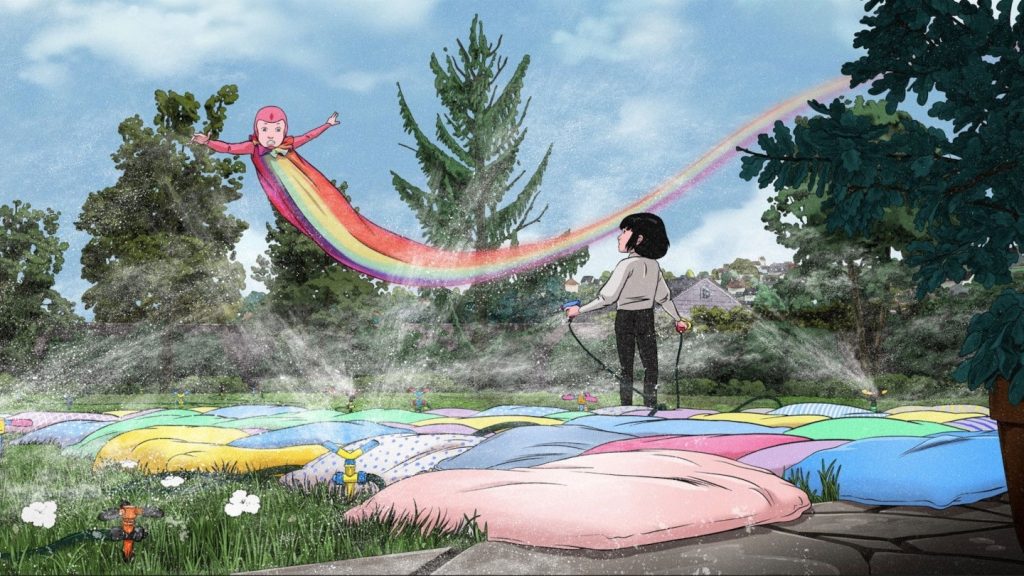
When time-travelling ten-year-old Arco (Juliano Krue Valdi) crash-lands in 2075, young Iris (Romy Fay) must help him return to his era.
“What if rainbows were people from the future travelling in time?” Arco’s poster tagline sums it up in a nutshell. A stirringly pretty French animated sci-fi which commits wholeheartedly to its colourful aesthetic, it is a story essentially set in two futures: the year 2075, with the Earth regularly beset by environmental disaster, where humanity lives in protective geodesic domes and robots populate the streets; and the far future of 2932, where there are whispers of “the great fallow”, the surface of the Earth uninhabitable, humans now occupying vast treehouses in the sky. This might all sound like the apocalyptic fever dream of James Cameron’s worst nightmares, but it is in fact a surprisingly optimistic yarn, bursting with charm and warmth, even as a clear and stark warning quickly emerges.

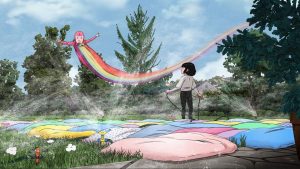
Our tale begins in that later future. In this timeline, people are able to traverse time and space by wearing Saturday-morning-cartoon-esque capes, leaving rainbow trails in their wake. Ten-year-old Arco (Juliano Krue Valdi in this English dub, replacing the original French version’s Oscar Tresanini) is desperate to time-travel back to see dinosaurs in the flesh — but he is still too young, according to the laws of these future-folk.
Its environmentalism and lovingly crafted hand-drawn animation feel very Miyazakian, with its bucolic futurist tendencies nodding to early Studio Ghibli movies like Castle In The Sky…
One night, he sneaks away from his floating sleep chamber (one of many lovely touches of sci-fi window-dressing) to slip the surly bonds of spacetime — and finds himself crash-landing in 2075, where ten-year-old Iris (Romy Fay) befriends him. An E.T. dynamic soon emerges: Iris as a head-in-the-clouds Elliott-alike dreamer, Arco as the tiny distant visitor who just wants to phone home. Together they bond over complicated relationships with their parents, and teach each other things both trivial (Arco can speak to birds, it turns out) and profound (both children live on broken worlds).
That Spielbergian tendency is not the only influence Arco wears on its many-coloured sleeves. Its environmentalism and lovingly crafted hand-drawn animation feel very Miyazakian, with its bucolic futurist tendencies nodding to early Studio Ghibli movies like Castle In The Sky, while its bittersweet time-bending shenanigans are reminiscent of Makoto Shinkai’s Your Name. There are also some flashes of the exaggerated humour of Sylvain Chomet, a little of the illustrations of French cartoonist Mœbius, even some surrealist touches akin to René Laloux’s Fantastic Planet.
But Arco does well to maintain its singular identity. Co-writer/director Ugo Bienvenu, whose background is in illustration, initially conceived the film entirely visually, building the story from sketches, and it shows — a film clearly designed for the medium. Arco’s amazing Technicolor dreamcoat is instantly iconic, and the future vision he occupies is bursting with visual innovation: from the bold primary-colour palette to the heart-shaped electric plugs to the holodeck school classrooms, there is a ton of compelling world-building here.
Yet it lives in a story that is, effectively, world-destroying. Like last year’s Flow, another animation constructed around fantastical ecological disaster, there is a clear and urgent underlying message propping up some simple family-friendly material. In 2075, the world is ravaged by storms and fires; in 2932, humanity has seemingly abandoned the surface level, moving to higher ground to “let the Earth rest”. The lessons here are gently didactic — there’s little doubt as to where the film stands — but for younger viewers especially it might be a galvanising force, a warning of what could come.
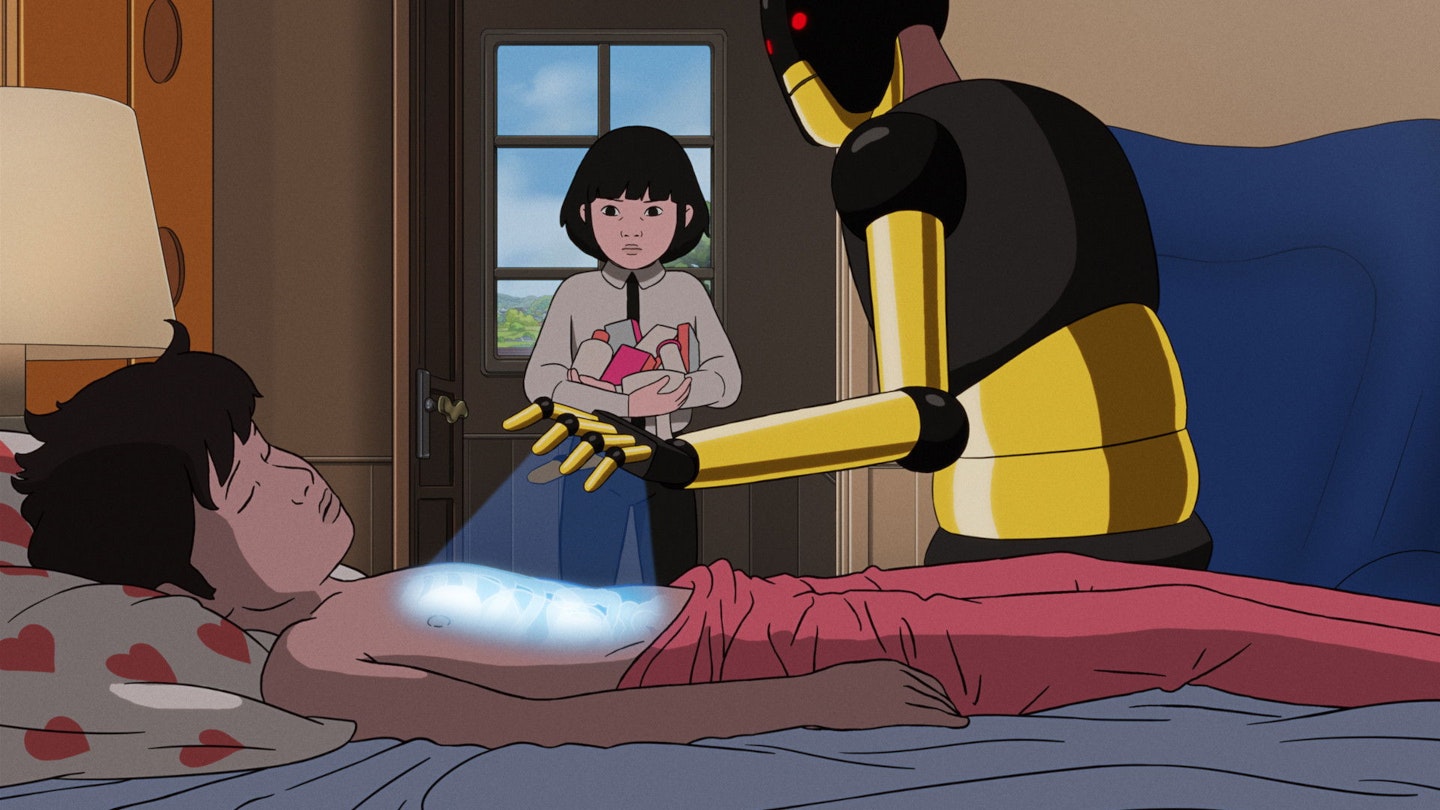
What sells the proselytising is the sweetness of the characters. Arco and Iris are engagingly adorable hosts. The surprise standout, though, comes in the form of robot nanny Mikki, whose red eyes evoke the sinister T-800, though he’s more like the kindly T-800 from Terminator 2. In the original French, Bienvenu himself voices Mikki, but in the English-language dub, Mark Ruffalo and Natalie Portman — who voice Iris’ parents, respectively — also share the role of Mikki, their performances overlaid. It neatly sells the idea that this metal droid is essentially a surrogate parent, making Mikki’s arc unexpectedly powerful.
If the final act gets a bit hectic, devolving largely to madcap sci-fi chase scenes, it ends on a note of surprising depth and beauty. Like Flow, this is an indie European animation which shows Hollywood how it can be done.
A special sort of film, one which can be enjoyed as a dark climate-change allegory and a bright, colourful, emotional yarn on friendship and family. Fantastique!