

I mean this in the best way possible: Pragmata feels like a game straight from the Xbox 360 era. It’s the kind of third-person action-shooter that hangs its hat on a specific gimmick, but then plays everything else fairly straightforward. By executing on the important parts really well, Pragmata is able to let its punchy shooting, creative hacking mechanic, and tough fights do the heavy lifting. The storytelling around that stuff isn’t exactly its strong suit, even with how much it emphasizes its budding father-daughter dynamic, and I’m a little disappointed it didn’t do more with what was initially an interesting space drama setup. But Pragmata is focused on the action first, and that part is so compelling and so satisfying that I didn’t even think twice about 100%-ing it.
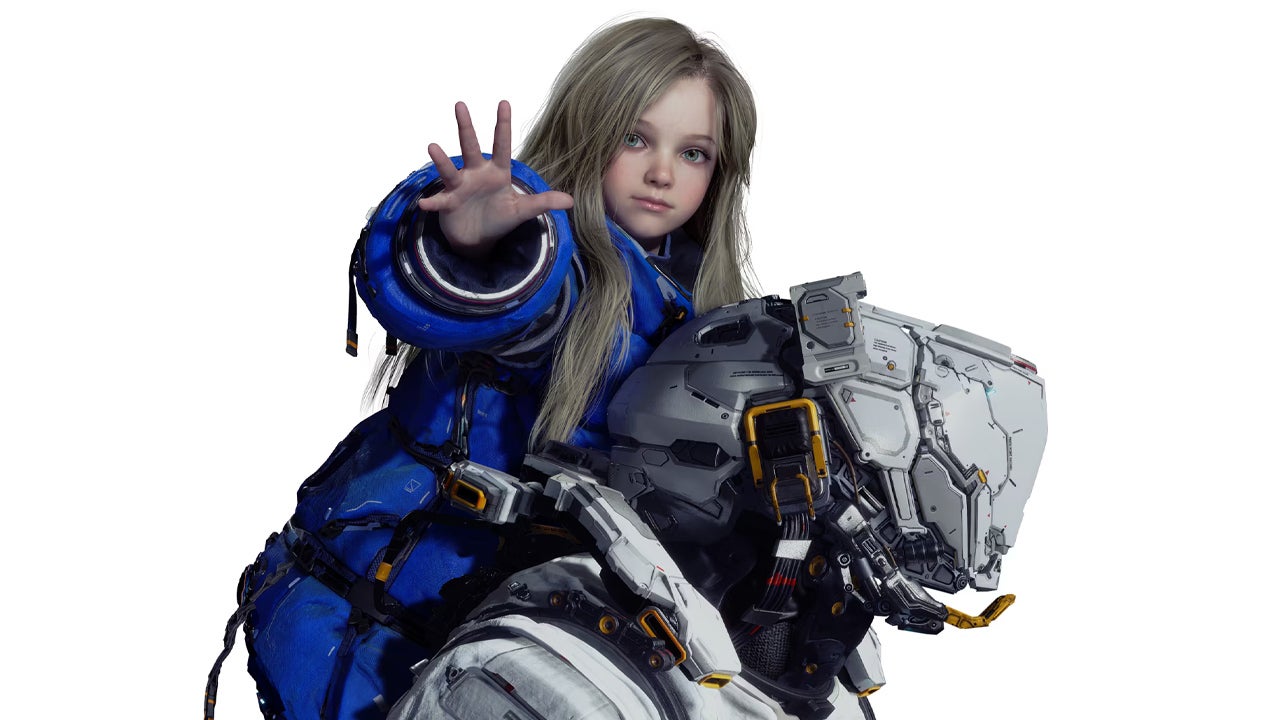
Something I appreciate about Pragmata is that it doesn’t really waste time getting you in the flow once it starts. A brief intro gives you just enough to understand Hugh, the main protagonist, before a rogue AI turns the Moon’s space station and endless supply of robots against his crew, leaving him as the lone survivor. There’s a brief conversation about how the crew’s company resorts to 3D printing at an unfathomably massive scale to fabricate most of what exists on the Moon, and how it’s easier for it to just reprint infrastructure than actually maintain it properly. It’s an effective opener that establishes a sensible premise for the rest of the roughly 12-hour campaign, although the overall story doesn’t really explore this with much depth. It’s more concerned with the truth about a humanoid robot girl named Diana, who quickly becomes Hugh’s partner in crime – she takes care of the hacking while he takes care of the shooting, and this is where Pragmata shines.
Hacking happens in real-time whenever you aim down sights, asking you to solve a grid-based pathing puzzle by drawing a route from one point to another using the face buttons on a controller. Successful hacks expose enemy weak spots and make them susceptible to real damage. This is Pragmata’s marquee feature, and there’s no avoiding it since enemies are basically impenetrable otherwise. My biggest concerns in the early hours were if this mechanic would get tiresome and if it could evolve in interesting ways as you progress – thankfully, those concerns were quickly put to rest, as it proves to be one of the best ideas I’ve seen in a shooter in a good long while.
The more “Open” blue spaces you include in your route, the longer enemies stay vulnerable. The yellow “Nodes” you have equipped will pop up on the grid at random, which tack on additional status effects like spreading hacks to nearby robots, increasing damage potency, or turning robots against each other. Tougher enemies and bosses have more complex grids with obstacles that can block or sabotage your hack as well. So not only do you need to keep an eye on the battlefield to dodge imposing foes and keep them in your field of view, you also need eyes on the hack to solve it as quickly as possible. Juggling the two broke my brain at times, and as frustrating as it might get when more enemies are thrown at you, finding a smarter approach and making the most of the weapons available to me made the hardest fights conquerable and intrinsically rewarding.
The shooting just feels good, too – between the shotgun and charge rifle, landing a direct shot on a robot’s weak spot has a satisfying weight and feedback to it. The grenade launcher clears crowds with authority and the stasis net can buy you much needed time to execute a hack, hit a clutch shot, or just reposition. And once I unlocked the automatic rifle to replace the pea-shooter pistol, I took every opportunity to let the chopper sing, so long as I could control the wild recoil from its beefy shots. It’s sometimes an annoyance to deal with the “heat” buildup on the pistol and rifle, but I found continually swapping weapons between cooldown periods to be an effective way to get more out of the great gunplay. These weapons are categorized in your loadout, so you can’t just take everything with you, and while there are numerous other options with varying functions, I dug my heels in with a weaponset that was both effective and fun as hell to work with.
The heavy weapons have limited ammo, however, so there is a degree of scavenging for guns that you’ll have to do in the middle of a fight, which also leads to neat moments of adapting to the situation. But more often than not, I wanted to get that sweet finisher on enemies – certain weapons and hacking with specific nodes drives up a stagger meter, and if you can fill it, you’re rewarded with an execution that comes with a quick camera cut and a nice, big damage number.
Some of the ways Pragmata harkens back to old-school design principles also comes from its level design. They’re fairly linear with plenty of rewards, resources for upgrades, and bits of storytelling in datapads and holograms to find off the beaten path, often asking you to search the environment for hidden paths to those goodies. (And it’s pretty sick seeing Diana rip a data vape to expand her ultimate meter.) Oftentimes, tight corridors lead to open spaces for combat arenas in a predictable rhythm that largely works, though it does get somewhat repetitive toward the end of the campaign. And as impressive as Pragmata can look at times, I did get pretty worn out by how frequently you’re fighting within the confines of sterile space station walls. Even still, I was happy to retread levels to pick up all the collectibles when I unlocked the ability to access certain areas for the love of the game (and to max out the levels on my favorite abilities and gear).
Pragmata doesn’t really push above and beyond the cadence it establishes in its early hours, but at least I knew I had intense combat encounters waiting for me at a brisk pace. And, of course, the boss fights that cap off each level are definite highlights. Hugh and Diana are dwarfed by these monstrous robots and their unique attack patterns, as well as how they can manipulate the hacking grid, throw tough challenges at you while bringing a bit of spectacle to it all. I also appreciate specific moments that use the hacking system outside its typical fashion, in the same way you might see a QTE punctuate a big fight or keep you engaged during a cutscene. It highlights Diana’s place not just in the story, but also in how she’s just as integral to the gameplay itself as Hugh.
Between main missions, it’s nice that you get a ton of simulation missions you can play back at the hideout hub area, sometimes challenging you in unexpected ways by showcasing offensive techniques or enemy quirks you can then take advantage of in real-level situations. However, some of the more granular mishaps in how Pragmata controls can rear their ugly head here. For example, Hugh’s momentum is pretty unpredictable, so when these missions ask you to do some basic platforming, the inconsistencies in movement tend to be infuriating. Thankfully, these aren’t prohibitively difficult, and rarely do the main levels require you to do things like this.
All that said, Pragmata is one of the few games I felt compelled to clear 100% – all the simulation missions, all collectibles in every level, and all the post-game content. While it took me roughly 12 hours to roll credits, doing all the extras took it to a worthwhile 15-16 hours. As of this review, I can’t show or detail what’s in the post-game, but just know that it’s worth seeking out – not just to get more out of the fantastic gameplay, but to also see what kind of curveballs lie ahead, if you can figure out how to find them all. And when it comes to boss fights, Pragmata certainly saves its best for last.
While Pragmata is mainly concerned with making sure you have fun while out in the thick of the action, it still shoots its shot with a story that tries to pull at your heartstrings and weave in broader sci-fi drama. It starts with some really smart ideas of what a theoretical spacefaring future might look like, extrapolating the technology we have today and taking it to an unhealthy extreme. The very existence of a fabricated Earth-like place opens up fascinating possibilities, but much of that gets sidelined for a more predictable story. Rogue AI gone mad: check. A robot girl who’s learning about humanity: check. One man who can save the day with laser guns and the will to fight: also check.
You’ll find well-written data logs and some voiced holograms that flesh out employee drama and exactly what went wrong on the Moon before Hugh’s crew arrived. I especially liked the series of entries hidden behind camouflaged walls that tells you about an employee who played hooky during work hours. And then there are ones that undermine what the story actually wants to say – some of the most important information about Diana and her existence, which should have been told in the main dialogue, are relegated to data pads. It’s absolutely head-scratching how flippant Pragmata is about these details.
Ultimately, it wants you to care about Hugh and Diana, and the found father-daughter relationship that eventually motivates them. At times, I found it charming in a way that made me really root for the duo. When you find REMs in levels – fabrications of real-world objects like toys, crafts, and electronics – and bring them back to the hub area, Diana has a curiosity about them that’s heartwarming, especially when she brings Hugh drawings after you get her crayons. Moments in which he explains to her what life on Earth is like which helps put her place in the world into perspective, too.
Hugh’s not a particularly interesting character, though – not just because he’s pretty generic, but also because his attachment to Diana isn’t really grounded in enough that’s tangible or developed on screen. It just kind of happens without taking enough time to foster a believable bond that aligns with his goals, so some of their dynamic feels forced. It’s disappointing because this duo is such a good spin on the companion campaign idea when it comes to the actual gameplay, with Diana being crucial to why Pragmata plays so well. Maybe the story just isn’t meant to be anything deeper than the popcorn-flick it is, and maybe that’s all it needed to be when I so thoroughly enjoyed the action side of things.