
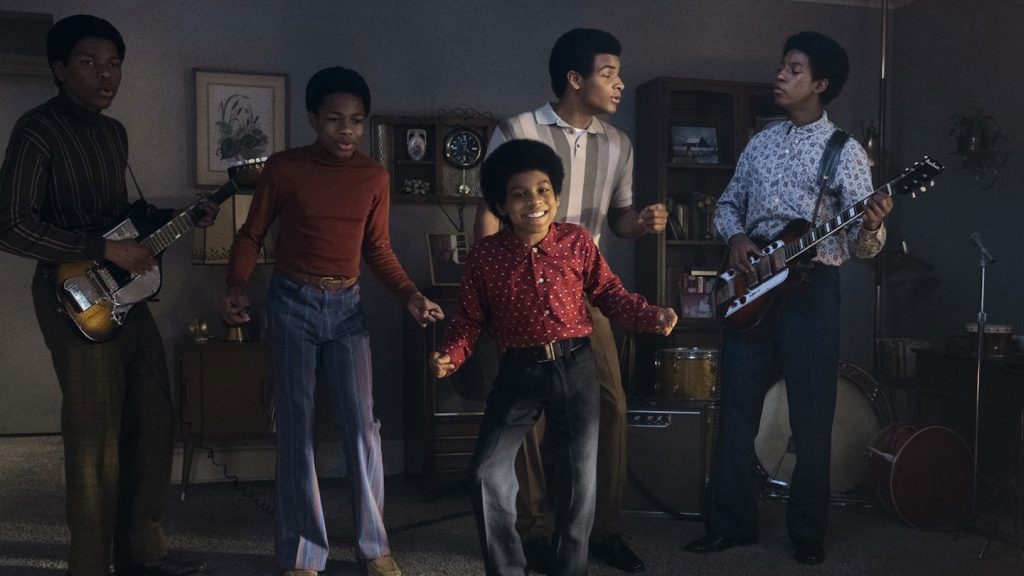
The early life and times of pop star Michael Jackson. As a kid (Juliano Krue Valdi) he is trained for success by his abusive father Joseph (Colman Domingo); as a young man (Jaafar Jackson) he seeks to strike out on his own.
When talking about Michael Jackson’s life story, there are two main elements to consider. There is, of course, his extraordinary and unprecedented pop-music career, which began aged just six with the Jackson 5, before as a solo artist releasing the best-selling album of all time, Thriller. And then there’s his eccentric and often troubling personal life, which includes numerous accusations of child abuse, which he denied (including being charged in 2003 with seven counts of child molestation, for which he was acquitted).
Michael, the first feature-length cinematic biopic of the star, decides to tell the story of the former, but ignores the latter. The number of Jackson family members listed in the credits as producers gives some hint to the hagiographic approach. Recent reports, meanwhile, have suggested that extensive reshoots had to take place in order to remove any reference to the accusations, due to legal reasons.
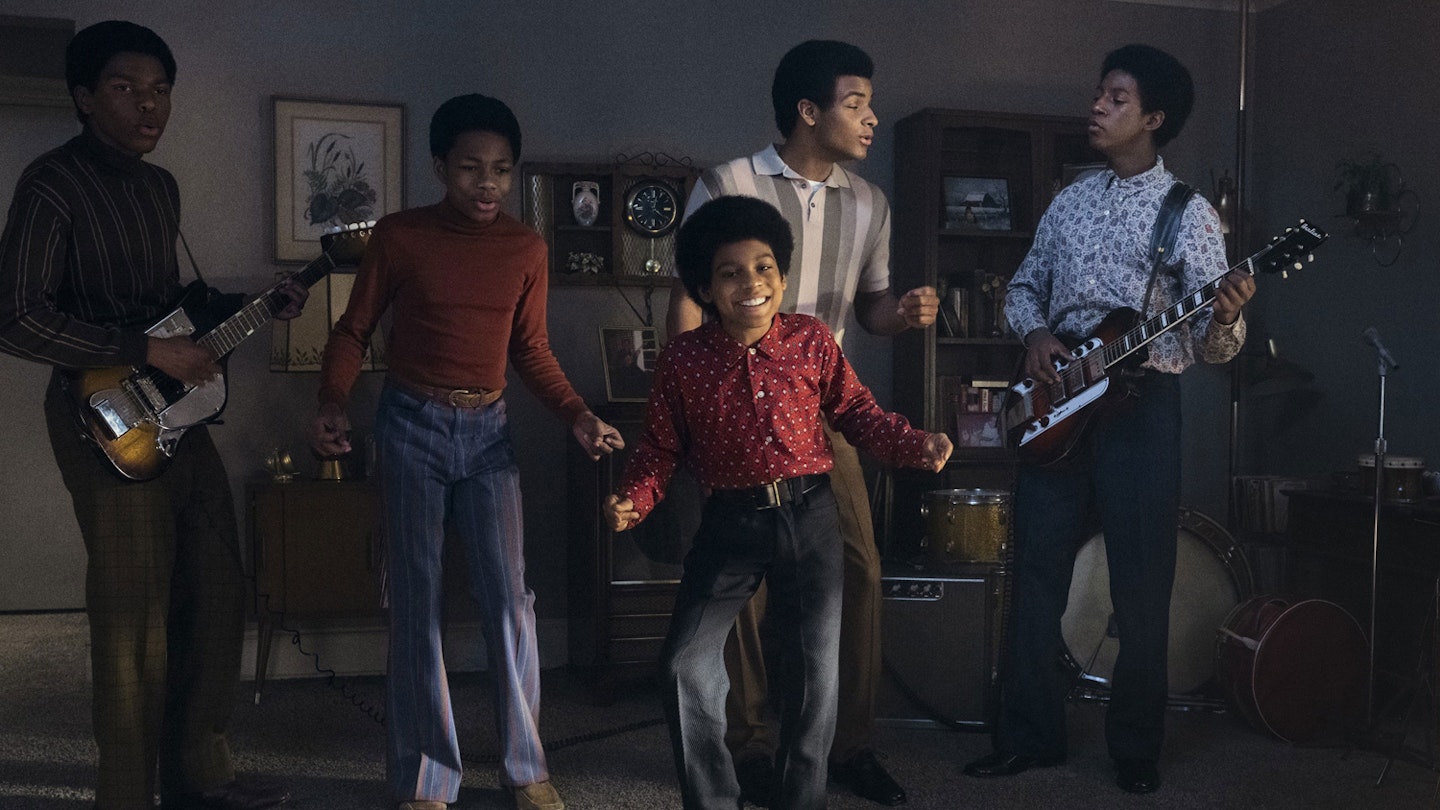
Whatever the truth, across this two-hour-plus runtime, there was apparently no room to mention Jackson’s controversies. Instead, it’s a deeply generic music biopic, the kind that would make even Dewey Cox raise his eyebrows. Our rags-to-riches account begins in 1966 in Gary, Indiana, when Michael is still a young boy living in a humble two-bedroom working-class house with eight siblings, and ends in 1988 — conveniently, a full five years before Jackson’s first abuse allegations surfaced — by which time he is the anointed King Of Pop.
Director Antoine Fuqua — whose work, which includes all three Equalizer films, has gotten progressively sillier after showing such promise with 2001’s Training Day — hits the key musical milestones with workmanlike efficiency. He has found impressive avatars for Young Michael in Juliano Krue Valdi and Slightly Older Michael in Jaafar Jackson (son of Jermaine and nephew of Michael), both of whom are hugely talented performers, dancers and, one presumes, singers (it’s unclear how much lip-syncing is actually involved). And nobody can deny the astonishing back catalogue of bangers in Jackson’s discography, an archive the film hungrily raids.
Feels very strongly like a cynical moneymaking machine.
In its ploddingly boring biopic-by-numbers way, Michael’s success was predestined, written in the stars, entirely inevitable. While professionally Michael’s career seems to find no friction whatsoever — he gets a record deal, he tops a chart, he tops another chart, he tops yet another chart — he encounters his main conflict with his father and former manager, Joseph (Colman Domingo, on terrifying form). John Logan’s script takes pains to emphasise the very real abuse Michael suffers; at one point, Joseph calls his son “big nose”, and the tyrannical way in which the patriarch runs his family business is heartbreaking — even if Michael’s siblings get short shrift (his brothers barely get a line of dialogue between them; Janet is Sir Not-Appearing-In-This-Film). But the film seems to insist that Michael’s story is only a triumph, when it is clearly just as much a tragedy. “I have to be perfect,” he tells a doctor when undergoing his first rhinoplasty.
Often, it is oddly revealing in ways it never intended to be. “There’s no-one like you and there never will be,” fawns his lawyer and manager John Branca (Miles Teller), portrayed here in glowing fashion (Branca also happens to be a producer on the film, as well as a co-executor of Jackson’s estate). Fuqua plays this scene as Michael finally taking control of his own destiny — but it reads loudly as if he surrounded himself with enablers and yes men.
And throughout, it is very difficult to avoid watching certain moments without thinking of the unspoken context, of the enormous, looming, hulking elephant in the room. The scenes where Michael obsessively reads Peter Pan, kisses his pet llama on the face, runs around a toy shop like a giddy toddler, plays Twister with a CG chimpanzee or spends time at a children’s hospital make for a surreal, uncannily uncomfortable viewing experience, especially in how it is uniformly played out as merely cute and adorable.
Ultimately, this feels very strongly like a cynical moneymaking machine. (There is already talk of a follow-up film — this one ends with the somewhat threatening, James Bond-esque title card “His Story Continues” — and perhaps that will find room for some darker material.) As with its theatrical cousin, the hit West End musical Thriller, it will undoubtedly make tons of cash, playing to packed houses of gleeful tourists and die-hard fans.
It follows the same template set by the near-billion-dollar-grossing Queen biopic Bohemian Rhapsody — both films share a producer in Graham King — and ends in much the same way. Instead of Queen’s Live Aid gig, we get the Jackson 5’s final performance at Dodger Stadium, followed by Michael’s Bad-era 1988 Wembley gig, all amounting to a good 20-or-so minutes of wall-to-wall music. It is the film in full jukebox mode, a cosplaying tribute act with no artistic point-of view, nothing to say other than, “God, they were good songs, weren’t they?” Like a lot to do with this film, it is, quite frankly, taking the Michael.
Hugely impressive musical and dance performances from the two young men playing Michael Jackson cannot shake off the uncomfortable fact that there is an entire other side to the pop star’s story which is entirely conspicuous by its absence here.