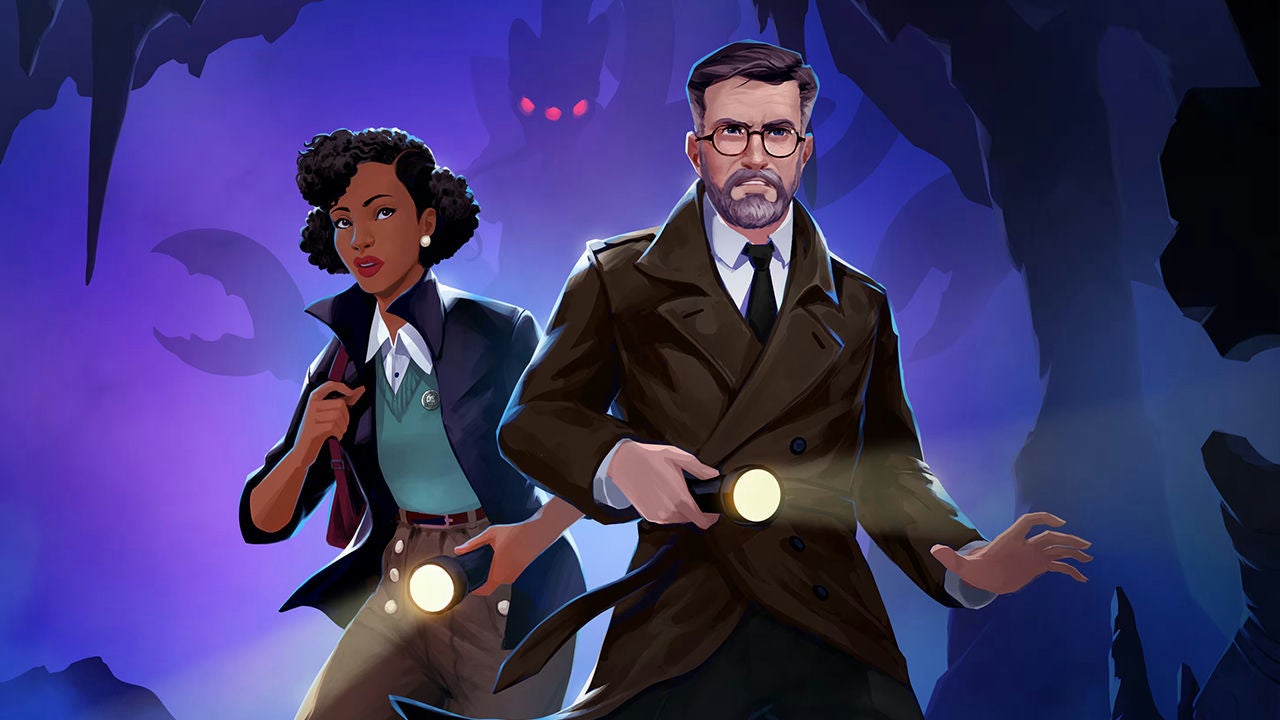


Call of the Elder Gods, from developer Out of the Blue Games, handles a careful balancing act between story-focused adventure and puzzle solving with grace. As the long-awaited follow-up to 2020’s Call of the Sea and its emotionally gripping puzzle-box adventure, it’s another rare Lovecraft-inspired game that effectively wields the surreal mystery and emotional stakes of confronting the unknown, rather than the macabre aspects of cosmic horror you may expect. The original game focused on exploring a winding, lush island that gradually revealed deeper mysteries and crushing loss with its protagonist, Norah, and Call of the Elder Gods continues the story as a noticeably tighter sequel with two new protagonists who embark on a parallel journey set in motion by its predecessor.
Call of the Elder Gods is set two decades after the first game and has you playing as both newcomer Evangeline Drayton, the daughter of Frank Drayton from the original game’s ill-fated expedition, and returning character Professor Harry Everhart. With Evangeline experiencing a lapse in memory and dreams of an ancient city of elder gods, she seeks out Harry Everhart for answers on what was uncovered from that expedition. All the while, the original protagonist, Norah – played by actor Cissy Jones – narrates the story’s events with a level of self-awareness that adds an even stranger layer of intrigue.
While Call of the Sea’s remote island jungle was equal parts an interactive mystery box filled to the brim with puzzles that tied into some heartfelt storytelling for protagonist Norah, Call of the Elder Gods is more of a globe-trotting Indiana Jones-style adventure – complete with familiar stylings like streaking red lines going across maps to give it that sense of scale. This change expands the series’ scope and leads to some unexpectedly profound and bizarre moments for its protagonists that even stretch across time and space.
It channels the tone and style of Lovecraft’s short story “The Color Out of Space” over the course of its five-hour journey. Yet, it takes it even further by drawing on his novella “The Shadow Out of Time” as the story escalates into out of body experiences and time-bending phenomena. Call of the Elder Gods takes the time necessary to absorb you into the perspectives of its characters as they explore the Everhart estate, ancient caves in the backwoods of Virginia, and all the way to the remote deserts of Australia.
I really enjoyed the way the story escalates with Harry and Evangeline traveling to increasingly peculiar locations, such as an abandoned Nazi compound housing corrupted eldritch experiments and even the ancient city of the distant past; it leans into the aforementioned style of sweeping adventure that’d make Indy proud. Although it works for the most part, I wasn’t as connected to each location by virtue of its brisk pace as opposed to the original’s more cohesive setting. Just when I was taking in the fantastic visuals and mesmerizing atmosphere of a specific chapter’s location, I would be whisked away to the next area, which sometimes funnels you into less imaginative enclosed spaces. This disconnect also extends to the in-game animated cutscenes, which showcase the strong personalities of its characters, but can also come off as stilted transitions between chapters.
Much like the original, Call of the Elder Gods puts a keen focus on investigation and puzzle-solving across its chapters. With the help of Norah’s trusty journal, which keeps track of all relevant information, the puzzles evoke the classic Myst and Riven approach to collecting clues left by other characters and inspecting environmental details to overcome obstacles. There is some genuinely inventive puzzle design at work within Call of the Elder Gods – I appreciated those organic moments where you’re learning how the pieces of its puzzles fit together in the process of deciphering solutions just before the eureka moment, and it’s one of the great joys that complements its wondrous atmosphere.
One of my favorite early sections was exploring the estate grounds during a storm. I had to carefully position the statues at right angles to unlock access to a gated area, all while thunder and heavy rain was coming down. It’s a sequence that starts leaning into the Lovecraftian influence of directly placing you in strange situations where otherworldly forces creep in to add a subtle sense of dread. Much like the original, Call of the Elder Gods weaves its sharp, visually striking environmental presentation to uplift its story-driven puzzle-solving. But it takes things further with a larger variety of spaces to explore that show the escalating stakes of the journey, which gives each chapter a unique theme and flavor.
Compared to the more straightforward progression and ramping up in complexity with puzzles in the original, Call of the Elder Gods’s more fragmented structure unfortunately leads to uneven difficulty at times. While I generally felt in sync with the pacing and level of challenge, so much so that I was able to knock out some of the seemingly complex puzzles with ease, some challenges were a stark jump in difficulty in terms of an overload of information and moving parts to keep track of. This was particularly troublesome when trying to get a handle of the more machine-heavy puzzles, which took a lot of cycling back to my journal as if I was combing through an instruction manual. I even hit some walls that left me retracing my steps for extended periods to find any missed clues that would help lead to a solution.
There is a handy hint option in the main menu to offset those periods of being stumped, which will outright give you a step-by-step breakdown of puzzles in select chapters. It’s a helpful feature that will keep you moving along and prevent stalling in your progression. Yet, I felt some aspects of the puzzle-solving could have benefitted from more natural ways of leading you on or just better explanations of the mechanisms behind its puzzles.
Thankfully, its stumbles don’t drastically detract from what Call of the Elder Gods is all about – that feeling of uncovering a great mystery across time and space. It does so in a less isolating way compared to the original, and with the two strong leads whose connections to otherworldly forces naturally unravel as you take in clues and progress. Call of the Elder Gods even includes moments where you’ll swap between both Harry and Evangeline to solve puzzles in tandem.
My favorite interactions between the two are during story moments where you’ll make decisions on how they’ll react to an interrogation, or a deeply affecting moment of personal trauma. This is all while a sinister cult is chasing the very same thing you are, trying to stay one step ahead to seize what it believes to be some kind of ancient power – it provides the adversarial element needed to keep the stakes high and broaden the consequences at hand.
Overall, it’s an elevation of the original game with its clever use of its dual perspectives, and I was impressed by both Harry and Evangeline’s parallel emotional journeys as they grapple with their memories of the past and the possible futures that lay ahead of them. The strong writing and voice performances by actors Yuri Lowenthal and Mara Junot, respectively, really do well to bring the characters and story to life. However, Call of the Elder Gods doesn’t quite stick the landing as it closes with an unsatisfying finish that leaves a lot of its mystery on the table. Still, Evangeline’s arc as a new protagonist adds greater weight to the original game, giving its story of the failed expedition a more poignant sense of tragedy.