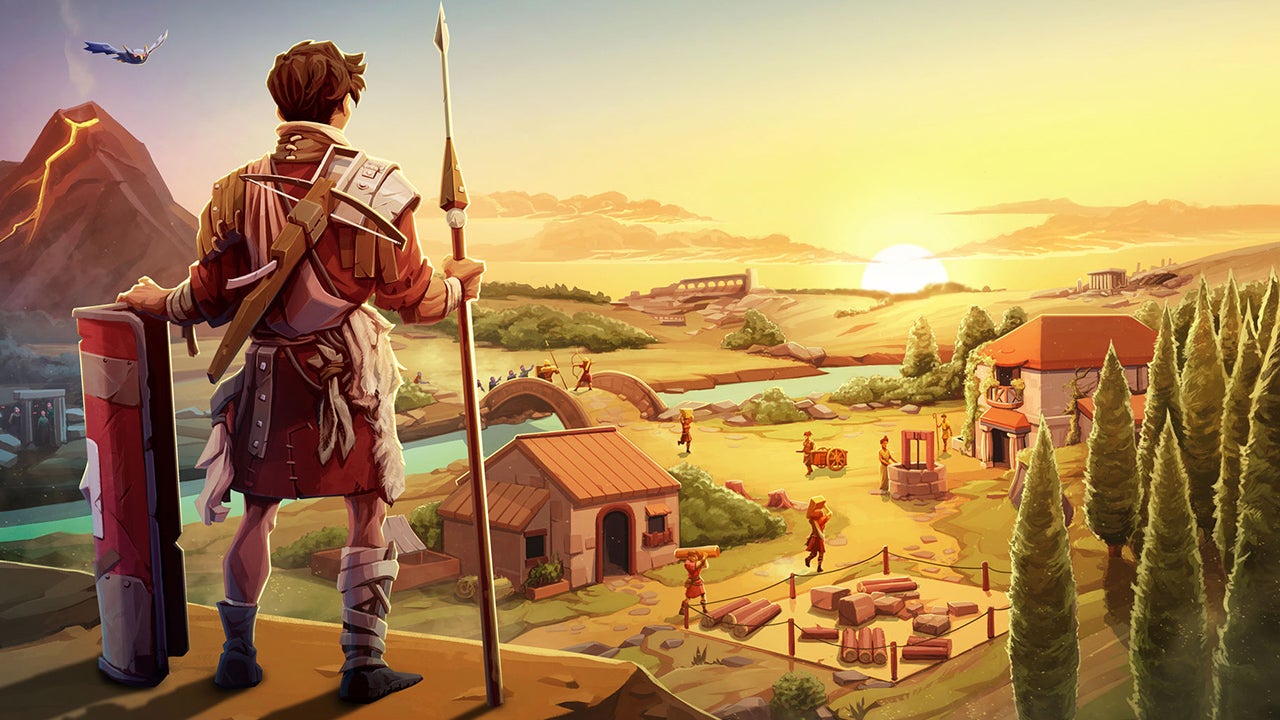


The fall of Ancient Rome has long been a fascinating period of human history to examine. But consider, for a moment, that instead of political infighting, the looming threat of invaders, and the slow decline of the population, what if a supernatural event befell the empire, resulting in zombies and other monsters roaming its ruins? That’s where Romestead really lays the foundations of its concept of an open-world survival-crafting RPG – all set in a post-apocalyptic take on Ancient Rome.
We recently got an early look at the upcoming early access release of the 2D action-RPG, which feels equal parts cozy community builder, but with a bit of a Souls-style, dark-fantasy twist. Developer Beartwigs’ charming, yet still tense survival game pulls together some cool ideas that make for an original take on a survival-RPG, and it’s certainly one that felt more and more intriguing as I dove further into my world.
Set just after the fall of Ancient Rome, the protagonist comes into contact with the Roman gods, who task them with rebuilding the empire and purging the land of supernatural threats. As you explore the surrounding lands, fight monsters, and loot dungeons, you’ll encounter lost Roman citizens looking for a new home. Once you’ve set your spot for your base, and new allies join your effort, you’ll be able to steadily build up the settlement and move one step closer to restoring connection to the lost gods and rebuilding Rome.
Much like Stardew Valley and Terraria, Romestead lets you create your own protagonist from scratch and prioritize particular skills and vocations – such as the sword-wielding legionary or the studious scholar. While the beginning goals and tasks are the same, and you can level up other skills as you progress, these different starting classes will give you the leg up in areas you want to invest time in during the opening parts of your journey. For instance, do you want to make chopping wood a little easier and have access to the axe from the start? Then pick the woodcutter and go from there.
Randomized Rome
What immediately impressed me most about Romestead was its massive, procedurally generated world filled with dungeons to explore and resources to find. Much like other games with procedurally generated worlds, this means each dive into a new game is its own adventure. When you start a new game, the world will be made up for your new character, and this seed can even be shared with others online so they can see your progress.
Much like other survival crafting games, the key loop focuses on extracting nearby resources – such as crops, minerals, and even the wildlife – and then bringing them back to base to begin getting your community in order. I started with the basics: a proper crafting bench, food storage, housing, and community defenses. It’s a basic start for sure, but it kept me busy and focused.
Some of the most fun I had was venturing out into the wild to find more resources once I had exhausted what was near my base. Along with roaming wildlife like boars and deer, I would also run right into supernatural beasts like headless minions that would grab any objects in sight to use as a makeshift head, or even some unusual shrub monsters that hide in plain sight. By using my dodges and quick strikes, I was able to take out most of the common foes. However, in one surprise encounter after staying out too late into the night, a pack of wolves came roaming and immediately gave chase.
They Mostly Come Out at Night…Mostly
The nighttime is where the dangers in Romestead lurk, and it’s also where the zombies known as The Fallen venture out. In addition to their large numbers, they also come in different varieties outside of the common fodder – such as the large bloater-style zombie that blows up once its health drains.
As well prepared as I thought I was, I did find the main goals of Romestead to be a noticeably steep obstacle to overcome. With the first major quest focusing on the defeat of a giant owl that looms over the starting zone, I had to venture far away from my safe zone to its nest. Once the fight started, I realized I was outmatched. After respawning and collecting my lost loot, I took a bit more time to try alternate strategies. Just when I thought I had made a breakthrough, the boss entered its second phase, which turned the battle into a Dark Souls-style boss fight.
Suffice it to say, this was a bit of a wall for me to progress. But the hook for these styles of survival-crafting games is to find your own way to overcome some challenges. That’s where the other activities came in, and I found a lot of enjoyment just from trying to collect as many resources as I could to help fortify and expand my settlement. I also appreciated the option to expand roads, which made walking much faster.
That’s where I particularly found enjoyment. It taps into that familiar, cozy feel of building something from nothing. I managed my time not only to improve my gear and weapon skills, but also to feel like I’m making genuine progress in creating a safer place for my community by building walls and defenses. As I built up my community, I was then able to make better gear, which then gave me the advantage I needed to finally take out that jerk of a boss.
A Roman Soul(slike)
The world design really comes to life the more you explore, revealing more opportunities to uncover. In addition to finding other settlements, I also found a lot of fun exploring Zelda-style mini-dungeons tucked away in the wild. These dungeons are also randomly generated, and range from quick excursions to a tucked-away chest to more involved encounters with elite foes guarding good loot. The ones I found were mostly minor side-events, but they still presented some challenges to overcome – especially with how quickly traps can take you out.
And therein lies the big challenge with Romestead: it can be quite brutal with the stakes. In very much the same vein as a Souls game, death will require that extended jaunt back to get your gear that’s tossed into the dirt – which can sometimes mean dying again shortly after. And this, of course, opens you up to other challenges, as roaming monsters will be ready to pounce on you. Still, I appreciate the sense of adventure that comes with each outing. I always find something new to like in Romestead’s world.
Romestead strikes a pretty deft balance between cozy and surprisingly tense in its combat and adventure. It’s gotten me thinking about how I want to build my settlement and how best to chart my path into the new wilderness of post-apocalyptic Ancient Rome. I really dig what’s available in the early access build so far, and I want to see more of what this wild mix of genres has in store for a more fleshed-out adventure.
Alessandro Fillari is a longtime games media professional. Talk video games with him on BlueSky at @afillari.bsky.social.