

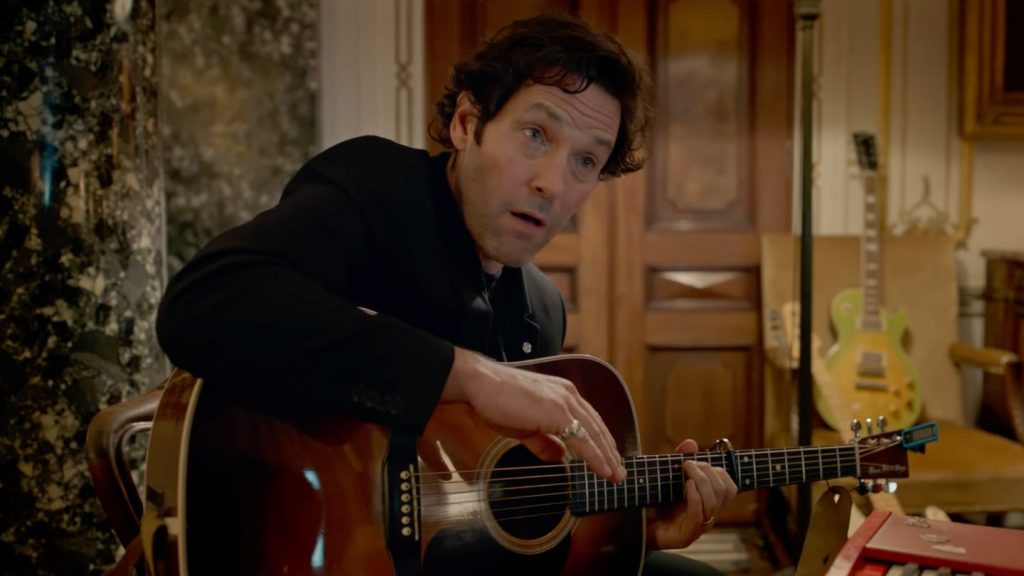
Following an all-night jam session, wedding singer Rick Power (Paul Rudd) accuses struggling boy-band star Danny Wilson (Nick Jonas) of stealing his song.
Every filmmaker worth their salt has their recurring obsessions, whether it’s the confines of privilege (Sofia Coppola), symmetry and pastels (Wes Anderson) or naked bare feet (you know who). For Irish writer-director John Carney, it is the enervating quality of music to connect and forge relationships of all stripes. From Once to Begin Again, Sing Street to Flora And Son, ex-muso Carney has plied his trade in funny, unashamedly uncynical song-centric films that wear their heart and art on their sleeve. His latest, Power Ballad, is no exception, again playing his favourite theme, this time adding some fresh new licks.
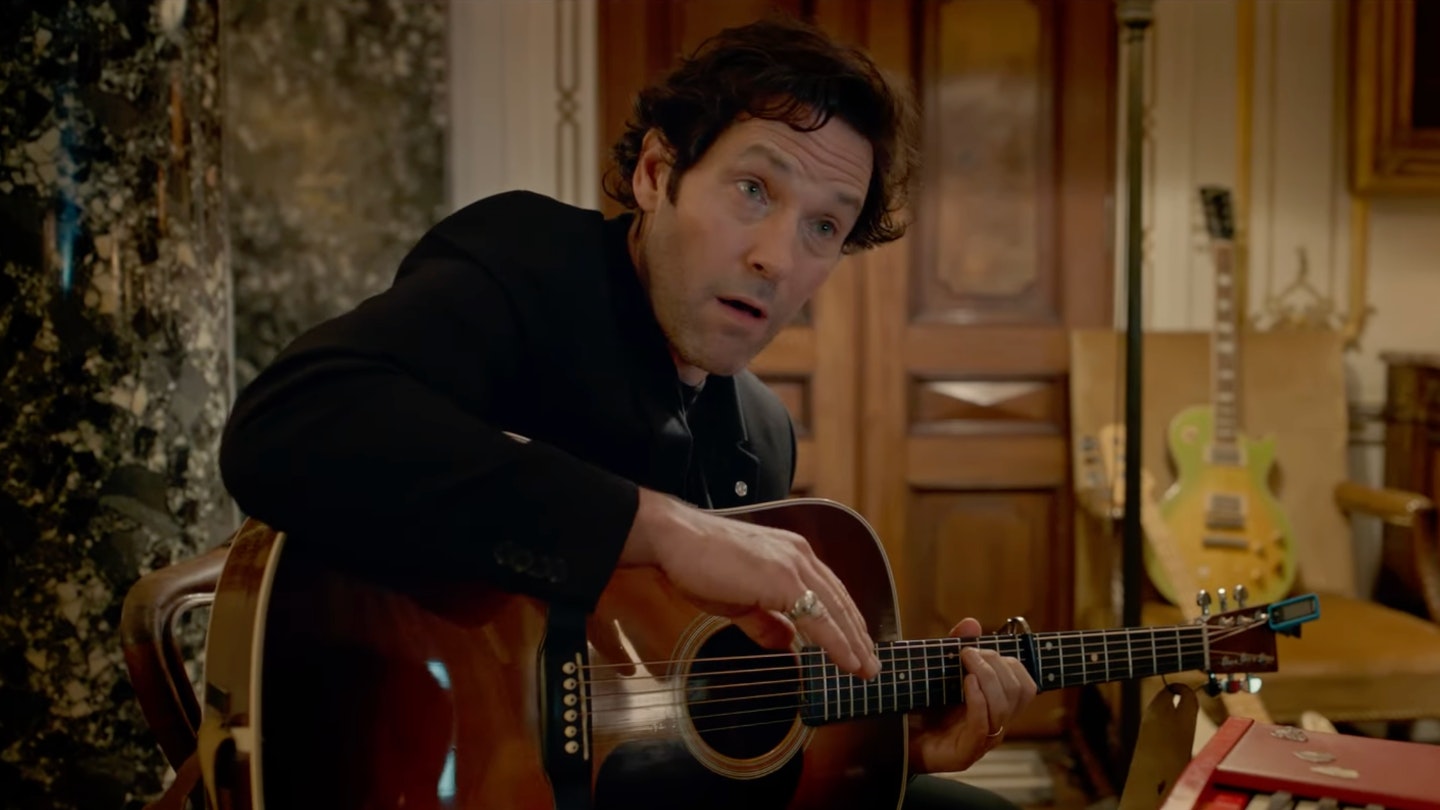
The set-up is efficiently, entertainingly sketched. Giving up his dreams of musical stardom to start a family in Ireland, American rocker Rick Power (Paul Rudd) is the frontman of wedding band The Bride And Groove (chef’s kiss), playing cover versions and occasionally harshing the buzz with his own compositions. During a reception at an Irish castle, friend of the groom and floundering former boy-band alumnus Danny Wilson (Nick Jonas) joins the band on stage and duets with Rick on a kickass version of Stevie Wonder’s ‘I Wish’.
Sharing an easy chemistry, Rudd and Jonas are such a delight together that there’s a dip when the demands of the story split them up.
The pair click and Danny invites Rick back to his hotel room, a makeshift studio filled with guitars, keyboards and recording equipment. In a lengthy sequence, Carney has a ball watching the music lovers vibe: if the jam session isn’t quite Paul McCartney making up ‘Get Back’ on the fly, it is a joy to watch the two men create, especially when the two riff on a Rick composition, ‘How To Write A Song (Without You)’. The two go their separate ways until Rick, six months later, is walking through a Dublin shopping centre and hears his tune, now an over-produced sad banger, seeping out of the PA system.
Sharing an easy chemistry, Rudd and Jonas are such a delight together that there’s a dip when the demands of the story split them up. Just wanting acknowledgement for his involvement, Rick becomes obsessed, alienating his bandmates, wife Rachel (Marcella Plunkett) and daughter Aja (Beth Fallon) while Danny returns to LA with 100 million views, an arena tour and a renewed sense of purpose. It’s refreshing to see the eternally youthful Rudd play crumpled middle age: smoking, swearing, seeing his lifelong dream become a nightmare. Jonas is eminently winning as a former star who, like Rick, just wants to prove his worth musically, buoyed by his agent (Carney regular Jack Reynor). To its credit, there are no villains in Power Ballad. Carney and co-writer Peter McDonald (who, in an endearing comedic turn, plays Rick’s bestie Sandy) do a smart, convincing job of blurring the lines of creative ownership. Like Carney’s other work, it’s a big-hearted film that likes its people, whatever their faults and foibles.
A former bassist with The Frames, Carney pulls off that rare trick of making ‘fictional’ pop music in his films sound not only credible but memorable. After working with Glen Hansard and Markéta Irglová on Once and New Radicals’ Gregg Alexander on Begin Again, this time around Carney has collab’d with Gary Clark, lead singer of ’80s popsters — hey! — Danny Wilson (their biggest hit, ‘Mary’s Prayer’, can be heard in a pub), who contributed to Sing Street and Flora And Son. There’s less music here than usual, but the pair make ‘How To Write A Song (Without You)’ an irresistible, iPhone-torch-in-the-air anthem about the importance of a muse for a love song. That song is not only memorable but also feeds into a twist in the tale that makes you feel differently about its relationships.
It might not have the soul of Once or the exuberance of Sing Street, but Power Ballad sees Carney try something different. It is consistently funny — an extended set-piece where Rick and Sandy gate-crash Danny’s LA pad hits the mark, in broad strokes — but it’s not out-and-out comedy. Carney is exploring more here than just laughs, tapping deeper and more earnestly into middle-age despair, youthful insecurities and thwarted aspirations. It’s a new palette that makes you wonder what a Carney film might look like if the guitar stayed firmly in its case.
Another catchy Valentine to the transcendent properties of music, Power Ballad is perhaps a little more grounded than your average John Carney playlist. Full of native wit, warmth and generosity: play it on repeat.