
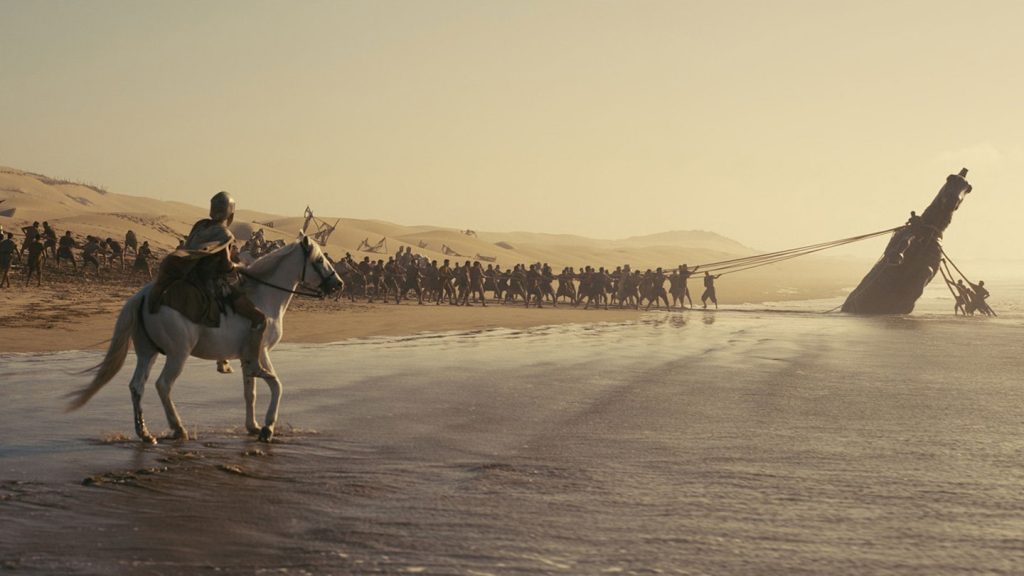
After victory in the Trojan War, Odysseus (Matt Damon) spends years struggling to return home to his wife Penelope (Anne Hathaway) and son Telemachus (Tom Holland). Will the gods allow it?
The Odyssey is the definition of epic. The word comes from the Ancient Greek epikos, an adjective used to describe a long narrative, prophecy, proverb or heroic verse. All such interpretations could describe Homer’s vast 8th-century BC poem, a masterwork of Greek mythology, about a bloke just trying to get home — the Planes, Trains And Automobiles of the Bronze Age, if you will. It is a 12,000-line, 24-book, 3,000-year-old piece of literature, a journey of gods and monsters, spanning many years, across seas and islands, over warring lands and into the underworld itself.
Fairly ambitious, then. Christopher Nolan, of course, is hardly a stranger to ambition: his first major film, Memento, was told both backwards and forwards, and he has tackled wars, superheroes, dreams, wormholes, the nuclear apocalypse and Victorian teleportation machines. But it’s not unreasonable to suggest that The Odyssey is his most ambitious film yet. Set in a “time of apparent magic”, as the opening title card has it, we dive headfirst into a world of both divine fantasy and grounded realism. From the start, the story here is dense with plot and detail, sometimes seemingly explained by a character called Expositionus.
Filmmaking at a magnitude few modern directors could ever realistically imagine, demand, or execute.
Still, it is as elegant and economical an adaptation as it’s possible to make of such a lengthy tome, and you don’t need a Classics degree to understand it. Some purists may bristle at the liberties taken with the text, with significant omissions (Odysseus accidentally opens a bag of wind! Odysseus competes in a sports day!). The dialogue, too, inevitably loses some of the poetry and lyricism of the original text; no dactylic hexameter here. But what it loses in faithfulness, it gains in visual and structural poetry. It is a beautifully edited film, Nolan taking Homer’s flashback structure and running with it, telling a story in nesting narratives. Sometimes you can only tell how far along on the journey you are from the grey in Matt Damon’s beard.
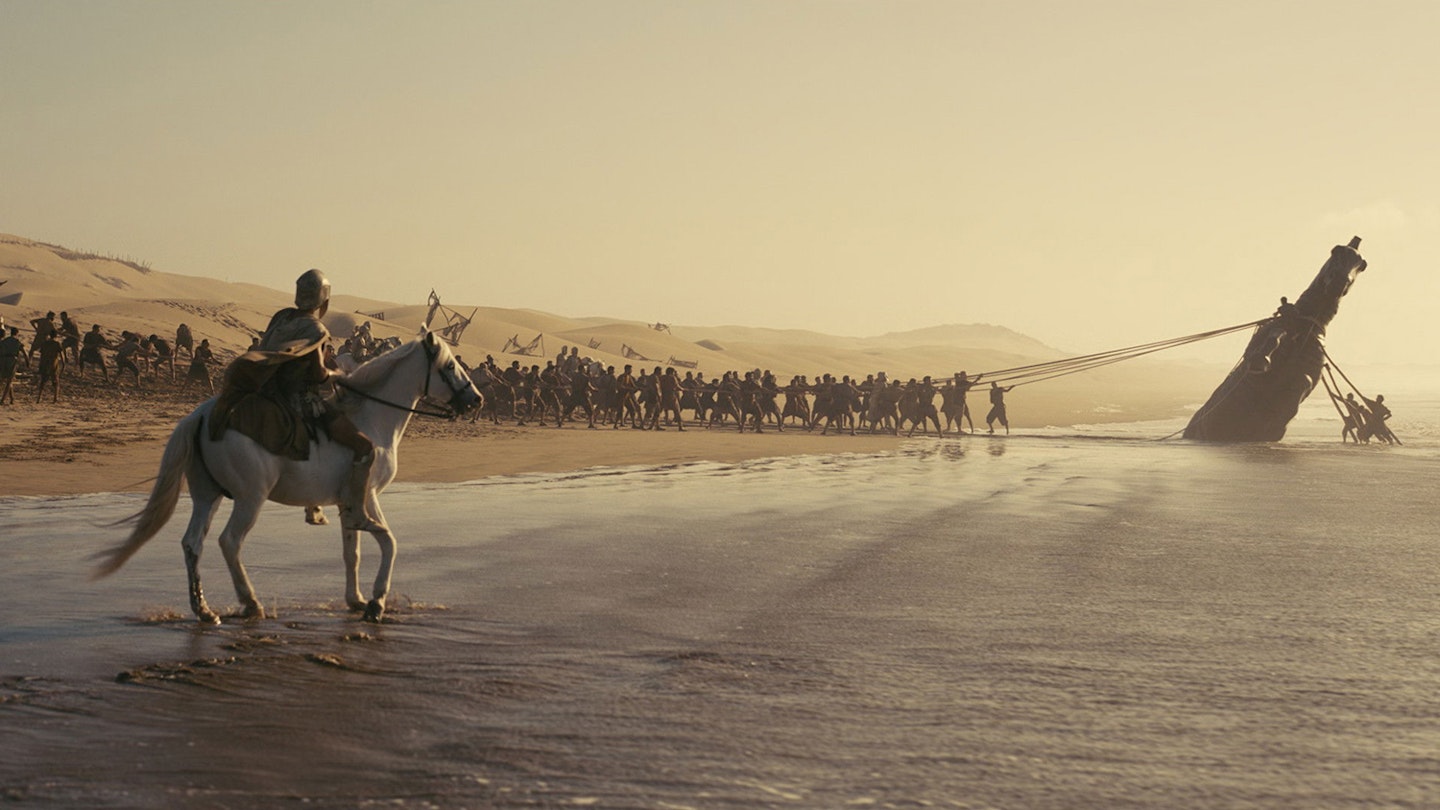
This is a film thickly packed with incident, the kind that may only truly be fully appreciated through repeat viewings. After efficiently introducing the world, we watch Odysseus (Damon) and his increasingly unfortunate band of merry men encounter a Cyclops (staggering and grotesque), Sirens (haunting and sad), and the giant Laestrygonians (featuring the most upsetting child acting this side of an Omen movie). Much has been made of Nolan’s love of practical effects, but what is most impressive during these extraordinary set-pieces — all soundtracked to Ludwig Göransson’s experimentally pulsing score — is the integration of techniques, blending puppetry, stunt performers, special effects and — yes! — CGI so seamlessly as to make this mythic world feel real.
The scale and scope here is, frankly, jaw-detaching. It is filmmaking at a magnitude few modern directors could ever realistically imagine, demand, or execute. Yet what is most striking about this film is its quieter moments. The gods here are human-sized: the fury of Zeus and Poseidon is felt only in the elements, while Calypso (Charlize Theron) simply wants a companion, and Athena (Zendaya, doing much with little, in a role strikingly similar to the one she played in the first Dune) is seen only in flashes of an enigmatic half-dream — or perhaps as a trauma-response. Samantha Morton’s Circe, meanwhile, provides the closest Nolan has come to full-on horror, an astonishing sequence full of shocking fury and sadness at the baseness of men.
Nolan is again raging at the folly of a humanity we might recognise.
As it was in the text, the heroes of this tale are mere humans, full of flaws and foibles. Damon, by now a Nolan regular, embodies Odysseus brilliantly and bravely, as a weary soldier burdened by the weight of leadership and his vast, Scylla-and-Charybdis-sized trolley problems. Nolan emphasises his fallibility; on more than one occasion, our champion is forced to leg it back to his boat in the manner of Monty Python’s King Arthur (“Run away!”).
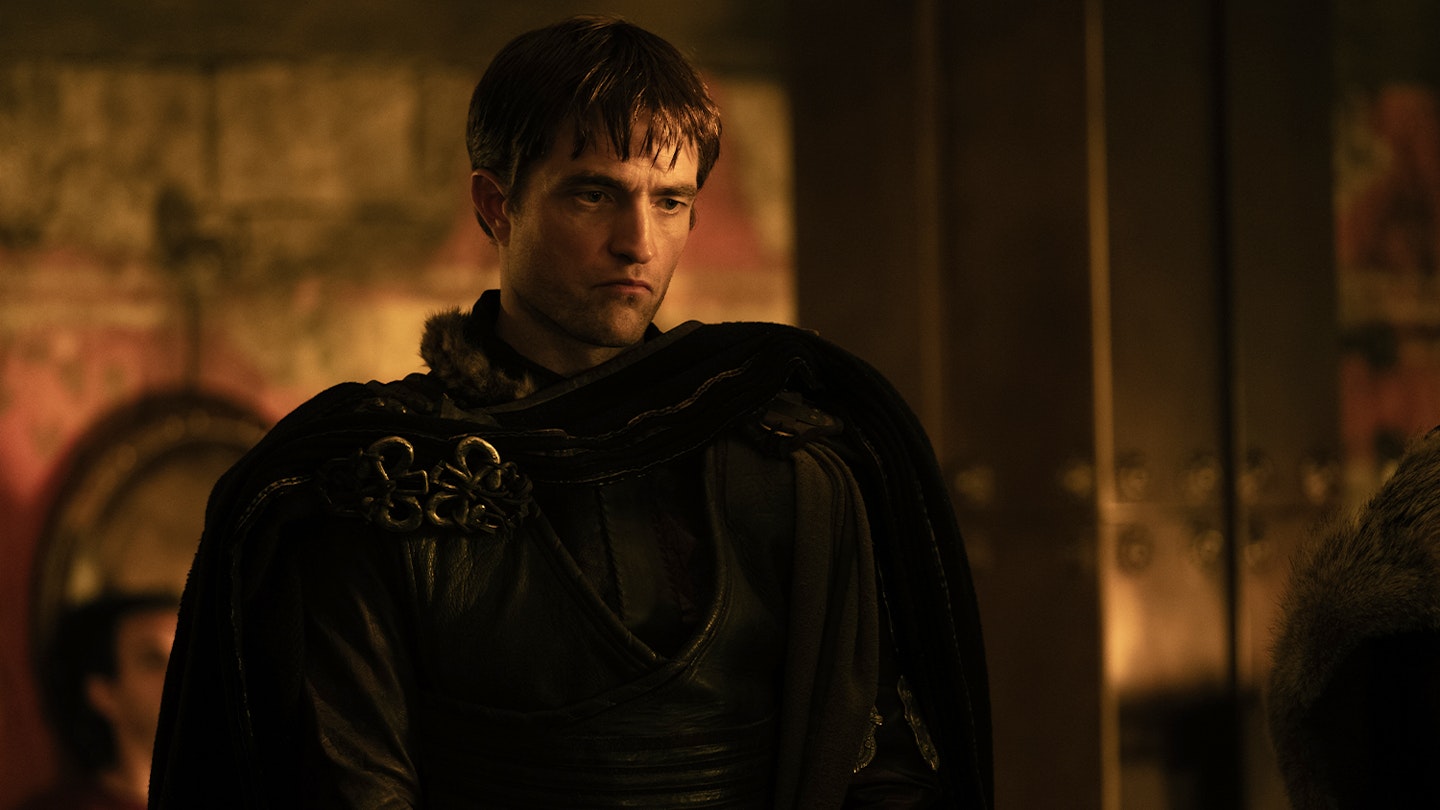
It is in the final act, when Odysseus finally makes it back to Ithaca, reunites with son Telemachus (Tom Holland, solid) and wife Penelope (Anne Hathaway, fierce) and confronts the boorish suitors led by Antinous (Robert Pattinson, chewing scenery delightfully), that the film comes into focus. Greece is spoken of as the “greatest civilisation the world has ever seen”, a fading empire policing and colonising the world, and Nolan seems to embrace parallels with American exceptionalism and Manifest Destiny; the accents adopted by the cast cements this point. (Make Ithaca Great Again?)
By his journey’s end, Odysseus seems heartbroken at the state of the world, and his role in its downfall. There is something of Powell & Pressburger’s The Life And Death Of Colonel Blimp in its coda, in a military man mourning the death of honour, as well as echoes as Nolan’s own work: like Dunkirk, it laments the absurdity and pointlessness of war, and like Oppenheimer, it trembles at the catastrophic failures of a great and terrible man. It may be set in a mythical universe, but Nolan is again raging at the folly of a humanity we might recognise — on an enormous, IMAX-sized canvas. Nobody does it better.
A worthy new translation of an ancient text, and yet another monumental piece of work from one of our boldest filmmakers. Watch it on the most colossal screen you can find.