
Over the next few months, I’m going to be taking a look back at each of the core Grand Theft Auto games and replaying them in the lead-up to the arrival of Grand Theft Auto 6. What we’ll be putting together won’t be traditional re-reviews, and they won’t carry IGN’s typical score out of 10, because it really wouldn’t be at all fair to simply pick apart old games published multiple hardware generations ago and make them sweat under the harsher standards of 2026. What we will be doing, however, is re-examining what made each GTA remarkable upon the time of its release, digging into what they achieved and the legacies they established, and rediscovering how much fun each of them remain today. We’ll also be identifying both the parts of the GTA experience that have seen the most evolution and growth, as well as the parts that remain fascinating, commendable, and timelessly impressive. At the end of the project, using GTA’s previously six-star wanted level, you should be able to get an idea of where each of these games roughly sit in my long-term love for this series.
Next in the queue? GTA 2.
Grand Theft Auto 2 arrived right at the tail end of the 20th century, sticking with the same brand of top-down turmoil that previously propelled its predecessor to great success. It’s a noticeable refinement of the original in some fundamental ways – slightly more forgiving thanks to the ability to save, and also a bit smoother to drive around in. It didn’t, however, replace its antiquated, tank-like on-foot controls for something that better exploited the dual-analogue controllers that had rapidly reinvented the status quo in the late ’90s. What it did shed was the original GTA’s recognisable, contemporary setting. It instead opted to set its action at an unspecified point in the near future, in a stylised, retro-futuristic backdrop called Anywhere City, USA – a place overrun by gangs, ruled by a megacorporation, and featuring the highest rate of Elvis Presley’s per capita this side of Graceland. Did it work? Well, the answer – unlike Anywhere City’s proliferation of Elvis impersonators – requires a little more conversation.
GTA 2 immediately comes off as a game with a bit of an identity crisis. Even if you ignore the fact that it sports a totally different look and vibe to the original, it also completely clashes with its own box art, and even its own intro movie – which features contemporaneous ’90s cars and an obvious New York setting. At the time of its release, I actually bounced off GTA 2 rather quickly, and this was absolutely a major reason. As soon as it began it just felt like an entirely unrelated product to everything that had come before – up to and including the tone-setting FMV intro it just served me. That’s a really weird problem to have. As a result, I don’t feel like I stuck around anywhere near long enough back in 1999 to get a feel for how much slicker it actually is to play.
Despite the fact it costs in-game currency to use, the addition of a save function represents a clear improvement over the original. Just head to the nearest church, and the good lord above will remember your progress for you. Jesus indeed saves in Anywhere City, albeit for a fee. Straight away GTA 2 appears a little more aware it’s a PC and home console product. By the late ’90s, hefty, mission-oriented action games had largely moved on from the ruthless arcade philosophy of starting from scratch every session with a tiny set of lives. Developer DMA Design adjusted its format accordingly, albeit only slightly. That is, GTA 2 retains score-based progression, still operates with strictly limited lives, and is hard as hell – but saving is nonetheless a crutch the original did not have.
A newly added health bar addresses another major frustration from the original GTA. If you’re trying to avoid cheating just to get through the missions, the boosted health is an even more useful fix than saving. Health in GTA 2 works on a 10-point scale (with five hearts that can be halved). This is in stark contrast to the first GTA, which essentially operates with your character on his or her final sliver of life at all times – where you’re instantly wasted after sustaining just a single hit. The tank controls make dodging incoming fire hideously difficult in both games, but the challenge is at least tempered here by the very sensible addition of that extra padding. It doesn’t make it easy, by any means, but it’s certainly less annoying.
Another Soul Saved!
The improvements don’t stop there. GTA 2’s camera is considerably less janky and, while it still shimmies around a little as you drive, it does a way better job of tracking cars smoothly. Cars also self-straighten when blazing along the streets, so it’s far less finicky to line up within a lane – or indeed change lanes – with less furious tapping of the d-pad.
There are also far fewer obstacles for cars to get hung up on than there were in the original. With the top-down perspective, it can be challenging to tell what objects are rooted into the ground and will cause a crash, because depth can be a difficult thing to effectively communicate from directly above. GTA 2 skirts this by having skinny things like light poles not even register to cars at all. It’s not a particularly realistic approach, but it cuts down on the constant collisions which bogged down the pace of the original.
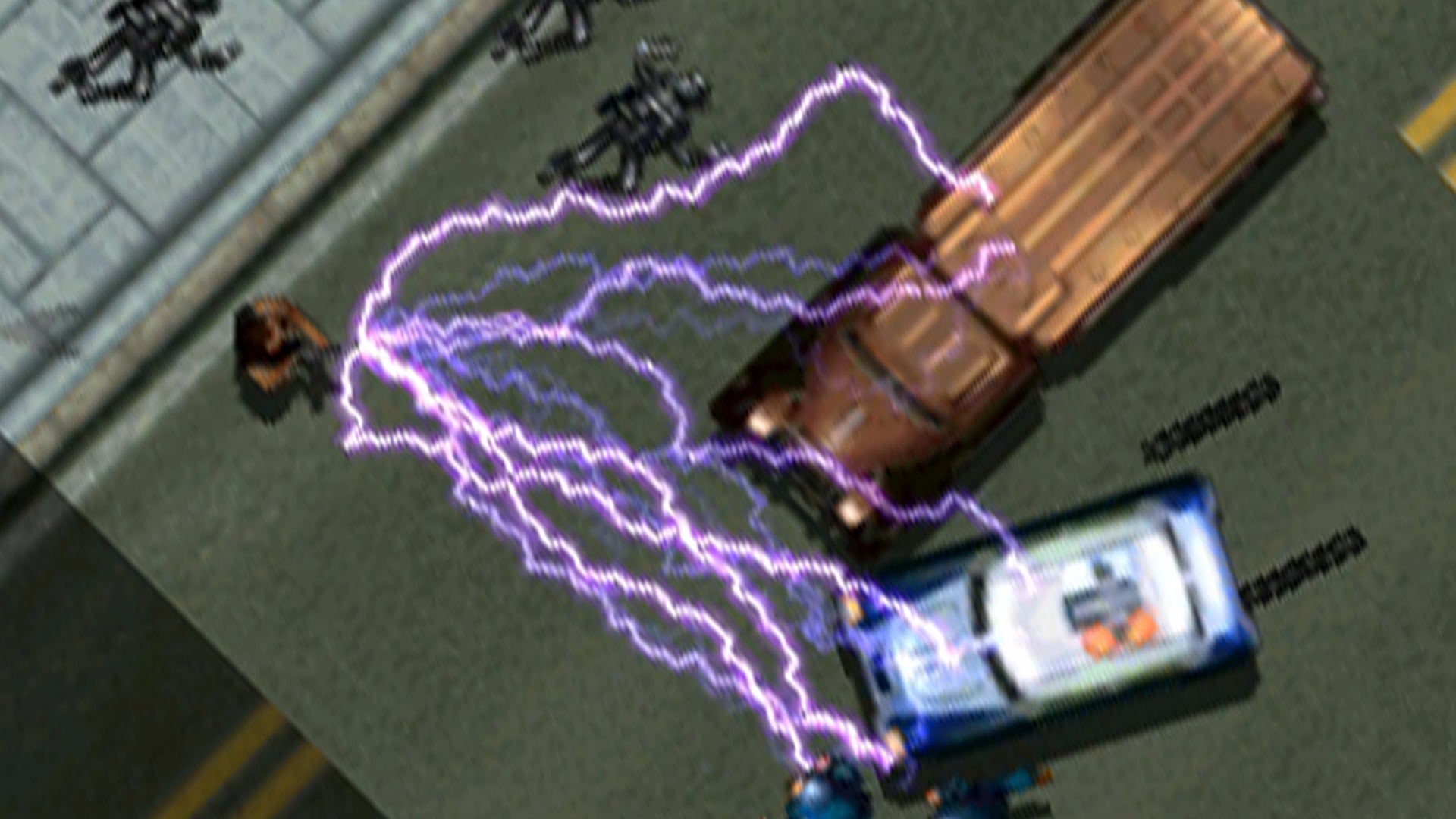
Cars can now be fitted out with weapons and gadgets, like machine guns, mines, and oil slick traps, and the amount of handheld weapons has been more than doubled. GTA 2 adds tossable explosives like grenades and Molotovs, a suppressed SMG that won’t alert other nearby NPCs, a shotgun for more devastating close quarters damage, dual pistols to dial up the John Woo factor, and a futuristic electro gun that will saute suckers into skeletons. The electro gun is particularly nifty considering it can lock onto multiple targets at once, but a mild auto-aim function (an assist sorely missed in GTA 1) makes for less frustrating combat all around, regardless of what weapon you’re using.
Respect is Everything
Despite the more polished gameplay, GTA 2 still leaves me indifferent in a number of ways. I know that merging the aesthetic of ’40s and ’50s vehicles with a crime-ridden, near-future corporate dystopia is a stylistic choice, but it just doesn’t really grab me. It’s not that I don’t find this era of automotive history interesting – I love skidding around in games like Mafia and LA Noire – but they just look silly in this setting and don’t sync with it at all.
It’s really easy to tell cars apart in the original GTA, because they resemble real cars and they all look quite distinct. In GTA 2, there are more than 60 different vehicles, but there are far too many that look too similar to each other – and none that really resemble anything particularly iconic. They just look like caricatures of cars, and I vastly prefer the realism of the original GTA’s vehicles.
I also prefer the original’s maps over the three districts of Anywhere City (the Downtown Sector, the Residential Sector, and the Industrial Sector). Now, GTA 2 boasts sharper graphics than its slightly murkier predecessor, and the effect of this cleaner image arguably makes it the more timeless-looking of the two. On PC there are even day and night versions of each area. However, with the possible exception of the Residential Sector (which is the most varied), there’s a plainness to Anywhere City that I don’t think the cities in the original GTA shared.
I do enjoy how much more alive and dangerous Anywhere City feels – with muggers, carjackers, and gang members scurrying the sidewalks everywhere as an omnipresent threat. However, I don’t think it has the charm of Liberty City, San Andreas, or Vice City – as primitive as their renditions were by modern standards.
I’m willing to concede my preference here may simply be because the amount of time I sunk into those maps dwarfs the moments I’ve spent in Anywhere City, but there is also something bigger at play. The 3,500 pound, 350-horsepower elephant in the room here is Driver, which was released on PlayStation in European territories about five months before GTA 2, in June 1999. Now, the original Driver has no on-foot component – so it’s not an entirely like-for-like comparison – but it is a fully 3D, open-world car chase classic that rapidly cemented itself as more or less my favourite game of all time at that moment. I’d seen the future, and GTA 2 couldn’t lure me back.
The dawn of 3D action-driving games was upon us. Prior to Driver we’d already seen Midtown Madness on PC, from future Midnight Club, Smuggler’s Run, and Red Dead Redemption developers Angel Studios. Following Driver came Mucky Foot’s ambitious but janky Urban Chaos in late 1999 on PC and early 2000 on PlayStation, which boasted a primitive brand of driving and third-person action. A PlayStation-exclusive Driver sequel followed in late 2000, where you could exit cars to steal another. June 2001’s World’s Scariest Police Chases sank with little trace after arriving on PS1 after the PS2 had launched, but it was actually a surprisingly decent open-world driving game of its own considering the totally outmoded hardware it was running on.
Any way you slice it, GTA 2 was a buck late and a dimension short to be a part of the first wave of 3D action-driving games.
Of course, the series wouldn’t be the bridesmaid for long – but that’s a discussion for next time.
Verdict
Playing Grand Theft Auto 2 again in 2026, I’ve definitely found myself with a stronger appreciation for its technical improvements over the original. Certainly much greater than I gave it credit for back as a teenager in 1999. The driving is better, the shooting is better – and those are important and welcome gains. However, I just cannot muster any true enthusiasm for its retro-futuristic setting. I don’t know that I’d go so far as to call it aggravating but, in the words of the king of rock and roll, it just ain’t satisfactioning me.

Luke is a Senior Editor on the IGN reviews team. You can track him down on Bluesky @mrlukereilly to ask him things about stuff.