
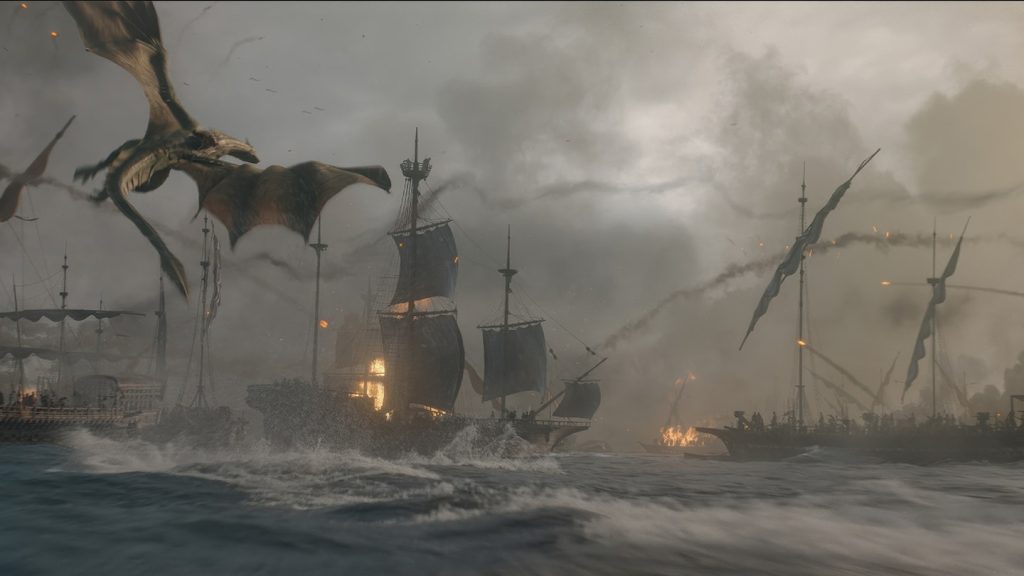
Team Black. Team Green. Dragons versus dragons; fire versus fire. Two matriarchs, Rhaenyra Targaryen (Emma D’Arcy) and Alicent Hightower (Olivia Cooke), once united in adoration for each other and their former king, now opposed in the fight over who is the rightful heir to the Iron Throne. In its first two seasons, House Of The Dragon has already given us slaughtered children, flaming massacres, brutal decapitations, and more. And almost all of it so far has been a prologue.
In the Season 3 premiere, everything is about to change – thanks to one almighty impending conflict that combines sea and sky, ships and dragons, swords and flames. “The Battle of the Gullet feels like this major crossing of the Rubicon,” showrunner Ryan Condal warns Empire. “Certainly in terms of the amount of blood shed.” This much-anticipated sequence is set to be one of the most ambitious ever brought to the small screen, and is the ultimate turning point in HOTD’s slow, two-season-spanning journey towards the end of a certain silver-haired dynasty. In the aftermath, desperation for power and revenge will expound, and the realm will descend into all-out war.
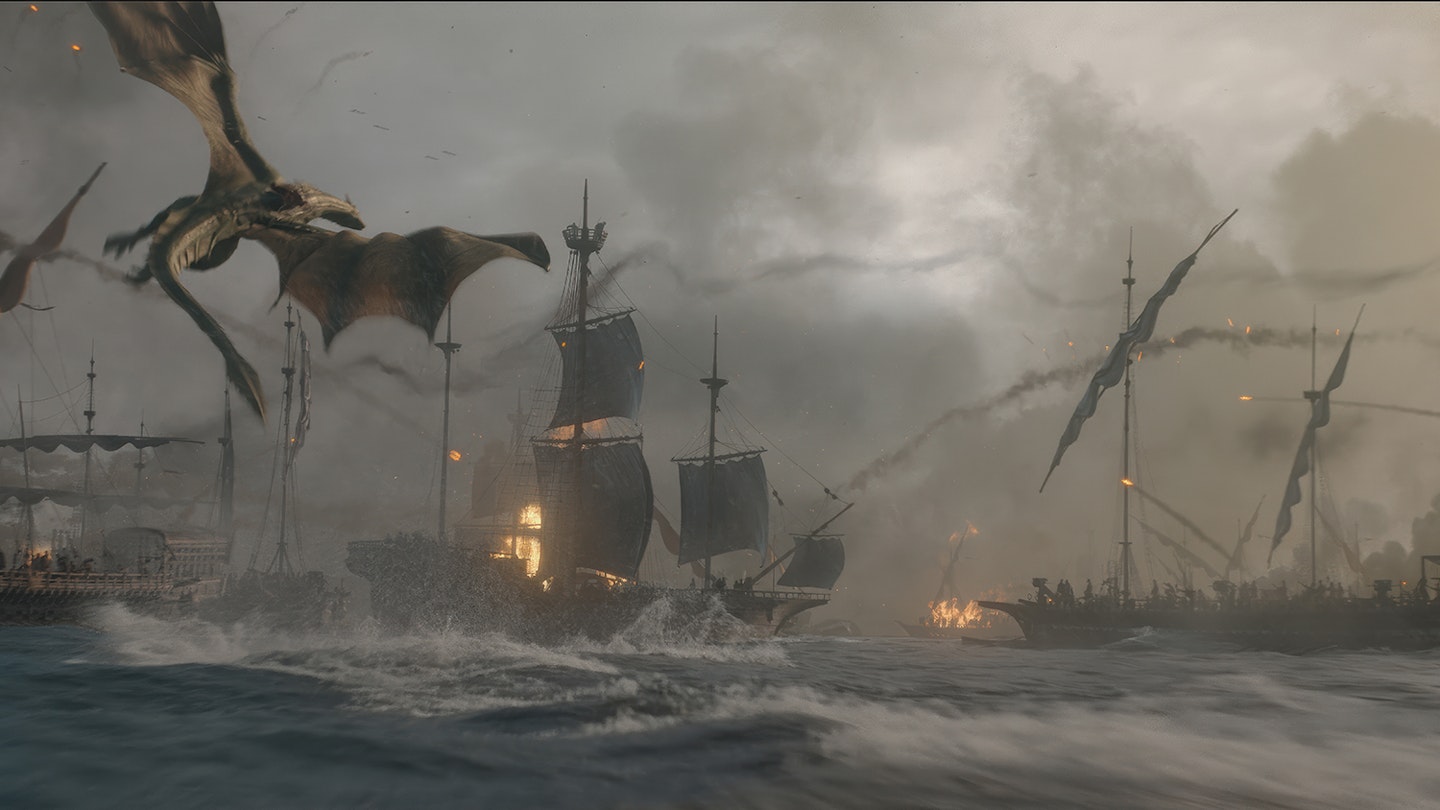
Back when reading Fire & Blood (the detailed Targaryen history on which HOTD is based) for the first time, when the show was still a mere twinkle in his eye, Condal was already considering the impending challenge of bringing this battle to life. “In my head, I couldn’t help but start breaking it down,” he recalls. “Not only as a writer, but also as a producer – like, how the hell are we going to do this?”
Even as far back as Season 1, this battle has been “the big thing that’s on the horizon,” Condal says. “It either had to happen very late in Season 2 or very early in Season 3, depending on how we break the story up.” HOTD’s second season was a tricky one to make, ending up with a shorter run of eight episodes as strikes loomed in Hollywood. Condal confirms that there was potential for this naval conflict to be the Season 2 finale, if it weren’t for having to work around those issues. “Certainly, that was a discussion point,” he says. “But the making of Season 2 was, in many ways, my own Battle of the Gullet, behind the camera.” With less bloodshed and swordfights, we can only hope.
“We were looking for touchpoints. We really liked the idea of The Wrath Of Khan.”
And so, the Gullet will instead wreak havoc across the Season 3 premiere. Whilst we’re no strangers to epic Westeros battles – of Winterfell, of the Bastards, of Rook’s Rest, to name a few – this one has a certain scaly, fire-breathing element that takes the consequences beyond many of those in the Game Of Thrones section of the timeline. “There is this fear of mutually-assured destruction,” Condal explains of the HOTD period, “so war is waged a bit more carefully than maybe it would be in Robert Baratheon’s era, where it’s simply armies versus armies. Big armies and better strategies can only get you so far against nuclear weapons.”
There are two major seafarers warring in the Gullet. Fighting for Rhaenyra on Team Black is Corlys Velaryon (Steve Toussaint), aka the Sea Snake, her hand and former father-in-law. And on Alicent’s Team Green is Sharako Lohar (Abigail Thorne), recruited to the fight in the Season 2 finale by Tyland Lannister (Jefferson Hall). Hailing from Essos and boasting many, many wives, this Admiral of the Triarchy fleet is in total contrast to her foe. “Corlys is the greatest naval commander that ever lived,” Condal explains. “Tyland probably makes his bed on the ship with hospital corners. Lohar is this larger-than-life chaotic force. She’s scary, fiercely efficient and confident. She knows her fleet back and forth, and knows her enemy back and forth.”
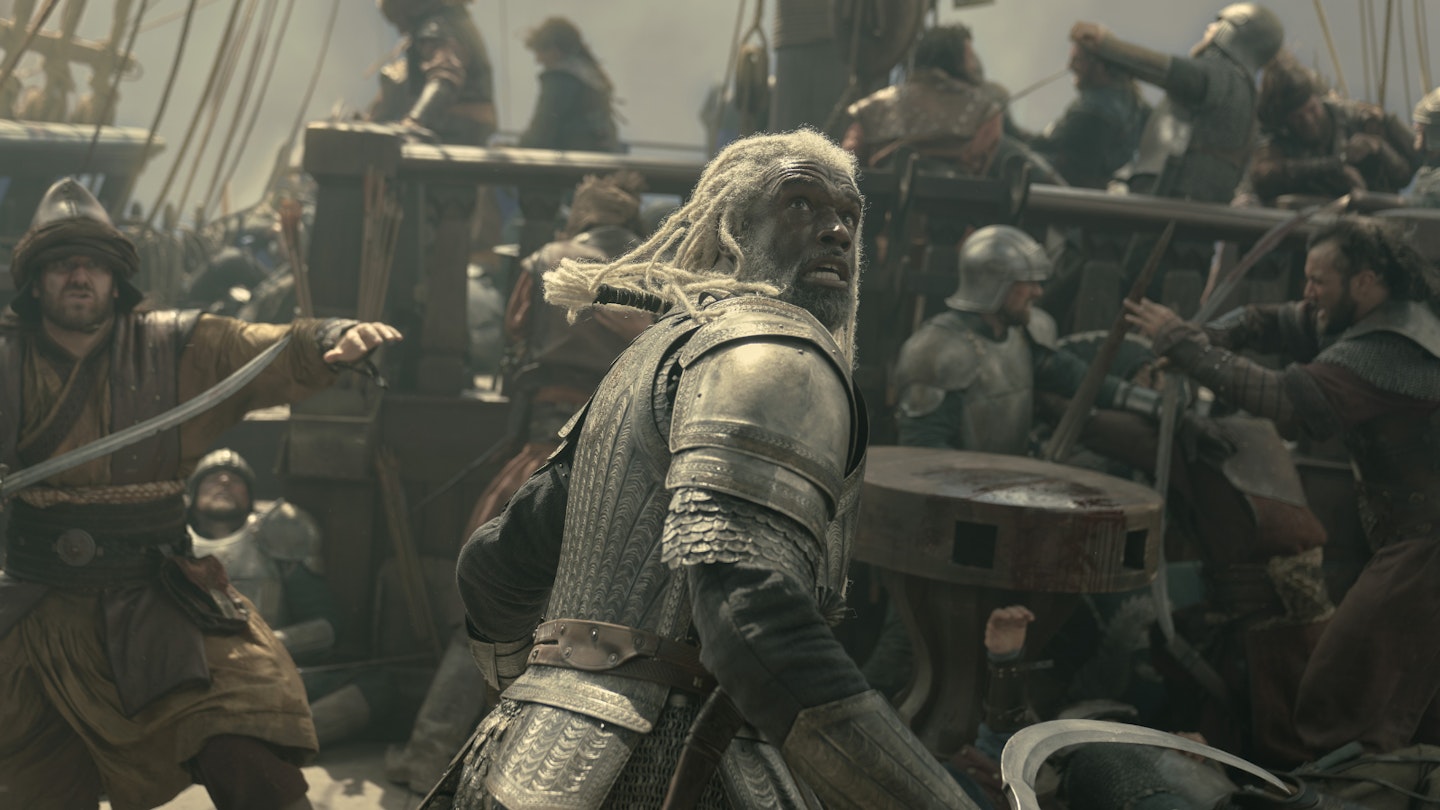
As Condal hints, this is not the first time Lohar and Corlys have butted ships. There’s some pretty significant personal beef driving Lohar to get involved here. “They’ve been in pitch battle for two decades,” Condal says, “and have maybe seen each other at a distance, but never been in close combat. [Lohar’s] whole quest, the minute the battle starts, is to get at the Sea Snake and ruin him; to create as much death and destruction for him personally as she can.”
Condal and episode director Loni Peristere, who worked on the excellent ‘The Red Sowing’ episode from Season 2, looked back to a certain sci-fi classic for inspiration when depicting Corlys and Lohar’s showdown. “We were looking for touchpoints to ground ourselves in it, and we really liked the idea of The Wrath Of Khan,” the showrunner explains. “It’s Kirk who’s from Starfleet – and that’s the Sea Snake – this orderly organisation. And then you have Khan – who comes from a totally different time and place, and is brilliant and chaotic – and that’s Lohar in this case.” Time to boldly go into battle.
———
It’s July 2025, and Empire is about to see Lohar’s vengeance mission in action. We are standing on a huge backlot in Warner Bros’ Leavesden studios, and we are, quite frankly, a little worried about getting wet. In front of us sits an enormous water tank, four metres deep, with two fully realised warships rising out of it – Corlys’ ‘Queen Who Never Was’, and Lohar’s exquisitely-named ‘The Bitchfist’. One is split clean in half; both are populated by tens of stunt actors. As special effects supervisor Michael Dawson later tells us, there are 200 tonnes of steel holding it all up, as well as a rig with five hydraulic gimbals running along an underwater track, and – this is House Of The Dragon, after all – a good portion of it is on fire. Ash, mist and water are being pumped into the air; fire trucks and cranes loom at the edges.
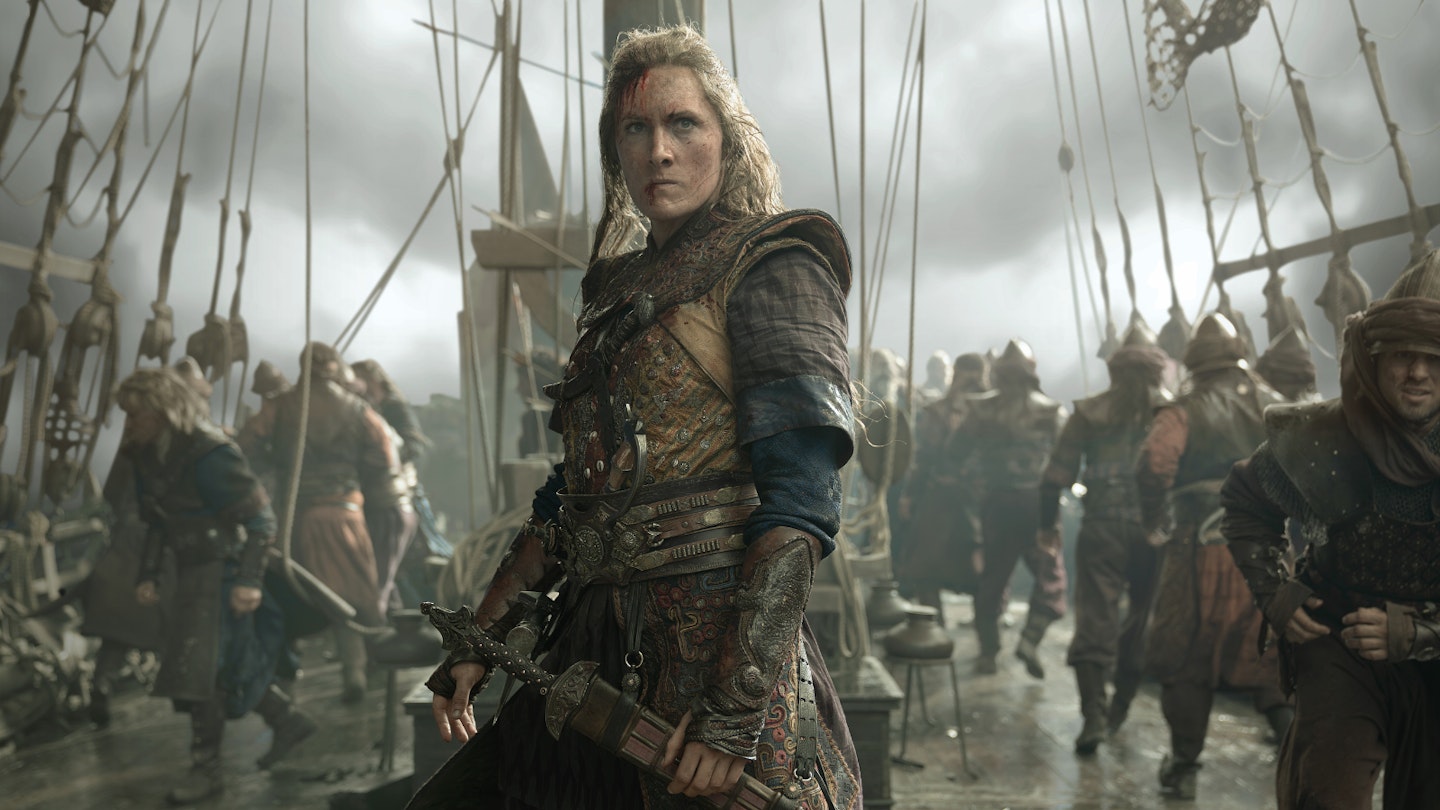
“Action!” calls Peristere. Lohar has boarded Corlys’ ship, the two of them carving through opponents on separate areas of the deck until she clocks her real target. “Sea Snake’s mine!” she yells, and the pair clash blades, before Corlys shoves her back. “Cut!” That, with all the flames and steel and intricate choreography, was maybe fifteen seconds of telly – but what an epic, cinematic fifteen seconds it was, its scale evident even on the small, multiple monitors Empire is later huddled around in video village. Put that together with the pre-vis footage we’re given a sneak peek of (wait – is that a kraken?!), and it looks like we are in for a treat.
“It very much is a statement episode. This is the boulder starting to roll down the hill.”
The sheer commitment to practicality is wildly admirable. The team employed two tanks to get the look and feel just right – a dry tank for sailing shots, and a wet one for any scenes where the actors need to be actually interacting with water. It is, says Dawson, the most complex thing the show has ever built, with his work on the episode going all the way back to August 2024. Condal knew the effort exerted on the practical effects would be worth it. “Audiences now are super savvy, and they understand there are visual effects involved, especially in things like this,” he says. “But they also really appreciate the practical, because it helps your brain willingly suspend disbelief.” Condal cites a certain Kiwi directing legend as a major influence in this respect. “It’s what Peter Jackson did so brilliantly with The Lord Of The Rings,” he says. “There’s a tonne of digital in that, but because he was so constantly mixing media, eventually your brain gives up trying to figure it out. You give yourself over to the fantasy, and I think that’s incredible.”
———
The Gullet may be but one battle, but its impact will ripple across the kingdom – it’s the straw that will break the dragon’s back in moving the Targaryen regime closer to complete ruin. Rhaenyra and Alicent aren’t present, but their actions – and the actions of those close to them – are what led us here. “The nature of this war writ large is really this build-up of mico-conflicts happening over years and decades,” Condal says. “At some point, Rhaenys asks, ‘What really started this war?’ Was it when Viserys [former king, played by Paddy Considine] named Rhaenyra the heir? When Aemond [Alicent’s son, played by Ewan Mitchell] lost his eye? I don’t think there’s a single answer, and the Gullet is just another example.”
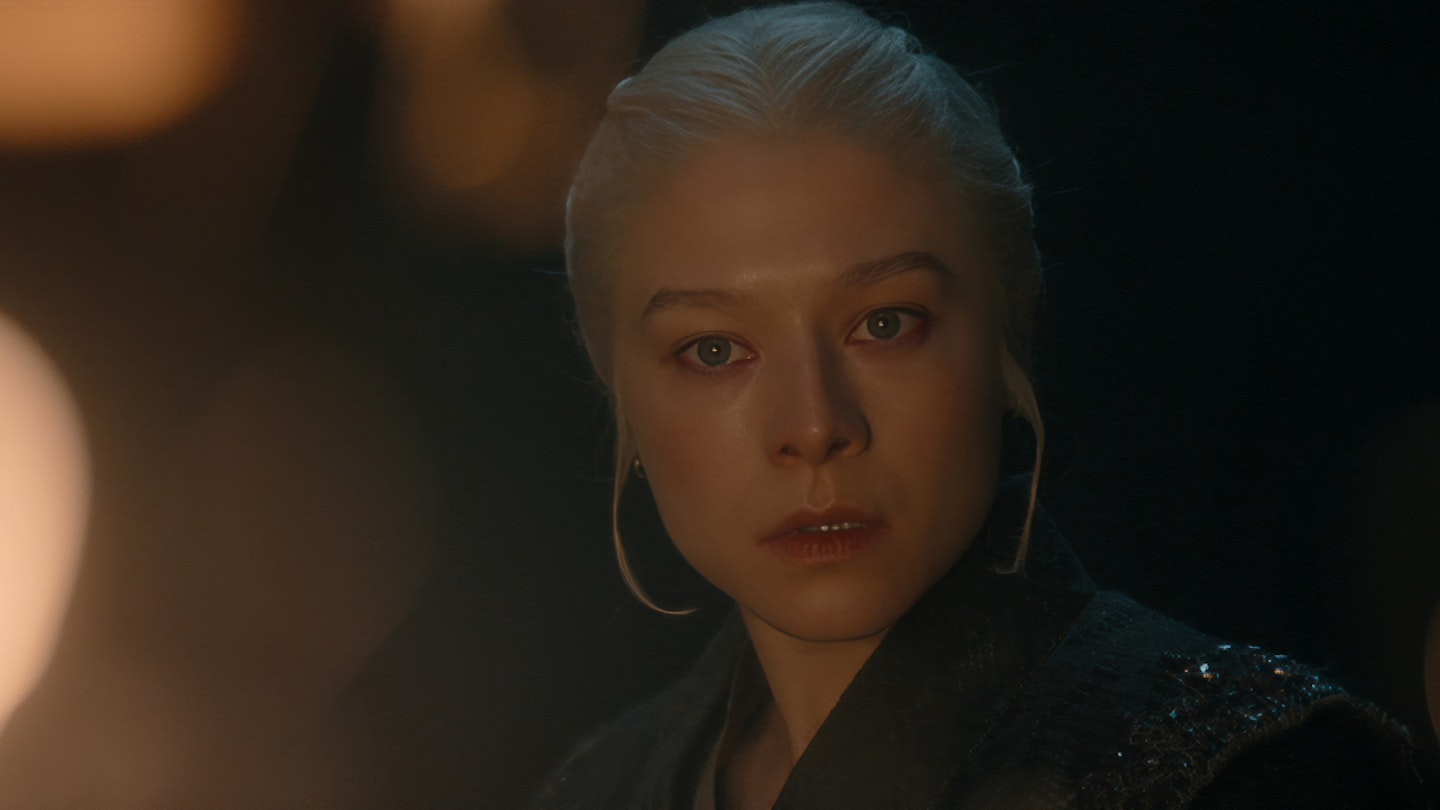
For Condal, that long and complicated build-up is what makes this particular escalation so satisfying, and significant. “I think the tragedy of this show is seeing these big events, and then counting the bodies afterwards, and going back and seeing all the little things that led to it,” he says. “How, at many points through this history of this Dance of the Dragons, if somebody had just shown a little decency or temper, maybe things could have gone a different way. But the nature of these entrenched conflicts is [that] it’s a son for a son, and blood for blood, and there’s this one-upmanship that keeps bringing you closer and closer to the abyss.” Sounds like all that blue water is about to get a whole lot more red.
If the prospect of such a barnstorming first episode wasn’t tantalising enough, the Battle of the Gullet is just the beginning. “It very much is a statement episode,” Condal says. “It’s a statement about the rest of the show from here. This is the boulder starting to roll down the hill. There’s this feeling of inexorability after this, both in the momentum of the storytelling and, sadly, the desperation and tragedy to which it goes.” Earlier this year, a fourth and final batch of episodes was confirmed, expected to air in 2028 and bring this blood-soaked era of the Targaryen timeline to a close with a bang. “There is tons of spectacle to come, both this season and with what remains in the final season,” Condal teases. Steel yourselves, and let the battle commence.
Additional reporting by Ben Travis
House Of The Dragon is streaming on 21 June in the US and 22 June in the UK, on HBO, HBO Max and Sky/NOW.