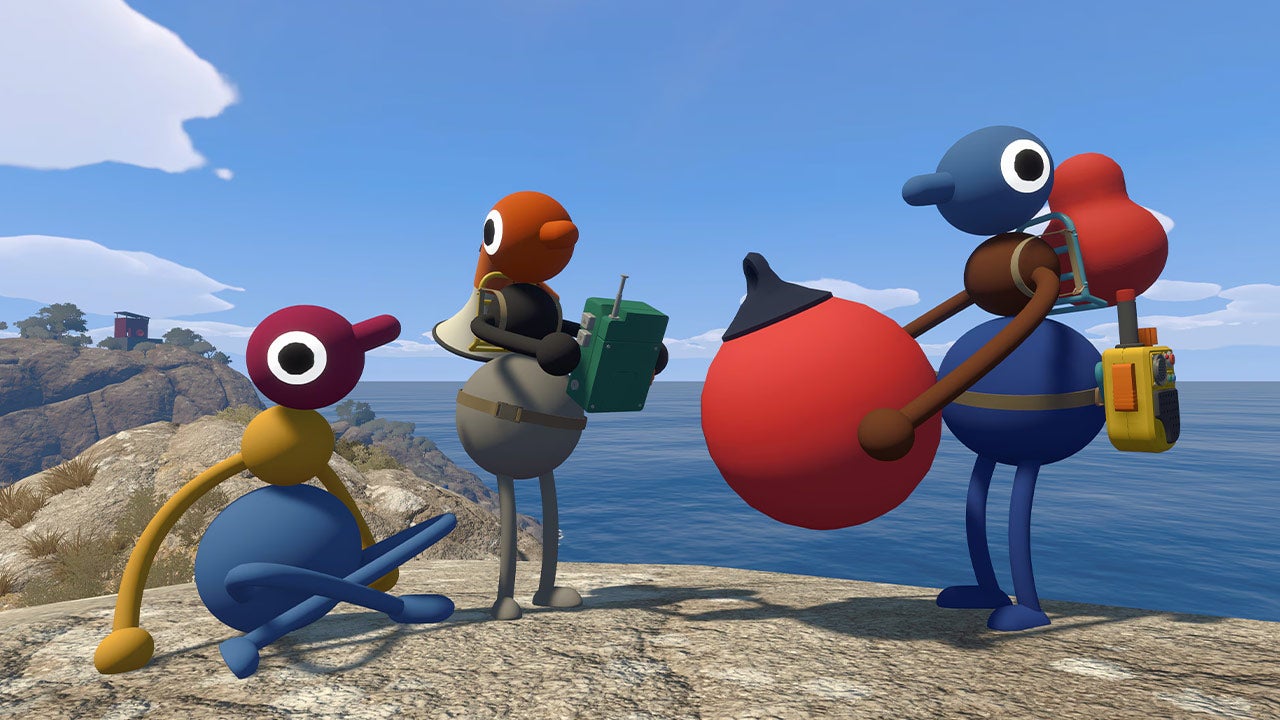


To know something’s name is to understand it — at least just a little, be it the thing itself, or the world around it. In Big Walk, there are lots of things yet unnamed. You will certainly recognize trees, mountains, that dang cowbell. But there are plenty of things you won’t: the red, peanut-shaped objects my group calls a bean, which makes the structures they must be delivered to the bean towers. To us, the underground tunnel system is the backrooms, and the glowing medicine balls that light paths throughout the world are simply orbs – but not to be confused with the Big Orb, a mysterious and ominous structure looming in the distance. Big Walk is a co-op-only puzzle adventure that relies heavily on shared experience, shared language. Its genius lies in how it pushes you to decipher the logic behind the clever puzzles spread around its open world in a way that only you and your companions will understand. With all the twists and limitations it imposes, it’s unlike any other multiplayer game out there.
Big Walk is a puzzle game, and the puzzle is communication. Everyone is initially dropped into a playground of sorts with some colorful, blocklike structures to climb on, light switches to flip, and your controls pinned up as posters. I call this place home. Crucially, you are given no objective. We fiddle about with the buttons, obnoxiously clang the cowbell. We test out our movement options – mostly arm gestures – by looking at our shadows. Eventually, we head out into a lifelike world with lush foliage and waves breaking on the beach; it’s a direct contrast to our charming, goofy characters, who are, essentially, a stack of three colored balls with googly eyes, stick arms, and twig legs (and a nose that moves like a mouth as we speak in-game).
When someone asked what we’re supposed to do, what the objective of this game was, I couldn’t really answer that. And so we walked. But here’s what I knew at this point: Big Walk has walking and puzzles. That, and outside of arm flailing or typing out written messages, we can only communicate through proximity-based voice chat. This means your voice is muffled when you’re behind a wall, and echoes when you’re in a vast tunnel. If someone wanders too far off, I can no longer hear them, and as a game that can only be played with others, it’s “cooperative” in the very sense of the term. There’s no way to play Big Walk alone, and it supports up to 12 players with different settings for different sized groups: two, three, or four-plus, which adjusts puzzles slightly to suit the number of people in a session. Big Walk cleverly takes advantage of the essential limitation of proximity chat, and it wouldn’t be the same without it.
Venturing out, my group of three walks together along desert terrain and up a cliffside until we find a button on a platform. We originally think nothing happens when it’s pushed, but someone notices a faint red light flashing in the distance. It illuminates each time it’s pressed, so we send someone in its direction to see what’s out there. There’s a red bean in a box, which opens when the button is pushed. He grabs it and rushes back. No one knows what to do with it but it seems important, so we hold onto it (or try our best until someone drops it while falling off a cliff). Through that simple opening task, we start to get it: This puzzle, this bean, they’re teaching us something about the world and what we need to do within it. We’re starting to create our own language.
Each piece of this map is cleverly designed to nudge your group to build something together, forms of communication that feel like only you understand. We keep walking, keep exploring and finding puzzles that require real teamwork, and continue to build our language. My group played in several sessions across a few days: a core group of three, with some stragglers jumping in here and there. We spent nearly 20 delightful hours romping around. It’s easy for people to jump in and out of the session, popping in to adventure for a bit. There is a kink in this system, though. The save file is tied to the player who originally hosted the game. For my group, that was me. If my companions wanted to play when I wasn’t there, they’d have to start a new save file—and a new big walk. This may very well be by design; developer House House wants a group to stick together. But I felt bad when someone wanted to play, but I couldn’t.
Big Walk’s world runs on a day-night cycle, with sun-soaked days and pitch-dark nights. And in the latter, a different kind of communication is built. Early on, my friend Riley dropped our only flashlight off a cliff, immediately after I accidentally kicked our walkie-talkie down the same one. We spent a not-insignificant amount of time looking for our tools because, without them, we could easily lose each other in the dead of night. (Even more so when looking for Riley, who got stuck in a hole while searching for our gear). Perhaps in another game, losing your tools or falling in a ditch would be frustrating. Not so here. While movement can be finicky at times, and you will briefly get stuck in spots, Big Walk often felt even more impactful when things were going very, very wrong.
We spent plenty of time doing Big Walk’s actual puzzles, which are scattered around the map and usually embedded in big, brightly colored structures: a green horror movie house, an orange colosseum, a blue sound stage. Some of them are relatively easy, like throwing an orb into a basketball hoop multiple times, or playing a game of telephone to identify a specific sequence of shapes or buttons to push. But there are mechanical challenges as well, ones that require platforming and precise movement or throws. There’s an entertaining puzzle that requires one person to put on a blindfold (which is actually a big, weird gold head that blocks their view) and navigate through an obstacle course. The others then have to yell instructions at them about where to go and what to do; the scariest part of this was figuring out how to time a jump over a gap. These challenges don’t necessarily get progressively harder, because you’re free to do whichever puzzle in whatever order you discover them. Some are certainly difficult, but never cruelly so. Big Walk always gives you the tools you need to solve them, so there’s no danger of a dramatic learning curve.
One particularly inventive puzzle had my friend Chris locked in a soundproof room trying to relay little musical jingles to us so we could match that to stereos playing the corresponding melodies. Another forced us to split up onto three platforms that were pretty far away from each other and correctly time a synchronized button push. There are a couple puzzles with similar ideas, and the problem was often that we only had two walkie-talkies amongst us. So, we used our laser pointer to signify a countdown or our arms to send a silent message. Little by little, we created a sort of body language cipher to help solve matching puzzles and timing-based challenges alike, and it was a thrill to naturally develop our own system of visual cues.
Each of these puzzles rewards us with another red bean we have to take care of as we bring it back to a bean tower for deposit. Once you’ve found enough beans for a given tower, you get a special key to unlock something new and helpful: stuff you otherwise couldn’t figure out how to operate, like a stalled train or an island-spanning chair lift. And in this progression, Big Walk further embeds the ethos that these discoveries are yours to make.
Big Walk’s puzzles are always sharp, and always fun. The use of proximity chat makes the process of solving them feel special in a way I haven’t experienced in a game for a long time. Despite the recent wave of co-op games with an emphasis on hanging out with your friends, it feels so new to play in this particular way, as if we were all physically in this virtual space together. Video games often make us feel like superheroes, like the world revolves around our individual characters. In Big Walk, relationships and language are that superpower. The world doesn’t revolve around me, but us.
So much of Big Walk’s fun is found in the spaces between the puzzles, too. One of my favorite moments was this time Riley and I wandered away from Chris to go gallivanting in nature without care. This would not have been a big deal… if Riley and I did not have both walkie-talkies. Notoriously bad at navigating, we got wildly lost, even more so after we tumbled down the mountains once again. We were lost for nearly an hour, maybe longer. We went to the train to honk its horn. We tried to follow the coastline, then the train line itself, to make our way back to the place where we first realized we’d lost Chris. Then, a flare shot up in the distance. We walked toward the sound and eventually the direction of the green hue the blast gave off. That’s where we found him, at a bean puzzle, firing off flares. Eventually, we sent Chris off to follow the curve of the flare and the bean was waiting at the end of it, like a pot of gold at the end of a rainbow. Riley and I certainly couldn’t have been trusted to go find it.
I spent a lot of time playing Big Walk over the last week, but I also spent a lot of time thinking about it, and talking about it with the folks I played with. I’m thinking a lot about names, and the power they hold. In the book Braiding Sweetgrass: Indigenous Wisdom, Scientific Knowledge, and the Teachings of Plants, author and scientist Robin Wall Kimmerer writes that names are how we, as humans, build relationships with each other and “the living world.” She muses on what it might be like to not know the names of things around you. Kimmerer writes, “I think it would be a little scary and disorienting – like being lost in a foreign city where you can’t read the street signs. Big Walk’s opening feels a little bit like that. Its island is not yet a place with which we’ve built a relationship, or developed a language. The moment you understand this, Big Walk changes. And what a special thing it is to name this world with friends.